

The untapped power of ocean winds – why New Zealand is looking offshore for future renewable energy
- Written by: Craig Stevens, Professor in Ocean Physics, National Institute of Water and Atmospheric Research
The latest synthesis report released by the Intergovernmental Panel on Climate Change (IPCC) makes it clear we need to prepare for intensifying impacts, while also cutting emissions dramatically.
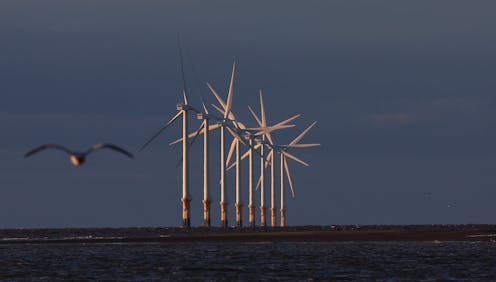
One beacon of hope is the global growth in renewable energy, with offshore wind in particular with new installations increasing almost six-fold in 2021 compared to 2020.
Aotearoa New Zealand is one of a few regions – with Norway, Iceland, Brazil and Canada – with an already high proportion of electricity coming from renewable sources. However, electricity does not equal total energy and New Zealand must consider a fundamental shift for other parts of its energy spectrum, including industrial heat.
There is no shortage of energy in New Zealand’s marine environment. A current discussion document (calling for public submissions by April 14) signals that offshore wind is poised to build a beachhead in a renewables market historically dominated by hydro power and underpinned by coal.
The technical and environmental challenges of offshore wind power are complex and expensive. Countries such as China, Denmark, Ireland and the UK currently lead the way, but New Zealand’s position in the southwest Pacific Ocean means there’s plenty of wind energy, both on land and at sea.
Read more: Ireland has the wind and seas to become an offshore superpower
A shift in energy supply
Ara Ake, an energy innovation centre with a mission to assist New Zealand’s decarbonisation, recently held a forum on offshore renewable energy in New Plymouth, the country’s centre for the natural gas sector.
The discussions centred around upcoming changes to the Resource Management Act, which will affect how development in the environment proceeds, and the recognition that any new initiatives need to engage with Te Tiriti and Māori perspectives on how resources are used and who benefits.
The discussion document highlights two regions: the Taranaki Bight and Foveaux Strait. Both locations are relatively shallow and well suited to installations of current technology.
A NZ$4 billion project to build the country’s first 65-turbine offshore wind farm off the Taranaki coast could be completed within a decade, but the document also identifies some potential future regions that are deeper and more exposed to the Southern Ocean.
Potential impacts of offshore wind farms
New Zealand is watching developments at a large Australian offshore wind farm off the coast of Gippsland, which aims to supply 20% of the electricity for the state of Victoria.
But offshore wind generation presents environmental challenges, including possible impacts of large arrays of wind turbines on seabirds and marine mammals. The seas around Aotearoa are home to a greater proportion of seabirds than almost any other populated centre, including many seabird species that breed nowhere else.
Other potential impacts extend to fisheries. But these depend on the location as ecosystems, fisheries and regulatory structures are unique to specific regions.
But one set of impacts has so far received little consideration. As tides push water past turbine pylons, the resultant wakes affect ocean stirring. This effect can be seen from space.
A recent study for UK offshore wind farms identified how large arrays are affecting the biological functioning of coastal seas.
With growing impacts from a changing climate, we need to ask more nuanced questions. For example, when considering environmental impacts, what baseline should we consider? Will the impacts of any particular development exceed the projected impacts of climate-driven extremes for that region?
Another compound question is how offshore renewables infrastructure will cope with a changing ocean. Climate projections are unequivocal about increasing future storminess and stronger or more frequent tropical cyclones. These will be challenging for all infrastructure, not just marine.
Future thinking
A notable aspect of the current discussions in New Zealand is the use of the term “offshore renewables” rather than “offshore wind”. This allows the focus to include a wider set of renewable energy resources, including next-generation ocean renewables such as wave and tidal energy.
While these approaches are niche compared to established offshore wind power, they bring a diversity of supply that will be vital when building a portfolio of renewable resources to move away from fossil fuels.
This evolution will require people, but New Zealand’s education sector is not producing enough graduates with a speciality in marine engineering. Beyond engineering, there are opportunities for data science, industrial services and infrastructure – and the possibility to develop a research initiative to foster long-term capability and ideas.
The climate emergency is upon us now and the rapidly closing window of opportunity requires a shift in energy perspective if we are to give future generations the best chance of a liveable and sustainable planet.
Authors: Craig Stevens, Professor in Ocean Physics, National Institute of Water and Atmospheric Research


















