

We need a National Energy Transition Authority to help fossil fuel workers adjust
- Written by: Fergus Green, Lecturer in Political Theory and Public Policy, UCL
Australia’s coal-fired power stations are exiting the grid. This transition is already well underway, as cheaper renewables displace coal and older generators close. Australia’s oldest coal plant, Liddell, is about to close. Eleven coal-fired power plants closed between 2013 and 2020, and at least seven others are slated to close between now and 2030.
Closing a power station sounds bloodless. But if it’s not done well, it can be devastating for affected workers and their families, and economically and socially disruptive to the communities in which they are based. Many towns grew up around coal mines and power plants. We cannot simply leave it to the market to smooth the transition.
To better manage the vital human part of our transition to a low-carbon electricity system, the Australian Council of Trade Unions (ACTU) recently proposed a solution. It called on the federal government to establish an independent National Energy Transition Authority.
This is an excellent idea, and well overdue given the rate at which our coal plants are closing. Countries that have embraced this approach, such as Spain, have seen the benefits, economic, social – and even political.
What would this authority do?
An energy transition authority, as envisaged by the ACTU, would have three main functions:
develop schemes to support affected workers, including through redeployment into similar facilities, or retraining and recruitment into sustainable industries
support, coordinate and partly finance plans to develop new industries in coal-dependent regions such as Gippsland in Victoria and the Hunter Valley in New South Wales, including attracting federal and state investment and incentives to drive investment in local sustainable industries
ensure education and training programs and infrastructure are in place to support industrial diversification in these regions.
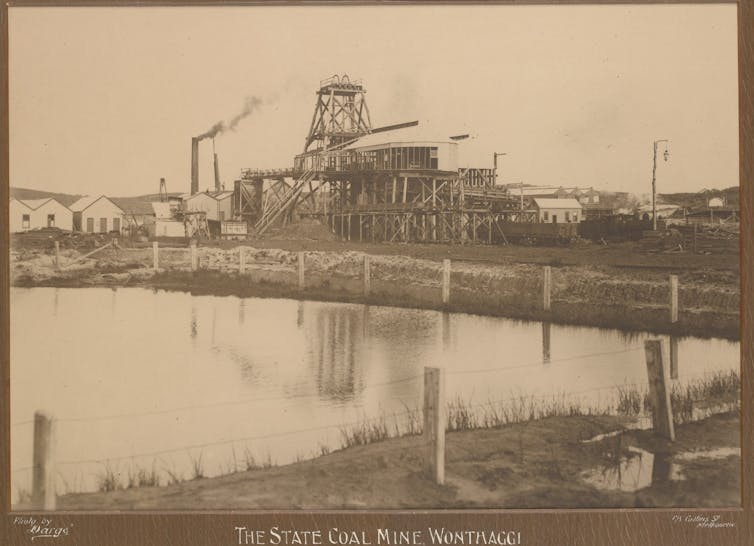
 Towns like Wonthaggi in Victoria sprung up around coal mining.
Darge Photographic Co/State Library of Victoria, CC BY
Towns like Wonthaggi in Victoria sprung up around coal mining.
Darge Photographic Co/State Library of Victoria, CC BY
Do we actually need a new authority?
This isn’t the first time we’ve seen proposals for authorities like this. The union movement has proposed several variants in the past, and Labor backed a similar initiative before the 2022 federal election.
After it won government, Labor set up a net zero economy taskforce aimed at advising on how to best support regional communities during the low-carbon transition.
The Greens have also proposed an expanded version of this authority, which would take on extra advisory and law-reform functions. An inquiry into the Greens’ proposed bill by a Labor-majority committee last month described the measure as “premature”, given the government’s taskforce is exploring options to help regions.
Labor, of course, would prefer its own version gets up. That’s entirely possible – the proposed authority has broad support beyond the labour movement.
But some have been critical, with Australian Energy Council experts questioning whether such an authority would be needed, given regional development programs already exist.
Regional industrial transitions are complex, requiring sustained governance over long periods. Australia’s existing programs are not enough, and are often fragmented across a patchwork of federal, state and local government departments.
A new federal authority would help coordinate existing programs across all levels of government, bring the additional capabilities of the federal government, and take a sustained, long-term focus to the challenging task of regional transition.
In a few weeks, we’ll find out whether the Albanese government decides to fund such a body in its May budget.
Read more: NSW's biggest coal mine to close in 2030. Now what about the workers?
The moral case for a transition authority
An authority dedicated to smoothing the path of the energy transition is, in my view, justified on moral grounds. It would elevate the voices of workers and regional communities who are most affected by the low-carbon transition, helping to ensure the benefits and burdens of the transition are fairly shared.
Those whose jobs are at risk have a moral claim to government support to help them adjust to these changes. But so do residents in these regions who never enjoyed the benefits of highly paid unionised jobs in the fossil fuel industry in the first place. They, too, should share in the benefits.
That’s why the ACTU is right to propose a wider, community-level mandate for the authority, to spur regional development that’s not only more environmentally sustainable but also more socially diverse.
 If not managed well, a transition away from mining could lead to poverty - or even the abandonment of mining towns, as Australia saw after the gold rush. This photo shows the gold-mining ghost town of Gwalia in Western Australia.
Shutterstock
If not managed well, a transition away from mining could lead to poverty - or even the abandonment of mining towns, as Australia saw after the gold rush. This photo shows the gold-mining ghost town of Gwalia in Western Australia.
Shutterstock
The political case
Residents of coal and gas regions are often sceptical of the low-carbon transition, and may view it as a threat. An authority like this could build local support by demonstrating what comes next.
In Spain, for instance, the incumbent Spanish Socialist Party is reaping the political benefits of the “just transition agreement” it negotiated with unions, employers and community representatives in coal regions in 2018.
This agreement made clear coal-mining would be phased out by the end of 2019. In return, the government agreed to provide €250 million (A$407 million) in support for workers and community-level investment over the next eight years.
At the April 2019 national election, the incumbents won. Interestingly, our research found their vote share in coal-mining regions covered by the agreement increased relative to comparable rural areas not covered.
Spain and Australia obviously have different political contexts. But our research does suggest there are potential political benefits – not just costs – on offer to governments that provide climate leadership grounded in a just-transition strategy.
An Australian transition authority will only be politically successful if it works with local bodies with similar mandates, such as the Latrobe Valley Authority and the Collie Delivery Unit – or helps establish them.
Working with locally supported groups is common sense. It is also backed up by research showing that fossil fuel communities do not like the idea of having their futures dictated to them by Canberra. But if they feel heard and see their concerns tackled in the transition, they are more likely to be supportive.
For years, organisations such as The Next Economy and the Real Deal project have been working on the energy transition in communities like Gladstone, one of the Queensland towns most reliant on gas and coal. This community-building expertise would be vital for the authority to draw on.
From the power stations to the mines?
If Australia creates an energy transition authority, the immediate task is to help catalyse just and politically smooth transitions in coal power-generating regions.
But there’s a bigger task lying ahead. Australia’s domestic emissions are dwarfed by the emissions from its coal and gas exports. If the authority proves itself, it could begin to support workers and communities to wind down Australia’s export-oriented coal mines and fossil-gas production industries.
Authors: Fergus Green, Lecturer in Political Theory and Public Policy, UCL


















