

Laws targeting protesters are being rushed through state parliaments. But they are often poorly designed and sometimes, unconstitutional
- Written by: Sarah Moulds, Senior Lecturer of Law, University of South Australia
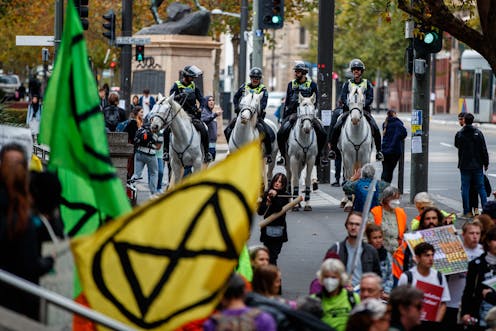
Across Australia, climate activists are testing the limits of what counts as lawful protest, in addition to the patience of commuters as their actions shut down roads or disrupt businesses. Authorities are responding with new police powers and increasingly harsh new penalties.
The speed at which these new laws are made and their impact on the right to protest are alarming.
Last week in Adelaide, an Extinction Rebellion activist dangled off a city bridge as part of a protest timed to coincide with a meeting of major oil and gas companies. Commuters along busy North Terrace were held up by road blocks set up by emergency services in response to the stunt. The activist was charged with several offences, including obstructing a public place.
The opposition in the state immediately called for tougher penalties for protesters who cause traffic chaos. The next day, the South Australian government introduced amendments to the Summary Offences Act 1953 (SA) that could see protesters hit with fines of $50,000 (up from $750) or three months imprisonment.
Protesters caught by the new laws could also be liable for paying the costs of any police and other emergency services called to the scene. These amendments were passed by the House of Assembly in Adelaide by lunchtime. In a matter of hours, the right to protest in South Australia sustained a grievous blow. And the laws are not limited to protesters – they can apply to any person who directly or indirectly obstructs free passage in a public place.
Both major parties were prepared to pass changes they barely had time to read, let alone scrutinise. There’s no human rights legislation in South Australia to slow down the race to legislate, and not even an requirement to publish explanatory material about the new law.
This type of knee-jerk lawmaking in response to climate protests has occurred in other states too.
In Queensland, laws have been introduced to make sure protesters who clamped themselves to buildings or other bits of the city could be hit with bigger fines and longer jail terms.
In New South Wales, harsher penalties have been introduced to target protesters whose actions disrupted businesses and other economic activity. These laws mean that people can be fined up to $22,000 or jailed for up to two years for protesting illegally on public roads, rail lines, tunnels, bridges and industrial estates.
And in Tasmania, anti-protest laws have been introduced to specifically target activists looking to disrupt logging activities by increasing penalties for anyone who obstructs employees from carrying out their work or causing a risk to worker safety.
These laws are designed to send a “zero tolerance” message to climate activists.
Using the threat of jail and crippling fines, authorities want to stop people from dangling from bridges, clamping themselves to buildings or chaining themselves to trees. They also want to help the commuters stuck in traffic, or the forestry workers locked out of their machines.
No compromise on right to protest, environment conservation
The problem is, when these laws are rushed through parliament, they are often poorly designed and sometimes, unconstitutional. They can also be unpopular.
This is because in the rush to respond to public outrage at the actions of protesters, politicians underestimate how much Australians care about the environment, and the right to peaceful protest.
This is playing out in the backlash to the new anti-protest laws in South Australia and in the judicial and public response to the sentencing of protester Deanna “Violet” CoCo in New South Wales.
These rushed laws also underestimate the reach of the implied freedom of political communication in our Constitution, which has been tested in a range of contexts.
Previous versions of anti-protest laws in Tasmania have been struck down by the High Court for going too far when it comes to imposing penalties on activists seeking to disrupt workplaces, with some judges taking a strong interest in the powers given to police and other authorities under these laws.
For example, in Brown v Tasmania, Chief Justice Kiefel and Justices Bell and Keane explained that anti-protesting laws that are drafted in vague terms, and are highly dependent on police interpretation on the ground, risk capturing or deterring lawful protests. When this happens, the laws may no longer be considered proportionate, and may be incompatible with our constitutionally protected system of representative democracy.
The concept of representative democracy is fiercely defended by the High Court, which means that although we don’t have a constitutional right to protest, we do have an implied freedom to communicate about political matters that might impact who we vote for.
The laws introduced in NSW in 2022 are also being challenged on the basis that they may breach the implied freedom of political communication protected in the constitution.
The community backlash
The common element in the community backlash to these laws and the constitutional challenges is proportionality.
Proportionality is a human rights concept that means we think about whether the new law is necessary, whether it will work in practice and what impact it will have on other rights and values we care about in our democracy.
Read more: What do we want? Charting the rise and fall of protest in Australia
People get rightly get frustrated when their drive to work or school takes three hours longer than usual because of protests. But recent surveys suggest there’s a good chance these same people also care about climate change and don’t want their kids to inherit a dead planet. They certainly don’t want their kids to live in a country where speaking out against the government lands you in jail or bankrupts you.
If we are going to stand any chance against the complex challenges that climate change poses to our way of life, we need parliamentarians who take their representative roles seriously, and take the time to listen to the community.
We need parliaments interested in making proportionate laws rather than breaking legislative speed limits.
Authors: Sarah Moulds, Senior Lecturer of Law, University of South Australia


















