

Housing and heritage aren’t mutually exclusive – a few basic rules can help get the balance right
- Written by: Alexander Gillespie, Professor of Law, University of Waikato
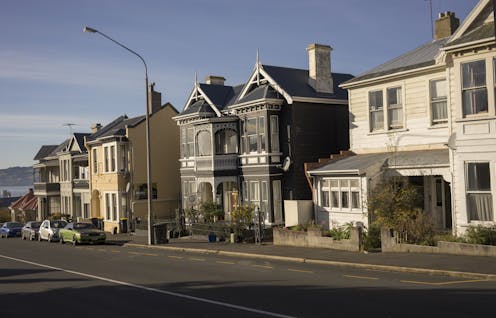
Anyone trying to follow the latest political debate over housing, urban intensification and development can be forgiven for feeling confused.
The National Party’s newly announced housing policy would allow local councils to opt out of the Medium Density Residential Standards the party originally supported. The Labour government calls it a “flip flop”, the Greens call it “confused”, but National says its policy is in fact “more ambitious”.
What does seem clear, however, is that some form of urban intensification will still play a role in New Zealand’s future planning. And that, of course, comes with its own layers of confusion and conflict – particularly between advocates of more medium-density housing and defenders of urban heritage.
For a long time, this clash of values and visions created mainly local and regional challenges. But since the Resource Management (Enabling Housing Supply and Other Matters) Amendment Act pushed old regional zoning laws aside, the problem has only grown.
Defining ‘heritage’
Many urban communities are now having to balance the urgent need for more housing and the perceived dangers of what can appear like a tidal wave of sometimes inappropriate development.
This is partly due to the vague definitions of what constitutes urban heritage in the first place. Essentially, it refers to the layers of history within a community, from iconic monuments and buildings to housing and green spaces.
Often in New Zealand it is assumed “heritage” refers to the leafy suburbs of renovated colonial villas and bungalows. But it can also be ordinary, informal, unspectacular and utilitarian – what is known as “vernacular” – and still have deep significance. This kind of heritage also maintains connections with previous generations.
Read more: National’s housing u-turn promotes urban sprawl – cities and ratepayers will pick up the bill
It’s hardly surprising, though, that the impact of development and regeneration can threaten urban heritage. Jackhammers or simply changes in planning law can fragment these valuable urban histories.
New Zealand has a particularly poor record of conserving its past, having failed to protect countless examples of its significant and vernacular built heritage. For every art deco treasure in Napier, there are many lost links to the past.
Despite resource management laws to protect historic heritage from inappropriate use and development, wider appreciation of heritage values has been slow to take hold.
Rules for progress
One way to see progress – and to avoid a perpetual standoff between vested interests – might be through greater appreciation of international best practice. The principles of the International Council on Sites and Monuments (ICOMOS) provide a useful guide.
ICOMOS is the only global non-governmental organisation of its kind dedicated to promoting the conservation of architectural and archaeological heritage. It has national committees in 107 countries, including New Zealand, and provides expert advice to bodies such as the World Heritage Convention.
Since 1964 it has set standards for safeguarding and conserving historic cities, towns and urban areas. These standards are based on its original principles, which were further updated in 2011.
As tension in New Zealand between urban intensification and preserving urban heritage seems likely to increase, these principles inform four broad themes that will be worth keeping in mind.
1. Local communities come first
Local people and communities should sit at the heart of any conservation efforts, not out-of-town developers or remote government departments. The desire to protect local heritage should be encouraged and supported. The relevant ICOMOS rule states:
The participation and the involvement of the residents are essential for the success of the conservation programme and should be encouraged. The conservation of historic towns and urban areas concerns their residents first of all.
2. Heritage areas must be credible
Planning for the conservation of historic towns and urban areas should be preceded by multidisciplinary studies that address not only architecture, but also the history, sociology and contexts of the places under review.
These plans should determine what must be preserved, what should be preserved under certain circumstances, and what may be expendable. But they should not be used as a tactic simply to deflect urban intensification. Once the authenticity and integrity of heritage areas is established, however, the presumption should be that conservation is a priority.
3. Protection requires a wide lens
Urban heritage protection needs to be about more than just buildings. It is about managing the relationship of the built environment to its surroundings, both natural and constructed.
This involves ensuring infrastructure is adequate and potential nuisances (such as traffic and parking) accounted for. Planners should also avoid sharp divisions between protected and unprotected areas by creating buffer zones.
These intermediate areas help enhance what is protected, rather than allow inappropriate bordering developments that can directly overshadow the conserved areas.
4. Improving housing is a priority
Urban heritage is not about preserving history in a glass case. Historic urban areas should be allowed to evolve. Change and development should be welcomed if they facilitate and improve housing, and are compatible with the character of a historic area, the existing spatial layout, scale and section size. ICOMOS is very clear on this point:
The improvement of housing should be one of the basic objectives of conservation.
The risk, of course, is that gentrification can price original communities out of their own neighbourhoods, and ultimately alter the character of a place to the extent its heritage value has changed too. As ICOMOS states:
Retention of the traditional cultural and economic diversity of each place is essential, especially when it is characteristic of the place.
None of these balancing acts is easy. But we need to avoid the perception of a binary choice between housing people and saving traditional urban areas. It is possible to do both – but this requires a degree of finesse currently missing from aspects of the local debate.
Authors: Alexander Gillespie, Professor of Law, University of Waikato

















