

Building activity produces 18% of emissions and a shocking 40% of our landfill waste. We must move to a circular economy – here’s how
- Written by: M. Reza Hosseini, Senior Lecturer in Construction, Deputy Director, Mediated Intelligence in Design (MInD) Research Lab, Deakin University
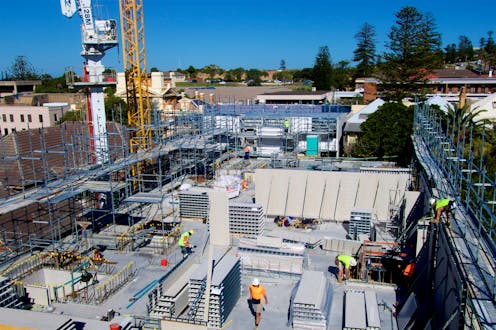
Architecture, engineering and construction employ 1.2 million people in Australia and account for 9% of GDP. But our biggest services sector also produces roughly 40% of landfill waste and accounts for 18.1% of Australia’s carbon footprint. The sector must change its practices fast for Australia to meet its commitments to cut emissions under the Paris Agreement.
A circular economic model can help solve the environmental challenges created by our built environment – water, waste and power systems, transport infrastructure and the buildings we live and work in. A circular economy involves sharing, leasing, reusing, repairing, refurbishing and recycling materials and products for as long as possible.
Circular economy principles have gained recognition from all levels of government in Australia. But there’s a big gap between acknowledgement and action. Progress towards systemic change has been very limited.
A new report by university and industry experts lays out a roadmap to a circular economy. Those working in the sector reported the top three barriers as: a lack of incentives, a lack of specific regulations, and a lack of knowledge. The top three enablers were: research and development of enabling technologies, education of stakeholders, and evidence of the circular economy’s added value.
Read more: Australia needs construction waste recycling plants — but locals first need to be won over
The huge amount of waste created by building construction and demolition makes the industry unsustainable.So what are the world leaders doing?
Extensive research for the report drew on real-world experiences, including a survey and interviews with stakeholders. The report offers practical recommendations to drive the transformation to a circular economy, with examples from global front-runners.
The first recommendation is to learn from these nations. Most are in Europe.
A leading example is the Netherlands’ “Cirkelstad”. This national platform connects key players in the transition to a circular economy in major cities. It provides a database of exemplary projects, research and policies, as well as training and advice.
Cirkelstad highlights the importance of broad collaboration, including research organisations. One outcome is the City Deal initiative. It has brought together more than 100 stakeholders with the shared goal of making circular construction the norm. They include government bodies, contractors, housing associations, clients, networks, interest groups and knowledge institutions.
We rarely see such collaboration in Australia. Connections between government, research and industry practices have been weak. Our universities compete fiercely.
In Denmark and Sweden, rigorous regulations have been effective in promoting circular practices. Denmark has incentives for the use of secondary materials such as recycled brick. It also promotes designs that make buildings easy to disassemble.
In Sweden, contractors must give priority to using secondary materials in public projects. Suppliers are evaluated based on their environmental impacts
Read more: A third of our waste comes from buildings. This one's designed for reuse and cuts emissions by 88%
In Canada, Toronto is notable for its proactive approach. Measures include a cap on upfront carbon emissions for all new city-owned buildings.
Test beds and pilot projects have proven effective, too. A good example is the UK’s Waste House.
Waste House was built using more than 85% waste material from households and construction sites. Yet it’s a top-rated low-energy building. The project is an inspiration for architects and builders to challenge conventional construction methods and embrace circular practices.
Much of the focus of Finland’s circular economy initiatives is on construction and urban planning. Various policy tools and incentives encourage the use of recycled or renewable materials in construction. The renovation of Laakso hospital in Helsinki is a notable example.
Strategic zoning of public spaces can also be used to bolster circular economy activities. An example is the repurposing of urban land for activities such as waste sorting.
Read more: How to make roads with recycled waste, and pave the way to a circular economy
The Brighton Waste House was made largely from recycled materials.How can Australia create a circular economy?
Australia has been slow to adopt such measures. There are voluntary schemes, such as Green Star, that include emission caps for buildings. However, Australia lacks specific, well-defined requirements to adopt circular economy practices across the built environment sector.
Our report’s recommendations include:
- develop metrics and targets to promote resource efficiency
- adopt measurable circular procurement practices for public projects
- provide incentives for circular practices
- establish technical codes and standards that foster the use of secondary products.
The report finds funding for collaborative projects is badly needed too. Regrettably, the Australian built environment is not seen as a research funding priority. But more funding is essential to foster the innovation needed to make the transition to a circular economy.
Innovation can help us reconcile the public demand for spacious homes with sustainable construction practices. We can achieve this through a mix of strategies:
- moving towards modular construction techniques
- creating incentives to adopt circular design principles
- making adaptive reuse of existing structures a priority
- designing multi-functional spaces that makes the most of resources.
Integrating circular economy principles into education and training at universities and schools can embed a culture of innovation. Equipping students with this knowledge and skills will enable the next generation to drive change in our built environment.
Currently, there are few Australian-based training programs that focus on the circular economy. And available courses and programs overseas are costly.
There is also a need to promote inclusivity in the built environment sector. Circular solutions must incorporate cultural considerations.
By embracing the above strategies, Australia can foster a harmonious balance between cultural values, environmental sustainability and efficient resource use.
Collectively, these initiatives will lay the foundation for a circular economy in the built environment sector. The growing need for housing and infrastructure underscores the urgency of achieving this goal in Australia. Ultimately, consumers, industry and the environment will all benefit.
Read more: With the right tools, we can mine cities
Authors: M. Reza Hosseini, Senior Lecturer in Construction, Deputy Director, Mediated Intelligence in Design (MInD) Research Lab, Deakin University

















