

the irreversible changes to come if we fail to keep warming below 2℃
- Written by: Timothy Naish, Professor in Earth Sciences, Te Herenga Waka — Victoria University of Wellington
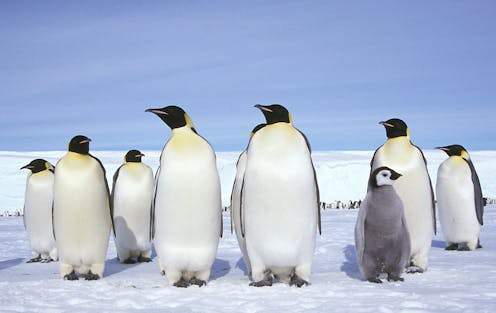
The slow-down of the Southern Ocean circulation, a dramatic drop in the extent of sea ice and unprecedented heatwaves are all raising concerns that Antarctica may be approaching tipping points.
The world has now warmed by 1.2℃ above pre-industrial levels (defined as the average temperature between 1805 and 1900) and has experienced 20cm of global sea-level rise.
Significantly higher sea-level rise and more frequent extreme climate events will happen if we overshoot the Paris Agreement target to keep warming well below 2℃. Currently, we are on track to average global warming of 3-4℃ by 2100.
While the recent Antarctic extremes are not necessarily tipping points, ongoing warming will accelerate ice loss and ocean warming, pushing Antarctica towards thresholds which, once crossed, would lead to irreversible changes – with global long-term, multi-generational repercussions and major consequences for people and the environment.
The Earth system is designed to reach equilibrium (come into balance) in response to climate heating, but the last time atmospheric levels of carbon dioxide (CO₂) were as high as they are today (423ppm) was three million years ago.
Read more: Antarctic alarm bells: observations reveal deep ocean currents are slowing earlier than predicted
It took a millennium for the world’s climate to adjust to this. When it did, Earth’s surface was 2℃ warmer and global sea-levels were 20m higher due to Antarctic ice-sheet melting. Back then, even our earliest human ancestors were yet to evolve.
The evolution of humankind could only begin after CO₂ levels dropped below 300ppm, about 2.7 million years ago. Since then, Earth’s average temperature has fluctuated between 10℃ during ice ages and 14℃ during warmer inter-glacial periods.
During the past 10,000 years of our present inter-glacial period, Earth’s greenhouse gas thermostat has been set at 300ppm of CO₂, maintaining a pleasant average temperature of 14℃. A goldilocks climate – not too hot, not too cold – but just right for human civilisation to flourish.
The Earth system is interconnected
Current global heating is taking the Earth system across a threshold humans have never experienced, into a climate where Antarctica’s ice shelves and marine ice sheets can no longer exist and one billion people, currently living near the coast, will be drowned by rising seas.
This will be a world where wildfires, heatwaves, atmospheric rivers, extreme rainfalls and droughts – such as those we have seen globally last summer – become commonplace.
The Earth system (oceans, atmosphere, cryosphere, ecosystems etc) is interconnected. This allows energy flow, enabling physical and ecological systems to remain in balance, or to regain balance. But connections can also mean dependencies, leading to reactions, amplifying feedbacks and consequences. Changes have roll-on effects, much like toppling dominoes.
Read more: Antarctica's heart of ice has skipped a beat. Time to take our medicine
Feedback loops – cyclical chain reactions that repeat again and again – can make the effects of climate change stronger or weaker, sometimes stabilising the system, but more often amplifying a response with adverse impacts.
Change is also not always linear. It can be abrupt and irreversible on human timescales if a threshold or tipping point is crossed.
Here, we outline one sequence of changes and consequences, including feedback loops and thresholds, using the example of global heating melting Antarctica’s ice sheets and the resulting sea-level rise.
We take a 50-year view into the future, as this is relevant for today’s policy makers but also sets in place much longer multi-generational consequences. While we focus on this example, there are many other Antarctic tipping points, including the effects of freshwater from ice-sheet melt on marine ecosystems and the effects of Antarctic change on Aotearoa’s temperature and rainfall patterns.
Antarctica in a warming world
Unless we change our current emissions trajectory, this is what to expect.
By 2070, the climate over Antarctica (Te Tiri o te Moana) will warm by more than 3℃ above pre-industrial temperatures. The Southern Ocean (Te Moana-tāpokopoko-a-Tāwhaki) will be 2℃ warmer.
As a consequence, more than 45% of summer sea ice will be lost, causing the surface ocean and atmosphere over Antarctica to warm even faster as dark ocean replaces white sea ice, absorbing more solar radiation and re-emitting it as heat. This allows warm, moist air in atmospheric rivers from the tropics to penetrate further south.
This accelerated warming of the Antarctic climate is a phenomenon known as polar amplification. This is already happening in the Arctic, which is warming two to three times faster than the global average of 1.2℃, with dramatic consequences for the permanent loss of sea ice and melting of Greenland’s ice sheet.
Antarctic tipping points
The warmed waters melt the ice shelves, which are floating tongues of ice that stabilise the Antarctic ice sheet, slowing down the flow of ice into the ocean.
Ice shelves can pass a tipping point when local ocean temperature thresholds are crossed, causing them to thin and float in places where they were once held in place by contact with the seabed. Melting at the surface also weakens ice shelves. In some cases, water on the surface fills up cracks in the ice and can then cause large areas to disintegrate catastrophically.
By 2070, heat in the ocean and atmosphere will have caused many ice shelves to break up into icebergs that will melt and release a quarter of their volume into the ocean as freshwater. By 2100, 50% of ice shelves will be gone. By 2150, all will have melted.
Without ice shelves holding back the ice sheet, glaciers will discharge at an even faster rate under gravity into the ocean. Large parts of the East Antarctic ice sheet and almost the entire West Antarctic ice sheet sit on rock in deep depressions below sea level.
They are vulnerable to an irreversible process called marine ice sheet instability (MISI). As the edges of the ice retreat into the deep basins, driven by the ongoing encroachment of warm ocean waters, the loss of ice becomes self-sustaining at an accelerating rate until it is all gone.
Another positive feedback, called marine ice cliff instability (MICI), means cliffs at the margins of the retreating ice sheet become unstable and topple over, exposing even taller cliffs that collapse under their own weight continuously like dominoes.
If global heating is not held below 2℃, ice-sheet models show global sea-levels will rise at at an accelerating rate up to 3m per century. Future generations will be committed to unstoppable retreat of the Greenland and marine sections of the Antarctic ice sheets, causing as much as 24m of global sea-level rise.
These changes highlight the urgency for immediate and deep cuts to emissions. Antarctica has to remain a stable ice-covered continent to avoid the worst impacts of rising seas.
Programmes around the world, including the Antarctic Science Platform, are prioritising research about future changes to the Antarctic ice sheet. Even if the news is not great, there is still time to act.
Mel Climo, Sandy Morrison and Nancy Bertler from the Antarctic Science Platform are acknowledged for their input and support.
Authors: Timothy Naish, Professor in Earth Sciences, Te Herenga Waka — Victoria University of Wellington


















