

The rise of the super-diverse 'ethnoburbs'
- Written by Shilpi Tewari, Lecturer, Deakin University
Since the early 1990s, Australia’s skilled migration scheme has brought a new category of migrants into the country. They have higher educational qualifications and economic capabilities than previous migrants. They come from affluent as well as economically disadvantaged countries around the world.
The mass immigration of professionals and entrepreneurs has given rise to different and distinct residential settlement patterns in all major cities, including Sydney, Melbourne, Brisbane and Adelaide. As a result, many suburbs in these cities have become demographically multicultural. Notable examples include Redfern and Ashwood in Sydney, Point Cook and Caroline Springs in Melbourne, Sunnybank in Brisbane and Ferriden Park in Adelaide.
Read more: Three charts on Australia's population shift and the big city squeeze
What has our research found?
Melbourne and Victoria are the city and state with the fastest population growth. A more detailed analysis of demographic changes in suburbs of Melbourne demonstrates a new urban phenomenon in migrant settlement patterns. Higher-income professional migrants of higher socioeconomic status now tend to live close to each other in the suburbs, rather than in more traditional migrant settlement areas.
The result of this shift in settlement patterns is suburbs with large migrant populations of diverse ethnic origins. We have called these “super-diverse ethnoburbs”.
For example, new migrants have increasingly chosen to settle in outer suburban locations of Melbourne. They, like many other home buyers, see the outer suburbs as more affordable than inner-city areas where property prices have skyrocketed in recent years.
Read more: New to Australia? Good luck! Migrants can no longer afford 'gateway' suburbs
Secondly, these new migrants seem to find greater satisfaction in living in more private and physically separated environments. Here they are surrounded by people of similar socioeconomic status and they and their families feel more secure.
This trend is giving rise to suburbs which have professional middle-class young families living within master-planned estates. Point Cook, Tarniet, Craigieburn, Caroline Springs and Glen Waverley are examples of such suburbs in Melbourne.
Where did the idea of ‘ethnoburbs’ come from?
Geographer-researcher Wei Li has explored a similar phenomenon of ethnic segregation in the US. There, ethnic minority populations of educated, professionally employed new migrant groups and second-generation migrants tend to disperse to and settle in suburbs rather than living in the traditional inner-city areas.
To retain their cultural identity in the host society, these ethnic groups tend to settle near to people of their cultural background. Drawing on the example of San Gabriel Valley in California, Li has shown how strong ethnic clusters of Chinese populations have completely altered the architectural styles, street signs, commercial streets and businesses of a suburb. They have turned it into what Li has termed an “ethnoburb”.
Reflecting on Li’s model of ethnoburbs and comparing it with the suburbs in Australia, a question arises. How comparable are these to Li’s ethnoburbs?
What makes our ethnoburbs different?
A comparison between the US model of ethnoburbs with outer suburbs such as Point Cook, Tarniet and Caroline Springs showed a few key differences. Li’s ethnoburbs were suburbs with one ethnic group dominating and concentrating in one suburb. They eventually transform the physical as well as social environment within these suburbs to reflect the dominant ethnic culture.
Suburbs of Melbourne are different in that they are a cultural mosaic. Many different ethnic groups co-exist, even though a few cultural groups are much larger than others.
Read more: Interculturalism: how diverse societies can do better than passive tolerance
Using Point Cook as an example, analysis of demographic data shows that residents come from many different destinations. The most common countries of origin are England, New Zealand, China, India and Philippines (Figure 1), although this suburb is home to people from 160 different ethnic backgrounds. A great variety in the countries of origin and ethnicity of migrant population has been described by sociologist Steven Vertovec as “super-diversity”.
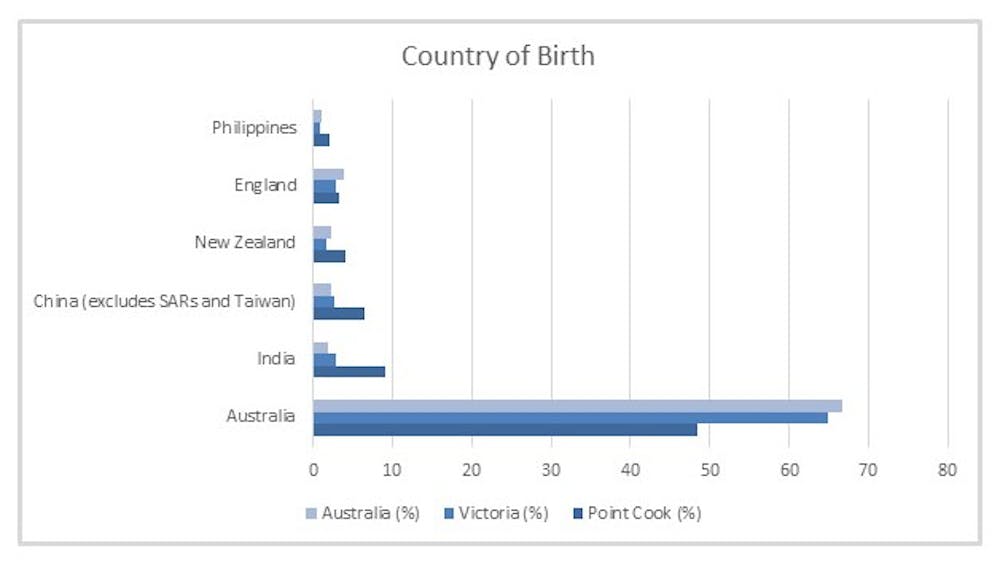 Figure 1: Most common countries of birth for residents of Point Cook.
Quick Stats 2016, Australian Bureau of Statistics, Author provided
Figure 1: Most common countries of birth for residents of Point Cook.
Quick Stats 2016, Australian Bureau of Statistics, Author provided
While the population in Point Cook comes from many different countries, they are all mostly professionals and managers with high educational qualifications and economic status (Figure 2). This means Point Cook is super-diverse in an ethnic/cultural sense but not in an economic/class sense. Point Cook has more high-income earners than the average for Victoria and Australia.
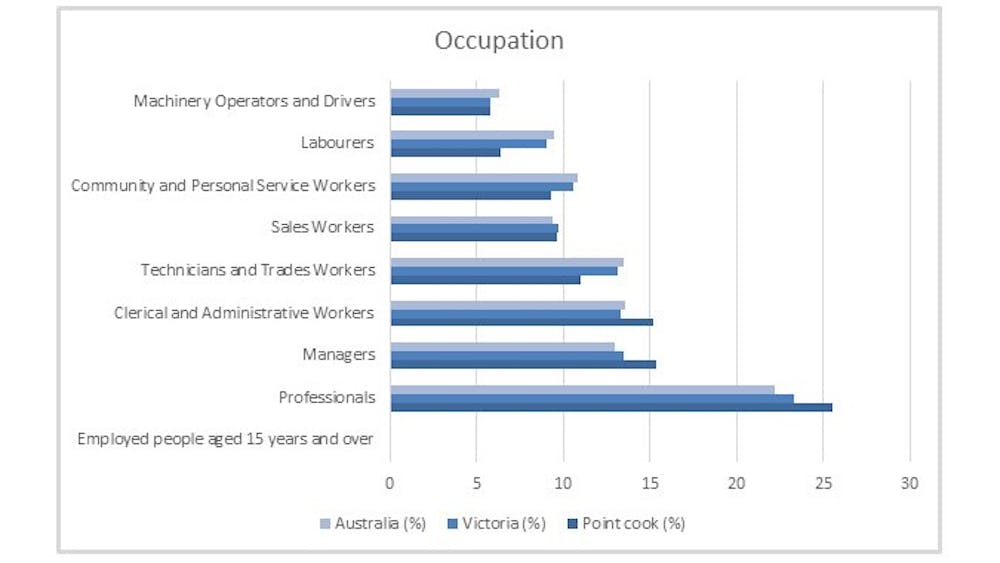 Figure 2: Employment by occupation type in Point Cook.
Quick Stats 2016, Australian Bureau of Statistics, Author provided
Figure 2: Employment by occupation type in Point Cook.
Quick Stats 2016, Australian Bureau of Statistics, Author provided
Nevertheless, combining the theories of ethnoburbs and the concept of super-diversity and applying them to the outer suburbs of major cities of Australia, a new phenomenon is evident: super-diverse ethnoburbs. Instead of being dominated by a population of Anglo-Celtic origin or by any particular ethnic group, these communities are comprised of many different ethnic minority groups existing together.
Read more: Migrants are stopping regional areas from shrinking
Authors: Shilpi Tewari, Lecturer, Deakin University
Read more http://theconversation.com/the-rise-of-the-super-diverse-ethnoburbs-90926

















