

How will my divorce affect my kids?
- Written by: Kim Halford, Professor of Clinical Psychology, The University of Queensland
This is part of a package on Parenting after Divorce. Read the other articles in the series here.
Most children adjust well to parental separation and divorce, at least in the long term.
A minority of children of separated parents have long-term problems, which can affect them through their childhood and into adult life. But it’s conflict between separated parents, and not the separation itself, which accounts for many of the problems children of separated parents experience.
Many Australian children experience parental separation and divorce. About 50,000 to 60,000 children in Australia experience their parents separating each year. Around one in five Australian children (about one million) will experience parental separation before the age of 18.
Immediately before and after parental separation, children are often upset. But for most children, their adjustment improves across the next year or two. Studies show most children adjust reasonably well in the longer term.
On average, children of separated parents do just a little bit worse than children of parents in intact families. This effect is evident across multiple outcomes. For example, children of divorce do a little bit worse on educational attainment, have slightly more behaviour problems, and are slightly more likely to suffer from anxiety and depression.
While the average effect of parental separation is small, children of separated parents have twice the rate of serious mental health problems and substance abuse, and are twice as likely to attempt suicide, as children of parents in intact families. These statistics reflect that a minority of children from separated parents have very poor adjustment.
Read more: How to tell your child you're getting divorced
Witnessing conflict
The strongest predictor of poor child adjustment after separation is conflict between the separated parents. Poor long-term outcomes for children occur when parental conflict is severe (such as verbal abuse or physical violence), is frequent, and occurs in front of the child.
Children are particularly affected when the conflict is about them, or issues around parenting. Many children blame themselves for parental conflict, particularly when the conflict is about parenting or child behaviour. If the child believes they have caused the conflict, or should be able to stop the conflict, then they are particularly likely to suffer adjustment problems.
Severe parental conflict in front of the children is also associated with child adjustment problems in intact families. In high conflict parental relationships, separation sometimes reduces children’s exposure to parental conflict. So staying in a relationship does not necessarily protect children from parental conflict.
As well as parental conflict, poor child adjustment is predicted by mental health or substance abuse problems in a parent. Many separated parents re-partner and these new relationships sometimes end. Frequent changes in the child’s living arrangements, and changes in who cares for the children, are also associated with poor child adjustment.
Read more: How to co-parent after divorce
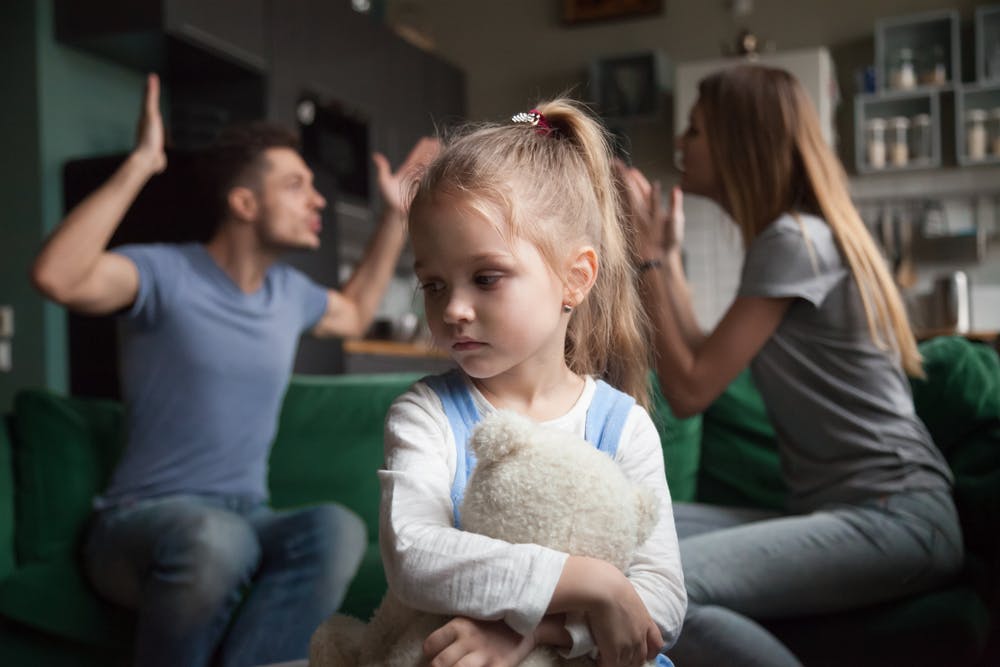 Children are particularly affected when the conflict is about them, or issues around parenting.
from www.shutterstock.com
Children are particularly affected when the conflict is about them, or issues around parenting.
from www.shutterstock.com
Co-parenting after divorce
When parents separate there has to be an agreement about how the children will be cared for. Agreements have to address issues such as where the child will live, how much time each parent will spend with the child, and how and where the parents will communicate about parenting decisions.
About 30% of separating parents reach a co-parenting agreement without assistance. Another 30% seek advice from professionals such as family lawyers, psychologists, or family counsellors, and then negotiate an agreement acceptable to both parents. But about 40% of separated parents have disagreement about parenting arrangements they’re unable to resolve.
In Australia, most parents who disagree about parenting arrangements are required to undertake mediation. If mediation does not produce an agreement, then the parents can apply to the Family Court to make a decision. In some circumstances, the parents can go straight to court without having to attempt mediation. Examples of such circumstances are if there is family violence, or if one of the parents has a mental health problem that is seen to make mediation inappropriate.
Family mediation usually involves four or five hours of sessions with a professional mediator. Typically the mediator conducts a separate individual interview with each parent to assess the family background, and identify the current issues of dispute around parenting. There might also be a session talking with the child or children asking them their views. Then there would be a conjoint session between the mediator and the two parents.
Read more: What type of relationship should I have with my co-parent now we're divorced?
Of separated parents who undertake mediation, about two-thirds reach a co-parenting agreement. The remaining third usually go to the Family Court to have a judge or magistrate determine what the parenting arrangements will be.
As most parents will realise, parenting arrangements need to change as children’s circumstances change. Parenting agreements need to allow for decision-making as new circumstances arise, and to be renegotiated across time. For example, a child who usually stays weekends with her mother might get interested in a weekend sport that occurs near her father’s home, and the child might want to change around where she spends her weekends.
Due to the ongoing nature of co-parenting, separated parents often have contact with each other for 20 or 30 years after they separate. Developing collaborative co-parenting can be challenging for separated parents. If separated parents allow conflict to occur in front of their children, the children suffer. If parents manage to be mutually respectful and keep their child’s best interests as their shared focus, then the child is likely to do well.
Numerous services are available to assist separated parents to develop more effective co-parenting. These include parenting education, counselling, and legal advice. The Family Relationships Advice line provides information and referral to services. Their telephone line is open Monday to Friday 8am to 8pm, and Saturday 10am to 4pm (local time) on 1800 050 321. Information is online here.
Authors: Kim Halford, Professor of Clinical Psychology, The University of Queensland
Read more http://theconversation.com/how-will-my-divorce-affect-my-kids-101594


















