

the markers we're laying down in deep time
- Written by: Duncan Cook, Associate Professor in Geography, Australian Catholic University
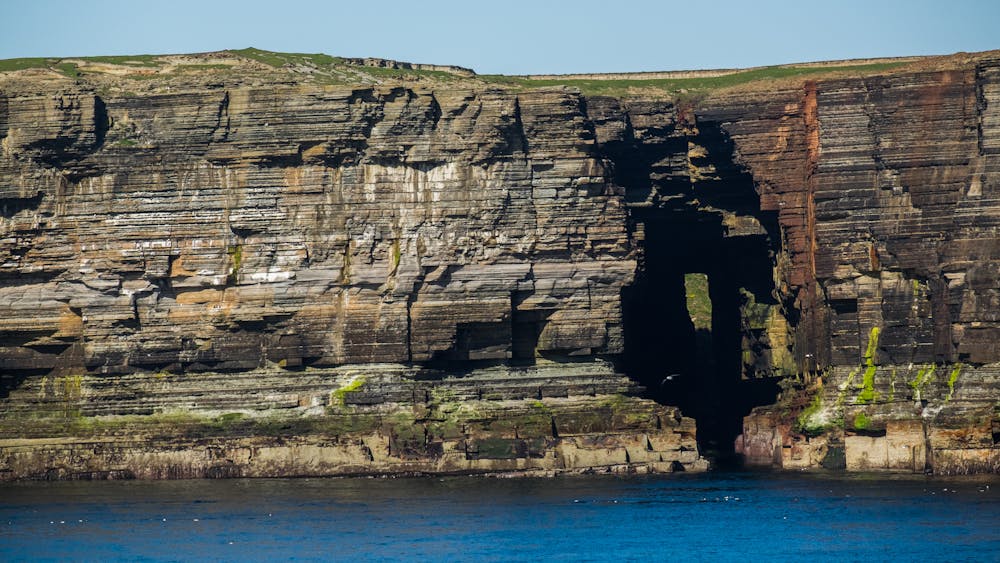
Rocks keep time. Not on our human-scale time, but deep time: the almost unimaginable span of billions of years which have already come and gone.
Let’s say you’re in the far future and you’re looking for evidence of previous civilisations. Where would you look? The first place would be in the rocks.
For decades, experts have debated whether our world-spanning impact on the planet represents the sign of a new geological period, the Anthropocene. Only recently, scientists selected a small lake in Canada as the site that best records our impact.
That’s because the waters of the lake don’t mix, which means sediment falling into the lake is laid down neatly and in incredible detail. Over long periods, the lake’s varved sediments have preserved an excellent, undisturbed record of the Anthropocene.
But what would have to be in those sediments to leave indelible evidence of our presence? Here are five of the markers we’re leaving for the future.
What markers are we laying down in rock?
We break up deep time into parts. Everyone is familiar with periods such as the Jurassic. But what separates them? Usually, a change in the global environment so large it leaves permanent evidence visible in the rock layers. That could be an asteroid strike, gargantuan volcanic eruptions in what is now India or trillions of bacteria injecting oxygen into the atmosphere and making respiration possible.
So to declare that we’re in a new geological epoch – and that we’ve left the balmy post-ice age Holocene behind – requires finding evidence of unmistakably clear markers. Here are five possibilities.
1. Plastics and plastic rocks
Plastics aren’t naturally produced – they’re manufactured from feedstock such as oil, coal, cellulose and fossil gas. Finding plastics in a sediment or rock layer is a clear sign that the layer dates from modern times.
There are also plastiglomerates, the mutant offspring of plastics and rock. These have been found in several places worldwide. They can be produced when plastic is heated, such as in campfires, or in bushfires. But they’re also being found in other places such as creeks.
2. Concrete
Concrete is now the most abundant human-made “rock” on the planet’s surface. Future archaeologists could dig down through mud and detritus to identify when widescale use of concrete first became obvious. This would tell them they’d struck the 20th century. Concrete, of course, has been used for millennia – ancient Roman concrete is still standing in some places. But it didn’t become ubiquitous until recently.
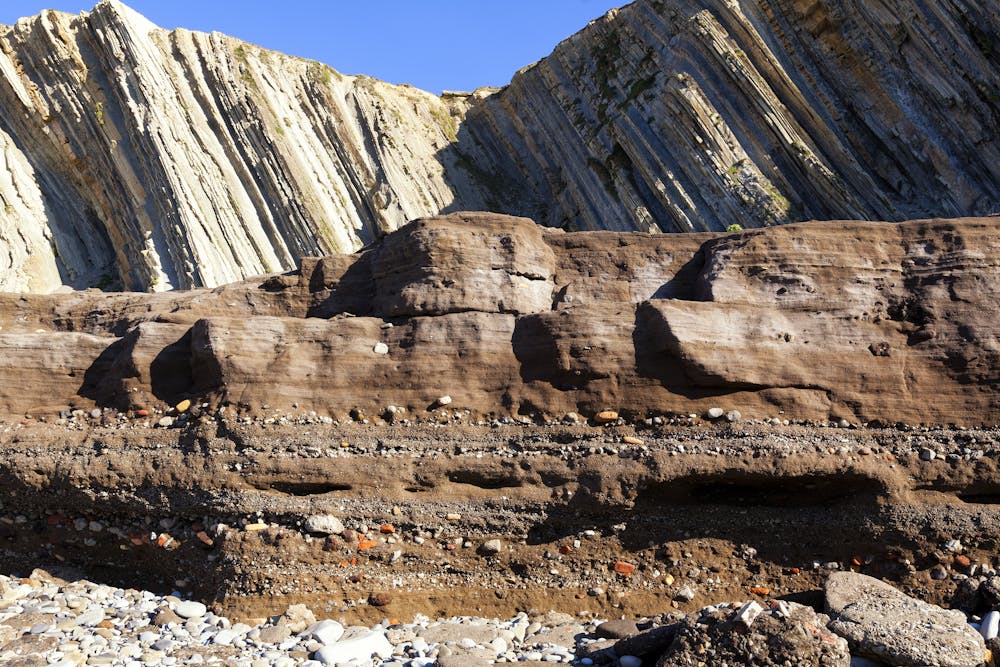 Cement, brick and industrial waste has been laid down in newly formed beachrock at Tunelboca beach in Spain.
Shutterstock
Cement, brick and industrial waste has been laid down in newly formed beachrock at Tunelboca beach in Spain.
Shutterstock
3. Chicken bones
Humans like chicken. As of 2018, we were eating about 65 billion of these birds a year. At any one time, there are 23 billion chickens alive. But why would chicken bones be a telltale sign we were here? Because of how common they are – and because our long reliance on these birds has changed them dramatically. They no longer resemble their sleek jungle fowl antecedents – they’re far larger, grow quicker and eat differently. Broiler (meat) chickens can’t survive without human intervention. These changes are so profound that it’s as if we’ve bred a new species, according to paleobiology and Anthropocene expert Jan Zalasiewicz, who told AFP: “It usually takes millions of years […] but here it has taken just decades to produce a new form of animal.”
 Broiler chickens grow much faster than their wild ancestors – and we breed billions upon billions every year.
Shutterstock
Broiler chickens grow much faster than their wild ancestors – and we breed billions upon billions every year.
Shutterstock
4. Plutonium and nuclear residue
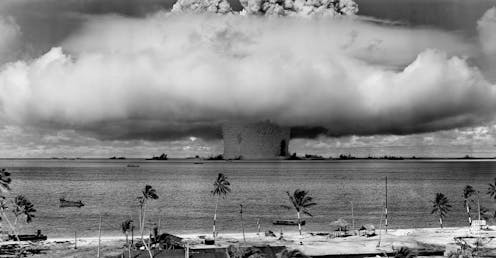
Nuclear testing began in the 1940s and accelerated through the 1950s and 60s before being phased out. Testing of new bombs now happens without exploding them. But those decades of testing in the 20th century have left behind a pollution time marker in our environment.
Explosive testing scattered traces of radiation across the entire planet. Plutonium, in particular, makes an excellent marker of 20th century human impact. While it does occur naturally, it’s only at incredibly low levels. The amount of plutonium spread by testing has left a clear spike, like a fingerprint, in the environment. Even now, we can identify samples from the 1950s and 1960s by the presence of plutonium and other radionuclides.
Read more: A Canadian lake holds the key to the beginning of the Anthropocene, a new geological epoch
5. Fossil fuels and climate change
We’ve been digging up and burning fossil fuels for a long time. People were using coal for heat thousands of years ago. But we really got going during what’s been dubbed the Great Acceleration in the mid-20th century, as many countries got richer, populations exploded, and demand for cars, planes and electricity soared. Burning these fuels leaves behind large volumes of fly ash and carbon particles, which fall to Earth, are laid down in rock in some areas. The carbon (CO2) pollution from burning the fuels will also eventually be recorded in rock. Future civilisations would be able to detect our presence because of the remarkably fast spike in carbon dioxide in the atmosphere.
Markers upon markers
There are many more markers, from sudden shifts in distribution of animal species, soil erosion and pollution, to refined metals, to looming mass extinctions of species.
Even so, the Anthropocene has not yet been declared. And it may never be. That’s because there are still many questions to sort out. Will these markers be recognisable long term? And – as some geologists argue – can we even say this is a distinct epoch, given it’s only just begun in geological terms?
All of this will be hashed out in discussions through this year. By the end of next year, we’ll learn the scientific fate of the Anthropocene.
Authors: Duncan Cook, Associate Professor in Geography, Australian Catholic University


















