

Twenty-five years after the Oslo Accords, the prospect of peace in the Middle East remains bleak
- Written by: Tony Walker, Adjunct Professor, School of Communications, La Trobe University
Looking back on events 25 years ago, when the Oslo Accords were struck on the White House lawn, it is hard to avoid a painful memory.
I was watching from a sickbed in Jerusalem when Bill Clinton stood between Israel’s Prime Minister Yitzhak Rabin and Palestinian leader Yasser Arafat for that famous handshake on the White House lawn.
At that moment, I was recovering from plastic surgery carried out by a skilled Israeli surgeon and necessitated by a bullet wound inflicted by the Israeli Defence Forces. (I had been caught in crossfire while covering a demonstration in the West Bank by stone-throwing Palestinian youths.)
That scar – like a tattoo – is a reminder of a time when it seemed just possible Arabs and Jews, Israelis and Palestinians could bring themselves to reach an historic compromise.
All these years later, prospects of real progress towards peace, or as American president Donald Trump puts it, the “deal of the century”, seems further away than ever.
Read more: Russia expands in the Middle East as America's 'honest broker' role fades
As a correspondent in the Middle East for a decade (1984-1993) and as co-author of a biography of Arafat, I had an understandable interest in the outcome of the Oslo process.
In hours of conversations with members of the Palestine Liberation Organisation’s historical leadership, I had tracked the PLO’s faltering progression from outright rejection of Israel’s right to exist to acceptance implicit in the Oslo Accords.
Throughout that process of interviewing and cross-referencing with Israeli sources, I had hoped an honourable divorce could be achieved between decades-long adversaries. Like many, I was disappointed.
In 1993, the so-called Oslo Accords, negotiated in secret outside the Norwegian capital, resulted in mutual recognition of Israel and the PLO. This enabled the beginning of face-to-face peace negotiations.
A devastating event
Two years after the historic events at the White House, and by then correspondent in Beijing, I witnessed another episode of lasting and, as it turned out, tragic consequences for the Middle East.
On November 4, 1995, Rabin was assassinated while attending a political rally in Tel Aviv by a Jewish fanatic opposed to compromise with the Palestinians.
That devastating moment brought to power for the first time the current Israeli Prime Minister Benjamin Netanyahu. He has distinguished himself by his unwillingness to engage meaningfully with the Palestinians through four US administrations: those of Bill Clinton, George W Bush, Barack Obama, and now Trump.
Some argue the Palestinians and their enfeebled leadership bear significant responsibility for peace process paralysis. That viewpoint is valid, up to a point. But it is also the case that Netanyahu’s replacement of Rabin stifled momentum.
Under Trump, Netanyahu finds himself under no pressure to concede ground in negotiations, or even negotiate at all. Indeed, the administration seems intent on further marginalising a Palestinian national movement, even as settlement construction in the occupied areas continues apace.
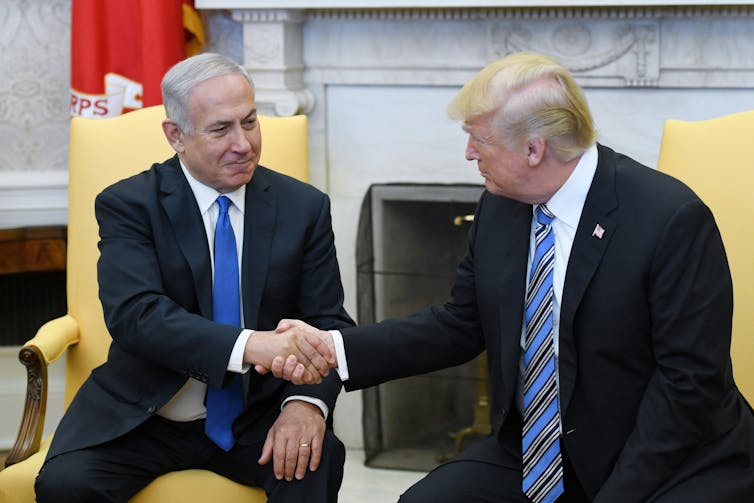 US President Donald Trump, here with Israeli Prime Minister Benjamin Netanyahu, has promised the ‘deal of the century’ in the Middle East, but the details have not yet been made clear.
AAP/ Olivier Douliery/pool
US President Donald Trump, here with Israeli Prime Minister Benjamin Netanyahu, has promised the ‘deal of the century’ in the Middle East, but the details have not yet been made clear.
AAP/ Olivier Douliery/pool
On the eve of the accords, there were 110,000 Jewish settlers in the West Bank and Gaza Strip. That number has grown to 430,000 today. In 2017, those numbers grew by 20% more than the average for previous years.
The Trump administration’s decision to move the American embassy to Jerusalem without making a distinction between Jewish West or Arab East Jerusalem could hardly have been more antagonistic.
By taking this action, and not making it clear that East Jerusalem as a future capital of a putative Palestinian state would not be compromised, the administration has thumbed its nose at legitimate Palestinian aspirations.
The administration’s follow-up moves to strip funding for the United Nations Works and Relief Agency (UNWRA) and assistance to Palestinian hospitals in East Jerusalem have further soured the atmosphere.
UNWRA is responsible for the livelihoods of thousands of Palestinian refugees in camps in the West Bank, Gaza, Jordan, Lebanon and Syria. These are the ongoing casualties of Israel’s 1948 War of Independence against the Arabs.
In this context, it is interesting to note that Jared Kushner, Trump’s son-in-law and Middle East envoy, has urged that refugee status be denied Palestinians and their offspring displaced by the war of 1948.
In that year, two-thirds, or about 750,000 residents of what had been Palestine under a British mandate became refugees.
Against this background and years of conflict between Israel and the Palestinians, including two major wars – the Six-Day War of 1967 and Yom Kippur War of 1973 – the two sides had in 1993 reached what was then described as an historic compromise.
Hopes dashed
What needs to be understood about Oslo is that its two documents, signed by Rabin and Arafat, did not go further than mutual recognition of Israel and the PLO in the first, and, in the second, a declaration of principles laying down an agenda for the negotiation of Palestinian self-government in the occupied territories.
What Oslo did not do was provide a detailed road-map for final status negotiations, which were to be completed within five years. This would deal with the vexed issues of refugees, Jerusalem, demilitarisation of the Palestinian areas in the event of a two-state settlement, and anything but an implied acknowledgement of territorial compromise, including land swaps, that would be needed to bring about a lasting agreement.
Writing in the Journal of Palestine Studies in 1994, Oxford professor Avi Shlaim described the White House handshake as:
one of the most momentous events in the 20th-century history of the Middle East. In one stunning move, the two leaders redrew the geopolitical map of the entire region.
Now emeritus professor, Shlaim’s own hopes, along with those of many others, that genuine compromise was possible, have been dashed.
Referring to the recent passage through the Knesset of a “basic law” that declares Israel to be “the nation-state of the Jewish people”, Shlaim recently observed:
This law stands in complete contradiction to the 1948 declaration of independence, which recognizes the full equality of all the state’s citizens ‘without distinction of religion, race or sex’… Netanyahu has radically reconfigured Israel as the nation-state of the Jewish people, rather than a Jewish and a democratic state. As long as the government that introduced this law stays in power, any voluntary agreement between Israel and the Palestinians will remain largely a pipe dream.
Martin Indyk, now en route to the Council on Foreign Relations from the Brookings Institution, shared Shlaim’s hopes of an “historic turning point’’ in the annals of the Arab-Israeli conflict.
As Clinton’s National Security Council adviser on the Middle East, Indyk was responsible for the 1993 arrangements on the White House South Lawn. He writes:
The handshake was meant to signify the moment when Israeli and Palestinian leaders decided to begin the process of ending their bloody conflict and resolving their differences at the negotiating table.
Two decades later, in 2014, the funeral rites were pronounced on the Oslo Process after then Secretary of State John Kerry had done all he could to revive it against Netanyahu’s obduracy. Oslo had, in any case, been on life support since Rabin’s assassination.
Read more: Fifty years on from the Six Day War, the prospects for Middle East peace remain dim
"Then,” in Indyk’s words, “along came Trump with "the Deal of the Century”. Indyk writes:
His plan has yet to be revealed but its purpose appears clear – to legitimize the status quo and call it peace. Trump has already attempted to arbitrate every one of the final status issues in Israel’s favor: no capital in East Jerusalem for the Palestinians; no ‘right of return’ for Palestinian refugees; no evacuation of outlying settlements; no ’67 lines; no end of occupation; and no Palestinian state… Over 25 years, in shifting roles from witness to midwife, to arbiter, the United States has sadly failed to help Israelis and Palestinians make peace, leaving them for the time being in what has essentially been a frozen conflict.
However, as history shows, “frozen conflicts” don’t remain frozen forever. They tend to erupt when least expected.
Twenty-five years ago, I shared a bloody hospital casualty station – not unlike a scene from M.A.S.H. – with more than a dozen wounded Palestinians. Some of them would not recover from terrible wounds inflicted by live ammunition.
I asked myself then, as I do now: what’s the point of it all?
Authors: Tony Walker, Adjunct Professor, School of Communications, La Trobe University


















