

Farmers are famously self-reliant. Why not use farm dams as mini-hydro plants?
- Written by: Nicholas Gilmore, Lecturer in Engineering Design, UNSW Sydney
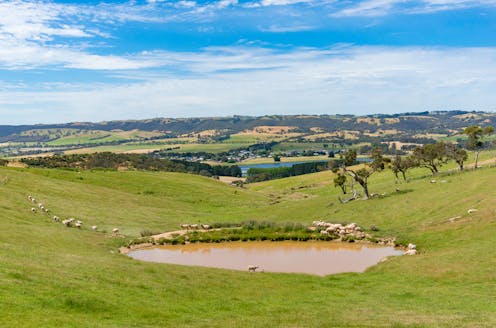
Farmers often pride themselves on their self-reliance. When you live far from the cities, it makes sense to do as much as possible yourself. Australia’s sheer size has meant many remote farms have long been off grid as it’s often simply too expensive to get a power connection. But for those still on the grid, there are now new options.
As solar gets cheaper, more and more farms are aiming to become self-reliant in power. But until now, getting fully off the grid has had a sticking point – solar intermittency. Solar power might be cheaper than ever, but if you don’t have storage or backup, you’re still reliant on the grid when the sun doesn’t shine.
Batteries are a compelling solution. But they might not offer a full day’s backup and come with concerns about fire risk and waste.
Generators offer reliable backup. But they too have downsides – they have to be resupplied and produce harmful emissions.
For farmers, there’s now another option: connect one of your dams to a river – or link two dams together – to create a small pumped hydro plant to store electricity from solar to use at night. The water in your dams could offer yet another form of self-reliance.
Our new research has identified over 30,000 rural sites where micro pumped hydro could work. A typical site could produce two kilowatts of power and store 30 kilowatt hours of energy – enough to run a typical home in South Australia for 40 hours.
Massive to micro? Yes, pumped hydro can work on farms
Pumped hydro is essentially turning hydroelectric power into a battery as well.
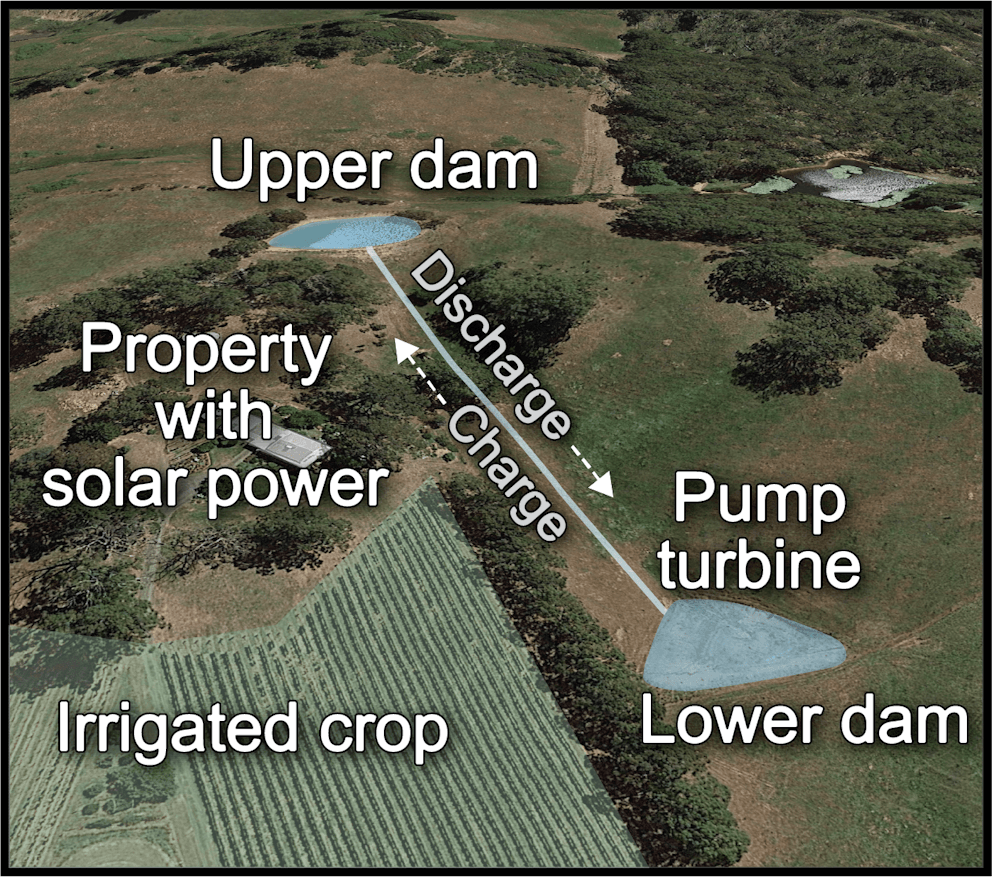
Take two reservoirs, where one is higher than the other. When you have extra solar power, you store it. How? By using the energy to pump water uphill to the top reservoir. When you need power later on, you release water down to the lower reservoir and produce electricity with a turbine.
At large scale, these plants are an established and efficient way to store energy, though they can suffer from cost blowouts, as in the Snowy 2.0 scheme. Queensland’s government is planning massive pumped hydro schemes to act as batteries.
Until recently, small-scale pumped hydro hasn’t made much economic sense.
But the steadily falling cost of solar means the numbers have changed. It’s now more cost effective to get larger arrays. And that opens up opportunities to find ways to store surplus electricity generated in daytime.
For farmers, another opportunity is the ability to use existing dams and reduce pumped hydro construction costs.
If it’s cheaper, it’s much more viable. Early research on solar-powered irrigation systems using pumped hydro suggests the payback period for this kind of energy storage could be up to four times shorter than for batteries.
What’s the catch? As you might have guessed, this solution depends on the size of existing farm dams and rivers, and topography of the land.
The steeper the slope between the two water bodies, the more useful the system will be as energy storage. To get the most out of these systems means finding the sites with the most potential value. And it’s likely the solution won’t work for farms on flat ground – you need a drop of at least 20 metres.
You’re probably wondering how this stacks up financially. We compared a micro pumped hydro system with 42.6kWh capacity and able to discharge 3.6kW to a commercial lithium-ion battery, the Tesla Powerwall, able to store 13.5kWh and discharge 5.0kW.
We found micro pumped hydro storage was 30% cheaper than a battery if locally generated solar was regularly needed overnight – such as to power a 24/7 irrigation system.
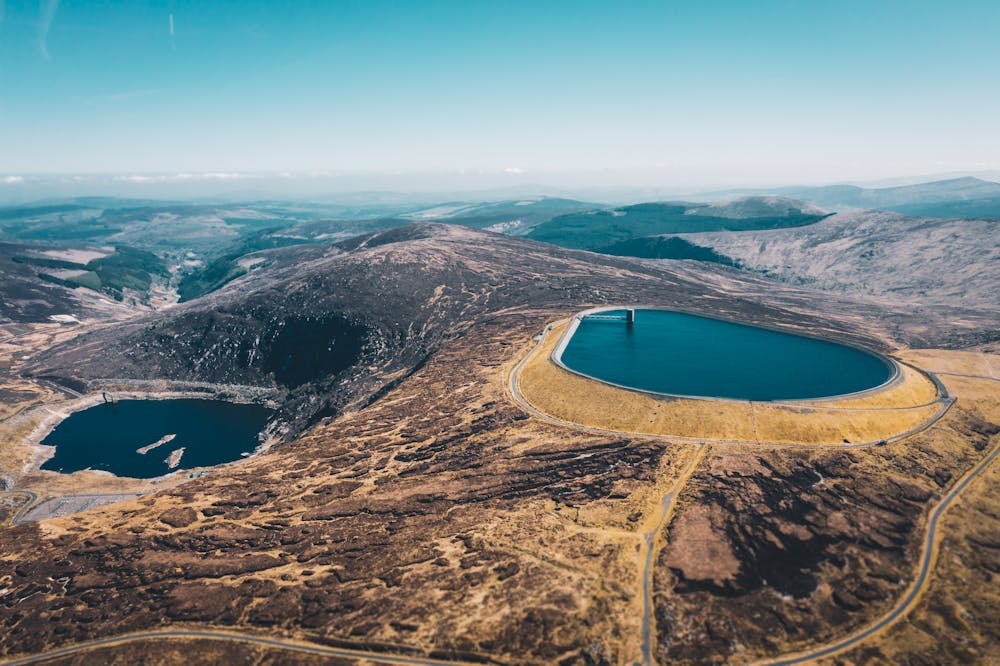 To date, most pumped hydro plants have been larger – but they can now work on a smaller scale too. This image shows Turlough Hill pumped hydro station in Ireland.
Shutterstock
To date, most pumped hydro plants have been larger – but they can now work on a smaller scale too. This image shows Turlough Hill pumped hydro station in Ireland.
Shutterstock
Australia has thousands of potential sites
Our research is the first continent-wide assessment of potential pumped hydro farm dam sites.
How did we figure out how many sites would suit micro pumped hydro? The magic of maths. We used algorithms from graph theory, as these are used to model networks, and set them loose on a 2021 survey of 1.7 million Australian farm dams. We didn’t want to raise people’s hopes if their dams weren’t suitable, so we set the minimum capacity at 24kWh (similar to a typical home battery after efficiency losses) and with a minimum slope of 17%, to make it price competitive with a battery.
That’s how we came up with our figure of 30,000 promising sites, including dam-to-dam and dam-to-river sites. Dam-to-river sites are a good option if you have a dam at a reasonable elevation above a river – you can pump water uphill from the river and return it later to make power.
What’s next for this approach?
You can make this approach more efficient by using new all-in-one hardware, such as combined turbines and water pumps, as well as integrating it with smart irrigation management.
To be clear, this solution won’t work for every landholder. If you’re farming wheat on flat plains, you’re unlikely to have the slope needed to make it work.
If you’re considering getting storage to go off grid, it’s essential to consider the pros and cons of each technology and how it would suit your local conditions.
For instance, if you’re in a drought-prone area with limited groundwater, it may not make sense to install pumped hydro. During a drought, you may well need the water on the farm. Our research assumes 70% of the water in the dams is available for use, which does not account for droughts or irrigation needs.
But for some landholders, this may be the missing part of the puzzle. Wind and solar installation is skyrocketing [around the world]. This, in turn, is boosting demand for cost-effective energy storage. Given there are 30,000 suitable farm dams in Australia alone, it’s likely this technology could play a valuable role around the world – especially for farmers in remote areas or where grid connection is too expensive.
Read more: Batteries of gravity and water: we found 1,500 new pumped hydro sites next to existing reservoirs
Authors: Nicholas Gilmore, Lecturer in Engineering Design, UNSW Sydney


















