

What causes lithium-ion battery fires? Why are they so intense? And how should they be fought? An expert explains
- Written by: Muhammad Rizwan Azhar, Lecturer, Edith Cowan University
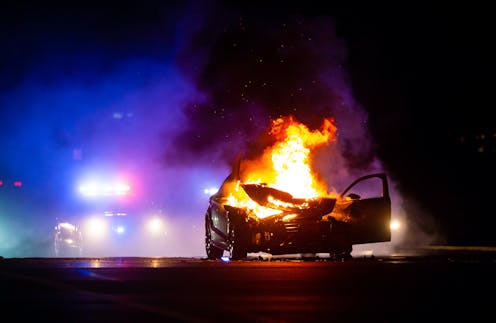
Picture this: you’re cruising down the Great Ocean Road in your brand new electric vehicle (EV), the ocean to your left and the wind in your hair. But what if I told you this idyllic drive could turn into a nightmare, with the faint smell of something burning?
This month we have had at least two large lithium-ion battery fires in Australia – one in the Sydney airport car park and another one more recently at the Bouldercombe battery storage site in Queensland.
When a lithium-ion battery fire breaks out, the damage can be extensive. These fires are not only intense, they are also long-lasting and potentially toxic.
What causes these fires?
Most electric vehicles humming along Australian roads are packed with lithium-ion batteries. They’re the same powerhouses that fuel our smartphones and laptops – celebrated for their ability to store heaps of energy in a small space.
The reality is that lithium-ion batteries in electric vehicles are very safe. In fact, from 2010 to June 2023, only four electric vehicle battery fires had been recorded in Australia. And a recent paper forecasts a possible total of around 900 EV fires from 2023 and 2050. This is, for all intents and purposes, a small amount.
Nonetheless, when EV batteries do overheat, they’re susceptible to something called “thermal runaway”. This chemical reaction can be triggered from faults in the battery – whether that’s an internal failure (such as an internal short circuit), or some kind of external damage. In extreme cases, it causes the battery to catch fire or explode.
The onset and intensification of lithium-ion battery fires can be traced to multiple causes, including user behaviour such as improper charging or physical damage.
Then there are even larger batteries, such as Megapacks, which are what recently caught fire at Bouldercombe. Megapacks are large lithium-based batteries, designed by Tesla. They are intended to function as energy storage and to help “stabilise the grid and prevent outages”.
The Megapack that caught fire on Tuesday is one of 40 lithium-ion Megapack 2.0 units on-site. A Megapack fire is daunting for obvious reasons. Megapacks have a capacity of 3 megawatt hours, which equals 3,000 kilowatts of electricity generated per hour.
It’s no surprise the Bouldercombe fire may be burning for several days.
What to do when a fire has started?
If a fire bursts out in an EV or battery storage facility, the first instinct may be to grab the nearest hose. However, using water on a lithium-ion battery fire could spell even greater disaster.
That’s because lithium-ion batteries have a rather unwelcome talent for chemical reactions when they come into contact with water. Instead of snuffing out the flames, water can actually fuel the fire and cause it to intensify. This is because the water’s reaction with lithium produces flammable hydrogen gas, adding more of a fire hazard to an already perilous situation.
While firefighters have used water in the past on lithium-battery fires (since water helps with cooling the battery itself), they have at times needed up to 40 times as much water as a normal car fire required.
It may often be safer to just let a lithium battery fire burn, as Tesla recommends in its Model 3 response guide:
Battery fires can take up to 24 hours to extinguish. Consider allowing the battery to burn while protecting exposures.
This would explain why Tesla advised authorities in Bouldercombe to not put out the blaze.
The risk from water doesn’t end there. Water also conducts electricity, which means spraying it on a battery fire could lead to electrical shocks or short-circuits – especially if the battery remains connected to a device, such as an electric vehicle.
The best way to put out these fires is to reach for a specialised fire extinguisher. Experts recommend using Class D fire extinguishers designed for lithium-metal fires, or dry chemical fire extinguishers that are appropriate for electrical fires.
These extinguishers contain substances – such as sodium chloride powder or pressurised argon – that can combat the challenges posed by lithium-ion batteries. Sodium chloride, commonly known as table salt, melts to form an oxygen-excluding crust over the fire. Similarly, argon is an inert and non-flammable gas, which can help put out fires by suffocating oxygen.
That brings us to the aftermath of the fire – and another often-overlooked hazard: toxic fumes.
When lithium-ion batteries catch fire in a car or at a storage site, they don’t just release smoke; they emit a cocktail of dangerous gases such as carbon monoxide, hydrogen fluoride and hydrogen chloride.
These fumes can be hazardous to your health, especially when inhaled in significant quantities. This is why these battery fires are a particular concern in confined spaces such as a garage, where noxious gases can accumulate quickly.
What to do if your car catches fire
Although EV fires are very rare, if you do own an EV (or plan to in the future), there are a few steps you can take to tip the scale in your favour.
First, get to know your EV inside and out. Familiarise yourself with its safety features. Does it have a functioning thermal management system to help keep the battery cool? What about sensors that could alert you to a problem before it turns into a crisis?
Secondly, be smart about how you charge your EV. Avoid using fast chargers as your go-to, because these can cause the battery to heat up more quickly. Overcharging your battery can also increase the risk of it lighting up.
If, despite your best efforts, you do find yourself head-to-head with a blaze, your first course of action should be to call emergency services for professional help.
Authors: Muhammad Rizwan Azhar, Lecturer, Edith Cowan University


















