

New Zealand’s carbon emissions are on the way down – thanks in part to policies now under threat
- Written by: Robert McLachlan, Professor in Applied Mathematics, Massey University
It may have been largely overlooked in the election debates, but New Zealand’s greenhouse gas emissions are finally on the way down.
Annual emissions of carbon dioxide from the burning of fossil fuels are the lowest since 1999 and the 12-month renewable share of electricity is back above 90% for the first time since 1981. The Ministry for the Environment has advised New Zealand is on track to meet the first (2022-2025) carbon budget.
All this can be attributed to a range of factors, including fossil gas running low, full hydro lakes, high petrol prices and working from home. But climate policies such as the Emissions Trading Scheme (NZ ETS), the clean car discount and the Climate Emergency Response Fund (CERF) have made a significant contribution to the turnaround.
Current decarbonisation policies have and will continue to deliver real emissions cuts, provided they remain in place.
It is therefore disconcerting that the National Party plans to take $2.3 billion from the CERF (almost two-thirds of the fund’s mid-2022 balance) to pay for tax cuts. The argument that individual households will use tax cuts to make their own decarbonisation decisions is unsupported by evidence and lacks credibility.
The Labour Party has also dipped into this fund, taking $236 million to pay for rebates for household installations of solar panels and batteries, and community energy schemes. These may produce some as yet unquantified emissions cuts.
Government funding is working
Allocations from the Government Investment in Decarbonising Industry (GIDI) fund to NZ Steel and Fonterra show direct and measurable avoidance of emissions. The installation of an electric furnace at NZ Steel to utilise scrap will save 1% (800,000 tonnes of CO₂-equivalent emissions, or tCO₂e) of New Zealand’s 2021 gross emissions. Support for Fonterra to convert coal-fired boilers at six plants to renewables will save 1.4% (1.1 MtCO₂e).
The Act Party has pledged to disestablish this fund.
The State Sector Decarbonisation Fund, valued at $215 million and used to reduce emissions in government organisations including hospitals and universities, is on track to deliver emissions savings of nearly a million tonnes over ten years (0.1% per year).
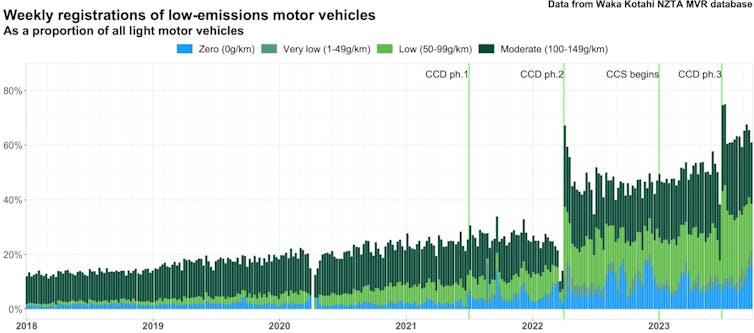
Since the introduction of the clean car discount in July 2021, sales of electric vehicles have quintupled and now have a 12% market share. The market share of all low-emission vehicles rose from 20% to 60%, easily surpassing emissions targets of the clean car standard which came into force this year.
While these rates of increase may look impressive, the actual number of EVs remains very low. Nonetheless, emissions cuts already run into hundreds of thousands of tonnes per year, a significant part of which is due to the clean car discount.
Need for more investment
New Zealand is not yet on track to meet its international pledge (known as Nationally Determined Contribution, or NDC, and covering all emissions from 2021 to 2030) or the second and third carbon budgets.
Many important policy matters are either unresolved or stuck in review: how to meet the NDC, whether and how to prioritise gross emissions reductions over tree planting, how to reduce agricultural emissions.
Read more: The battle for NZ’s farming heartland: Groundswell, ACT and the changing face of rural politics
In its pre-election fiscal and economic update, Treasury warned of the risks these uncertainties entail:
The actual cost of achieving emissions reduction targets and addressing risks from climate change will likely exceed the overall size of the Climate Emergency Response Fund.
Lack of an integrated plan
In the year to June 2023, oil was responsible for nearly three-quarters of fossil fuel emissions. Two-thirds of this came from transport. But transport emissions are supposed to fall 41% by 2035 – a massive task that will involve pressing hard on all three parts of the avoid/shift/improve transport framework.
Unfortunately, the framework is looking shaky.
Read more: New Zealand must get over its obsession with big cars and go smaller or electric to cut emissions
Regarding avoidance, even the draft local plans for avoiding car travel are not yet ready. Labour and National are competing as to who can offer the most extravagant motorway plans, known to encourage driving.
When it comes to shifting modes of transport, there has been some expansion of urban cycleways. But Auckland’s city rail link will not open until 2026. And a great deal has to happen to meet the Climate Change Commission’s draft advice to “complete cycleway networks by 2030 and take steps to complete rapid transport networks by 2035”.
The National Party plans to cut public transport funding and increase fares.
As for improvement, the National Party plans to cancel the clean car discount and weaken the clean car standard. The current plan requires 30% of the entire light-vehicle fleet to be zero emission by 2035 (currently at 1.4%), which is ambitious but doable under the existing framework.
New Zealand still doesn’t have any kind of fuel-efficiency standard or coordinated policy on heavy-vehicle emissions.
Renewable energy
New Zealand’s renewable share for all energy (not just electricity) has been stuck below 30% for decades. It is supposed to reach 50% by 2035 and then continue to increase until use of fossil fuels is almost entirely eliminated.
New Zealand has untapped resources of renewable energy, wind, solar and geothermal. An even bigger supply of offshore wind is now being explored.
Read more: The untapped power of ocean winds – why New Zealand is looking offshore for future renewable energy
At the recent New Zealand wind energy conference, many massive possible projects were mooted. But delegates said they needed to be sure the electricity demand would be there before making final investment decisions.
The fate of the Climate Emergency Response Fund is of great importance, as international evidence shows:
It is the use of revenues from carbon prices, not the carbon prices themselves, which trigger change.
Depleting this fund will slow electrification and demand for renewable energy.
New Zealand’s current emissions reduction plan, which runs to 2025, is a package. Its parts support each other and attempt to balance many people’s needs. If one part is weakened, the difference has to be made up elsewhere.
This article was prepared with the assistance of Paul Callister.
Authors: Robert McLachlan, Professor in Applied Mathematics, Massey University


















