

Google AI


Modern Australian

We built a 'brain' from tiny silver wires. It learns in real time, more efficiently than computer-based AI

  • Written by: Zdenka Kuncic, Professor of Physics, University of Sydney
We built a 'brain' from tiny silver wires. It learns in real time, more efficiently than computer-based AI

The world is infatuated with artificial intelligence (AI), and for good reason. AI systems can process vast quantities of data in a seemingly superhuman way.

However, current AI systems rely on computers running complex algorithms based on artificial neural networks. These use huge amounts of energy, and use even more energy if you are trying to work with data that changes in real time.

We are working on a completely new approach to “machine intelligence”. Instead of using artificial neural network software, we have developed a physical neural network in hardware that operates much more efficiently.

Our neural networks, made from silver nanowires, can learn on the fly to recognise handwritten numbers and memorise strings of digits. Our results are published in a new paper in Nature Communications, conducted with colleagues from the University of Sydney and the University of California, Los Angeles.

A random network of tiny wires

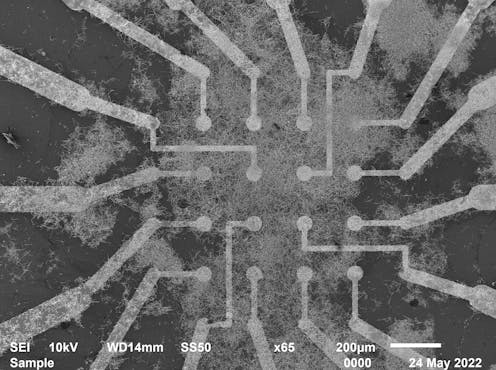
Using nanotechnology, we made networks of silver nanowires about one thousandth the width of a human hair. These nanowires naturally form a random network, much like the pile of sticks in a game of pick-up sticks.

The nanowires’ network structure looks a lot like the network of neurons in our brains. Our research is part of a field called neuromorphic computing, which aims to emulate the brain-like functionality of neurons and synapses in hardware.

A microscope photo showing a messy web of thin grey lines against a black background.
Each nanowire is around one thousandth the width of a human hair, and together they form a random network that behaves much like the web of neurons in our brains. Zhu et al. / Nature Communications

Our nanowire networks display brain-like behaviours in response to electrical signals. External electrical signals cause changes in how electricity is transmitted at the points where nanowires intersect, which is similar to how biological synapses work.

There can be tens of thousands of synapse-like intersections in a typical nanowire network, which means the network can efficiently process and transmit information carried by electrical signals.

Learning and adapting in real time

In our study, we show that because nanowire networks can respond to signals that change in time, they can be used for online machine learning.

In conventional machine learning, data is fed into the system and processed in batches. In the online learning approach, we can introduce data to the system as a continuous stream in time.

With each new piece of data, the system learns and adapts in real time. It demonstrates “on the fly” learning, which we humans are good at but current AI systems are not.

Read more: Networks of silver nanowires seem to learn and remember, much like our brains

The online learning approach enabled by our nanowire network is more efficient than conventional batch-based learning in AI applications.

In batch learning, a significant amount of memory is needed to process large datasets, and the system often needs to go through the same data multiple times to learn. This not only demands high computational resources but also consumes more energy overall.

Our online approach requires less memory as data is processed continuously. Moreover, our network learns from each data sample only once, significantly reducing energy use and making the process highly efficient.

Recognising and remembering numbers

We tested the nanowire network with a benchmark image recognition task using the MNIST dataset of handwritten digits.

The greyscale pixel values in the images were converted to electrical signals and fed into the network. After each digit sample, the network learned and refined its ability to recognise the patterns, displaying real-time learning.
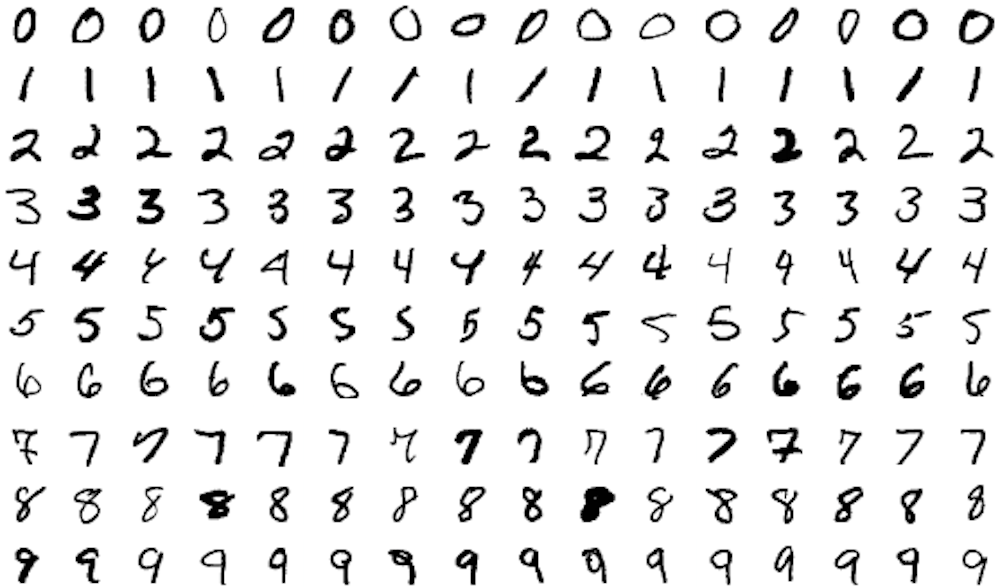
A grid of handwritten digits The nanowire network learned to recognise handwritten numbers, a common benchmark for machine learning systems. NIST / Wikimedia, CC BY-SA

Using the same learning method, we also tested the nanowire network with a memory task involving patterns of digits, much like the process of remembering a phone number. The network demonstrated an ability to remember previous digits in the pattern.

Overall, these tasks demonstrate the network’s potential for emulating brain-like learning and memory. Our work has so far only scratched the surface of what neuromorphic nanowire networks can do.

Authors: Zdenka Kuncic, Professor of Physics, University of Sydney

Read more https://theconversation.com/we-built-a-brain-from-tiny-silver-wires-it-learns-in-real-time-more-efficiently-than-computer-based-ai-216730

Pool and Deck Design: How to Plan the Perfect Outdoor Living Space for Your Sydney Home

For many Australians, the backyard is where life happens. Summer barbecues, weekend swims and long evenings outdoors are all part of the lifestyle, ...

Is Solar Pool Heating Worth It? What Sydney Homeowners Should Know

There's nothing quite like a backyard pool on a hot Sydney day. But once autumn rolls in, many pools sit unused for months because the water is simp...

Planning a Luxury House Move: A Week-by-Week Timeline for Prestige Sydney Homes

Selling or buying a prestige home is a major milestone. Whether it's a waterfront residence in Birchgrove, a grand Federation home in Haberfield or ...

Downsizing or Upgrading Your Caravan? Here's How to Sell It Without the Hassle

Selling a caravan can feel like a major task, especially when you are unsure about its value, paperwork, or how to find a buyer. Whether you are dow...

The Best Overseas Adventure Holidays for Australians Who Love the Outdoors

Australia offers no shortage of incredible outdoor experiences, but sometimes the best way to satisfy your sense of adventure is to head overseas. A...

Cape Town Wine Shuttle: Winelands Tasting & Tours

Embark on an unforgettable journey through the picturesque Cape Winelands, where world-class wines and breathtaking scenery await. Our Cape Town Win...

Why Giant Rats Tail Grass Keeps Coming Back After Spraying

Giant Rats Tail Grass (GRT) is one of the most frustrating pasture weeds for farmers and lifestyle property owners. You spray an infested area, see th...

When Custom Cardboard Boxes Make Sense for Your Business

Custom cardboard boxes can be useful when a standard carton does not fit a product, packing method or presentation requirement particularly well. A ...

Virtual Livestock Fencing and GPS Tracking: Improving Visibility Across Cattle Properties

What Virtual Livestock Fencing Means for Modern Cattle Management Managing cattle across extensive properties requires more than knowing where anim...

Sydney Pawnbrokers Explained: How Hocking Your Car Actually Works

Sometimes you need cash, and you need it soon. If you own a car, you may already have a way to get it. That's what people mean when they say they've...

Moving Interstate from the Gold Coast to Brisbane (or Back)? What Removalists Wish You Knew First

Have you talked to anyone who’s done the move? They say the same thing: the drive up the M1 is the easy part. It's everything around it that catches...

Why the Spring School Holidays Are a Great Time to Visit Coffs Harbour

The spring school holidays are a good time to spend a few days on the Coffs Coast. The weather is starting to warm up, there is plenty to do outdoor...

What to Do When an Older Car Is No Longer Worth Keeping in Melbourne

Ever looked at another repair quote and wondered whether your old car is still worth the trouble? It is a common turning point for Melbourne motoris...

Your Baby's First Year: A Local Guide to Feeding, Sleep, and When to Get Extra Support

Ask ten parents in a Brisbane mothers' group how their baby is feeding or sleeping, and expect ten different answers.  Someone's baby sleeps throug...

Kitchen and Laundry Makeover Ideas That Don't Require a Full Renovation

Full kitchen renos are expensive — and most people don't actually need one.  They need the kitchen to stop looking like it's stuck in 2009, or they...

How Technology Is Reshaping the Modern Australian Commercial Kitchen

The commercial kitchen has always been shaped by technology. Refrigeration changed how ingredients could be stored, modern ventilation transformed k...

The Number on a Roller Blind Fabric That Nobody Explains

Somewhere in the fabric book, next to the colour name, there is a percentage. Three per cent. Five per cent. Ten per cent. Nobody explains it, most c...

What’s Trending in Men’s Jewellery This Father’s Day!

Finding a Father’s Day gift that feels personal, stylish and genuinely wearable is not always easy. While socks and novelty mugs have traditionally ...
















