

a new Aussie post-COVID Theatre of the Absurd
- Written by: Leah Mercer, Associate Professor of Theatre Arts, Curtin University
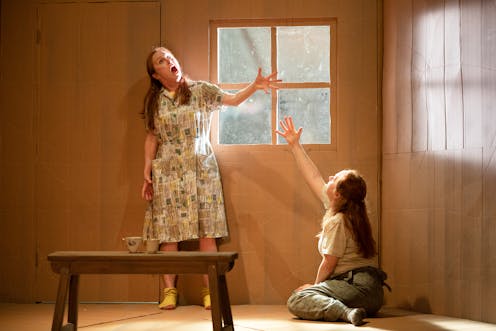
Theatre is littered with sister double acts: Antigone and Ismene, Kate and Bianca, Blanche and Stella, Fleabag and Claire. The shared history of sisters delivers inbuilt emotional stakes and lots of baggage. The doubling of experience brings both love and rivalry, the joys of being known and the horrors of being trapped by the reflection of the other. Looking like not-quite twins, real-life sisters Hayley and Mandy McElhinney are the dirty birds of the title, in the world premiere of a co-written work in which they play reclusive sisters.
With a broad resume of work on stage and screen, Dirty Birds is their debut play and the first time the McElhinney sisters have shared the stage. It wasn’t until COVID shut us all down that they found the time and space (on Zoom) to collaborate on the script, later developed with director Kate Champion.
Dirty Birds is indebted to Theatre of the Absurd. Writing in the 1960s, Martin Esslin brought an otherwise disconnected group of playwrights like Beckett, Adamov, Ionesco and Genet together under the umbrella term “Absurd”, coined via Albert Camus’ 1942 essay The Myth of Sisyphus.
For Esslin, such theatre “strives to express its sense of the senselessness of the human condition and the inadequacy of the rational approach”. Emerging as it did after the horrors of the second world war, absurdism makes sense in a post-COVID work such as Dirty Birds.
Read more: Tragedy is dead in Australia, long live laughter and weather reports
Are we inside or outside?
At first the set (designed by Bruce McKinven) seems to be a single, nondescript brown house interior. But over the course of the play, with the addition of Paul Jackson’s lighting, a multitude of locational possibilities appear: an abandoned house; a submerged shipwreck; a cubby house; a cathedral; a doll house; a paper house; a box.
Matching the experience of the sisters, the longer the audience spends in the space, what seemed like the inside becomes the outside, until they are interchangeable. The interplay of McKinven and Jackson’s images do a lot of the narrative heavy lifting in terms of the structure, build and cumulative emphasis of the performance.
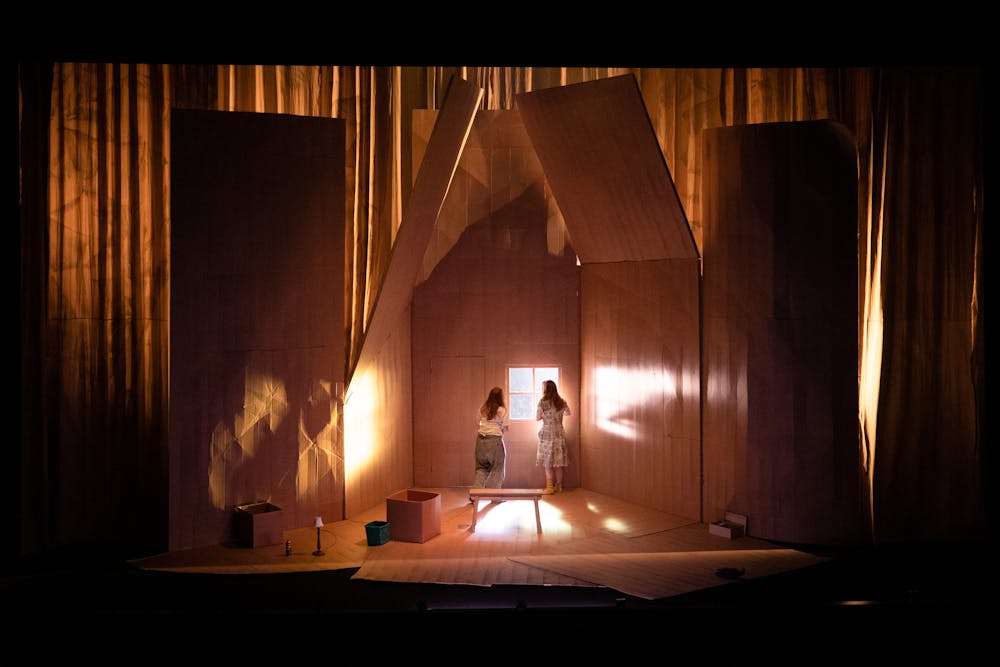
There is a sculptural quality to Champion’s use of static imagery in recurring sequences of one sister waiting for the other. Flickering through images like a life-sized flipbook, the sisters are in a constant state of waiting – perhaps the most well-known absurdist trope.
The sense of time passing could be minutes, years or forever. And yet, despite this stasis, as layers of costume are shed, there is a build from winter to spring, from dormant to active, until the expanse of time becomes today.
You could be anyone else
We are introduced to the sisters via their multiple alter egos as they pretend to be anyone other than themselves in a series of games and rituals that keep them separated from the outside world and embedded in their shared, internal world: both an escape and a trap.
In what could be a continuation of childhood games, the sisters play with tropes of Irish storytelling (tied to the McElhinneys’ own Irish heritage), 1950s American sitcoms and moments of camp horror.
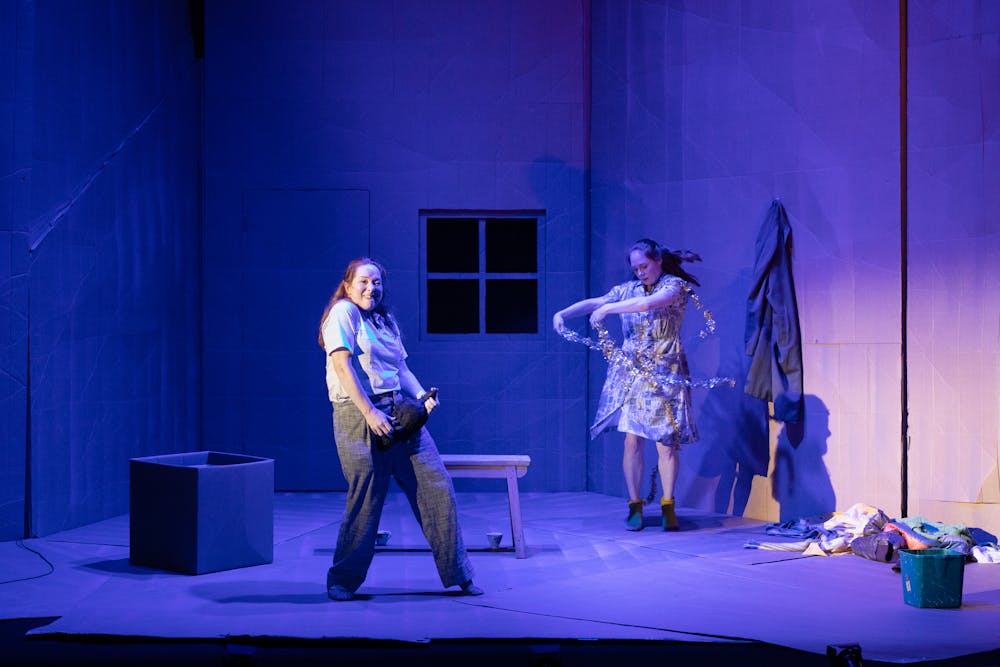 A childhood game – or an act of camp horror?
Daniel J Grant/BSSTC
A childhood game – or an act of camp horror?
Daniel J Grant/BSSTC
There’s a tonal touch of the psychological rivalry of What Ever Happened to Baby Jane? – another story of sisters – of one sister being held captive by the other.
Having cobbled together their own personal mythology of stories, the sisters are pulled between the games and the outside world, where everything’s big except the conversations (which are small). There are glimpses of it via trips to the box (aka the letterbox) and the mounting foreclosure notices that culminate in a stunning visual cavalcade as the outside world awakens.
Unlike Beckett or Ionesco (the most famous of Esslin’s absurdists) Dirty Birds often breaks the conceit when one of the sisters (usually Hayley) brings them crashing into their present by referring to their predicament. The rules are also broken non-verbally when the other sister breaks the confinement of the house to appear at the edges.
Read more: Guide to the Classics: Samuel Beckett’s Waiting for Godot, a tragicomedy for our times
Well-worn relationships
The McElhinneys have written themselves a spectacular showcase. The meta-quality of them as real sisters is unavoidable, and their compelling biological chemistry is on full display. Women’s bodies are central in this contemporary rendering of the Absurd. The stink of embodiment is tangible, comforting and symptomatic; it speaks to the joyous freedom as well as the suffocating snare of secretive, sisterly intimacy.
There are also moments of exquisite physical comedy emerging from the timing and repetition of a well-worn relationship.
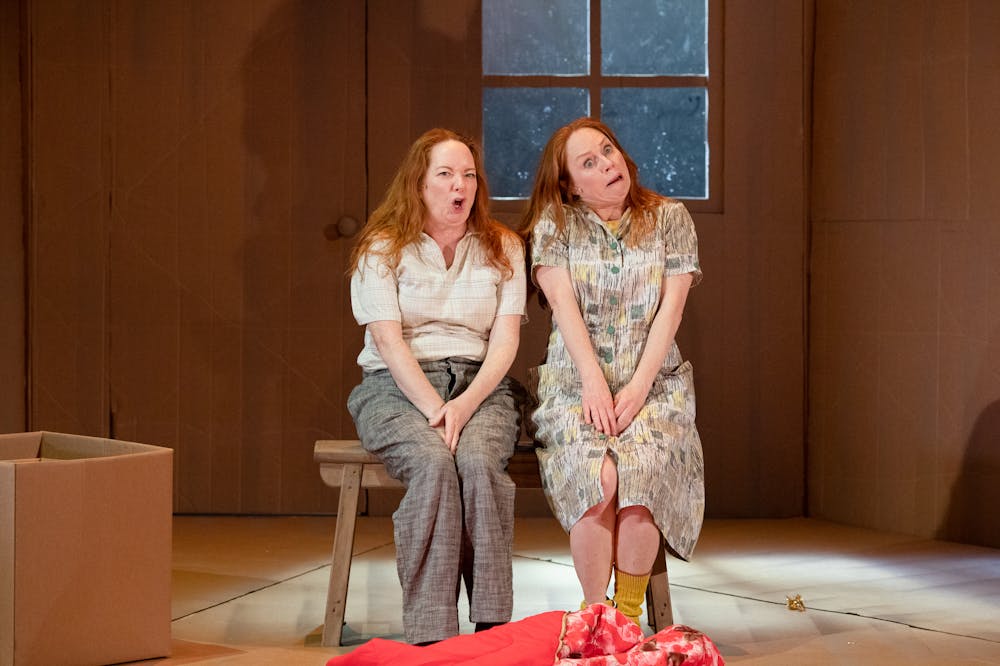 The biological chemistry is palpable.
Daniel J Grant/BSSTC
The biological chemistry is palpable.
Daniel J Grant/BSSTC
Esslin refuted the common misconception that Theatre of the Absurd should necessarily be despair-filled and meaningless. Rather, he saw these plays as an “endeavour to come to terms with the world”, to “face up to the human condition as it really is” and free us “from illusions that are bound to cause constant maladjustment and disappointment”.
Or, as theatre critic Michael Y. Bennett argues, absurdist plays are “ethical parables that force the audience to make life meaningful”.
As the sisters grapple with themselves and each other, between taking personal responsibility or being overwhelmed by despair, what perseveres is the poignancy of their connection and in the play’s final moments the endurance of hope.
Dirty Birds, from Black Swan State Theatre Company, is at the Heath Ledger Theatre, Perth, until December 10.
Authors: Leah Mercer, Associate Professor of Theatre Arts, Curtin University


















