

The government's Murray-Darling bill is a step forward, but still not enough
- Written by: Celine Steinfeld, Director, Wentworth Group of Concerned Scientists & Adjunct Lecturer, UNSW Sydney
This week, the Senate is debating changes to Australia’s most important water laws. These changes seek to rescue the ailing A$13 billion Murray-Darling Basin Plan to improve the health of our nation’s largest river system.
The Water Amendment (Restoring Our Rivers) Bill 2023 is a crucial step forward. It proposes to lift the Coalition-era cap on water buybacks, allowing the federal government to recover more water for the environment through the voluntary purchase of water entitlements from irrigators.
It also proposes to extend the deadlines for the many beleaguered water-offsetting projects put forward by state governments.
Through the Wentworth Group of Concerned Scientists – an independent group working to secure the long-term health of Australia’s land, water and biodiversity – we strive to restore river health for the basin’s communities, industries and ecosystems. Here we ask whether the bill can fulfil the Albanese government’s 2022 election promise to deliver the plan.
Securing support of the Greens and crossbenchers
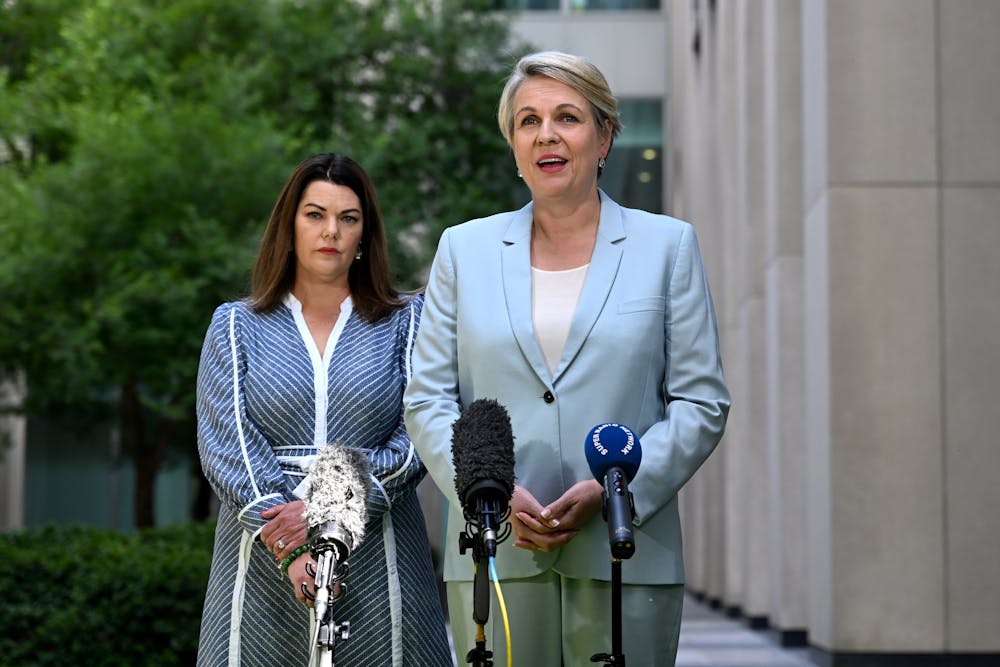
The bill is central to Prime Minister Anthony Albanese’s five-point election promise to deliver the plan, and Federal Water Minister Tanya Plibersek’s subsequent commitment to implement the Murray-Darling Basin Plan in full.
With the Coalition voting against the bill in the lower house, the federal government secured the support of the Greens with measures that considerably strengthen the bill.
It is now up to key crossbench Senators to secure passage through parliament. But they have said the bill doesn’t go far enough, citing serious concerns it excludes First Nations water rights and interests and ignores climate change.
The federal government must pass the bill in the next two sitting weeks to avoid triggering a statutory deadline, after which unfinished water offset projects would be cancelled and water recovery would be required instead.
Read more: Labor’s new Murray-Darling Basin Plan deal entrenches water injustice for First Nations
Water Act and Basin Plan: where are we at?
Born of the crisis of the Millennium drought, the Water Act 2007 was announced by the Howard government to “once and for all” address over-allocation of water in the Murray-Darling Basin.
Five years later, the Basin Plan 2012 was established to recover 3,200 billion litres of water for the environment from other uses, or to implement projects that deliver “equivalent” outcomes. That includes securing 450 billion litres for the health of the River Murray, Coorong and Lower Lakes.
But this volume of water fell substantially short of the Murray-Darling Basin Authority’s best estimate of what was needed to “ensure the return to environmentally sustainable levels of extraction”, and did not take climate change into account.
All water recovery targets were expected to be met by June 2024. But while some progress has been made, water recovery has almost stalled in the past decade.
Only 26 billion litres have been recovered of the crucial 450 billion litres.
Of the 36 water offset projects meant to be operational by 2024, 16 are not likely to be complete, contributing to a likely shortfall of between 190 billion and 315 billion litres.
No onground work has commenced to alleviate flow “constraints”, leaving thousands of hectares of floodplain forests in the River Murray disconnected from their channels and at risk of drying out and dying.
The Water Act and the plan do not provide for First Nations people’s water rights and interests. And they fail to deal with climate change.
Reforms to both the legislation and the plan are desperately needed to address these major shortcomings.
Voluntary buybacks are necessary
The new bill represents a clear step towards the first of the Albanese government’s five-point promises to “deliver on water commitments” by removing the cap on buybacks.
Without buybacks, it is unlikely the federal government will be able to deliver the 3,200 billion-litre plan in full.
While the Senate Committee acknowledged the impacts of buybacks on communities, the committee found some concerns were “overinflated and not supported by the high-quality evidence base”, referring to a literature review.
The Wentworth Group has long argued for funding to establish a regional transition fund to support impacted communities through these reforms. As part of these reforms, “significant transitional assistance” was announced by Plibersek.
Statutory guarantees are needed
The bill requires additional measures to guarantee the unfinished business to which parliament agreed more than a decade ago:
a legally binding 450 billion litre water recovery target. The public needs a legal recourse if governments fail to deliver the full volume. We understand the intent of today’s announcement is to make the target a statutory requirement, in line with other water recovery targets under the plan.
improved integrity of the water offset method and withdrawal of unviable water offset projects The agreement reached today allows the Commonwealth to remove non-viable projects. Significant flaws in the method used to calculate water offsets still need to be addressed.
milestones in the bill’s proposed “constraints roadmap” which specify targets linked to incentive payments.
transparency and accountability measures to restore public confidence in water reform, such as whole-of-basin hydrological modelling, water accounting and auditing, and validation of annual permitted take models.
Several of these measures were announced today. We’re yet to see details but the high-level agreement is encouraging.
Urgent reforms can’t wait to 2027
Australia’s water laws have failed to address the rights and interests of Indigenous people. Indigenous peoples own a mere 0.2% of surface water entitlements in the Murray-Darling Basin.
In 2022, the Albanese government committed to “increasing First Nations ownership of water entitlements and participation in decision making”.
The Senate Committee found “overwhelming support […] that significantly more needs to be done to incorporate the values and interests of First Nations people in Basin Plan management”.
Many solutions can be readily incorporated into the bill. It should be amended so the legislation is consistent with the United Nations Declaration on the Rights of Indigenous Peoples, and recommendations of Indigenous organisations, such as the Murray-Lower Darling Rivers Indigenous Nations.
The $100 million announced today for the Aboriginal Water Entitlement Program is welcome, although much was already committed and the remainder won’t make up for the lost value given entitlement prices, according to analysis commissioned by the Murray-Lower Darling Rivers Indigenous Nations.
The bill also needs to provide greater clarity for basin communities on how climate change will be incorporated into the Basin Plan review, and strategies for adapting to climate change. This cannot wait until 2027 – communities need to prepare now for their future.
Authors: Celine Steinfeld, Director, Wentworth Group of Concerned Scientists & Adjunct Lecturer, UNSW Sydney


















