

An inside look at the dangerous, painstaking work of collecting evidence of suspected war crimes in Ukraine
- Written by Olivera Simic, Associate Professor, Griffith University
In a village in the Chernihiv region of northern Ukraine, activists documenting evidence of potential war crimes in Russia’s invasion of Ukraine last year interviewed a witness whose relative went missing during the early days of the war. The relative’s phone had ended up in the hands of the Russian military, who forgot to deactivate the owner’s Google Photos account.
Russian soldiers then used the phone to take photos of their weapons and equipment, the belongings of Ukrainian civilians that had likely been stolen, and Russian military positions in the area. These were then uploaded to the phone owner’s cloud storage, allowing the Ukrainian war crimes trackers to access them.
With the assistance of their collaborators and specialised open-source intelligence tools, the activists managed to identify more than 20 Russian soldiers – their surnames, positions, ranks, military units and even mobile phone numbers.
This information was then passed to Ukrainian law enforcement officials for possible further investigation.
These activists work for the Educational Human Rights House Chernihiv (EHRHC), a non-governmental human rights organisation. In March 2022, a month after the Russian invasion, the group became a part of two coalitions with significant experience documenting suspected war crimes and human rights violations committed in Ukraine since the Russian annexation of Crimea in 2014.
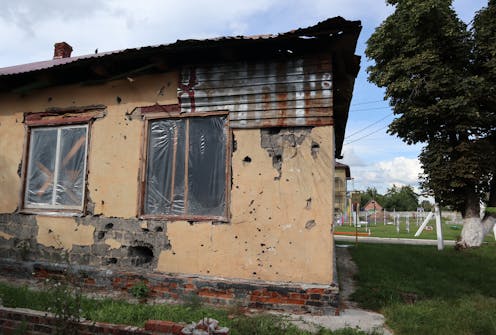
Their main task has centred on collecting and documenting evidence of attacks and other suspected crimes on Ukrainian educational facilities. Their work is dangerous – even life-threatening – as these activists must visit areas near the front lines that are exposed to daily shelling and littered with landmines and missile debris.
So far, the activists have organised more than 60 field missions and documented more than 3,000 incidents involving attacks on educational facilities.
As of this month, nearly 3,800 educational institutions across Ukraine have been partially destroyed or severely damaged from bombing and shelling, with another 365 destroyed completely, according to Ukraine’s Ministry of Education.
How war crimes evidence is collected
As part of our research into the human cost of war and grassroots activism in Ukraine, we have been interviewing activists and organisers from EHRHC to learn about their work documenting suspected war crimes.
The organisation has two main goals. First, it wants to help hold suspected perpetrators of crimes to account by passing evidence to law enforcement agencies. It also wants to preserve people’s memories and experiences during the war for future generations.
Its recruits come from a variety of backgrounds – some have worked for police, others in education. And they are trained from the ground up, as most have never done this kind of work before.
Groups of six are typically sent out on missions to gather evidence and document suspected attacks. This work typically involves recording video and audio testimonies of witnesses with informed consent. These can include school administrators, teachers, technicians, parents and neighbours.
One of the first things the activists try to establish is whether the Russian soldiers involved in an attack discussed their unit affiliation or had any special insignia on their uniforms. Sometimes, soldiers accidentally leave behind military documents or other items, making it possible to identify their unit.
The activists also try to determine the nature of the attack, the type of weapon used, and whether the school was a military target due to the presence of soldiers or concealed weapons used for military purposes.
In addition, the teams sometimes gather physical evidence. This might include taking videos or photos of damage to facilities or recording craters from rockets or holes in buildings and fences. Usually this happens after Ukrainian soldiers or police have inspected a site due to the danger of unexploded debris.
What happens with the information next?
When activists return from the field, they transcribe their testimonies and write analyses of the suspected war crimes they believe occurred, in accordance with international humanitarian law.
As Serhii Burov, the head of the EHRHC, explained:
Schools and educational institutions receive special protection under international humanitarian law. These are treated as special civilian objects, together with the medical facilities. This is what makes them distinctive from other civilian objects.
According to the laws of war, schools and other educational facilities are protected from attack unless they become legitimate military targets. However, if a school is being used for a military purpose – such as a barracks for soldiers – then it may no longer be protected from attack.
The evidence collected by activists is passed to Ukrainian law enforcement agencies, who will decide whether to pursue further investigations. Some cases may go nowhere, as many agencies lack the capacity to do this work.
However, the EHRHC is often approached by foreign legal experts who can use the principle of universal jurisdiction to launch war crimes investigations in their countries. Lithuanian prosecutors, for instance, have identified 90 victims of war crimes in their investigations thus far.
The evidence collected by EHRHC is also shared with their partners in the two larger Ukrainian justice coalitions, which have connections with the International Criminal Court and other institutions involved in investigating war crimes.
As Yaroslav Kyryienko, manager of the EHRHC documentation program, told us:
At the beginning of our documentation efforts, we were more focused on international institutions […] as we believed it was the most effective mechanism for bringing war criminals to justice. However, most civil society organisations in Ukraine have now come to realise that the most promising approach is to cooperate with national law enforcement agencies, as they will bear the primary responsibility for prosecuting war crimes.
‘All of this is for the future’
Even after the EHRHC trains its recruits how to document attacks, they still have to deal with the psychological part of the job, which can take a toll.
They also encounter witnesses who do not want to speak with them. People may be afraid of condemnation from fellow villagers. Or they might be wary of communicating with the police because they do not believe in the possibility of holding suspected Russian perpetrators to account. There is also a lack of trust in civil society organisations and their ability to bring justice to victims.
Many witnesses may also be in a state of shock, making it difficult to share their stories. As Burov told us:
The most significant challenge for me personally is communicating with people who have experienced trauma or witnessed traumatic events, and the risk of re-traumatising them. Care must be taken in these situations.
We also strive to protect ourselves because, as interviewers, we can become traumatised when talking to witnesses.
The other main challenge is the lack an immediate, tangible result for the team. Kyryienko says:
Knowing that the war criminals we have identified are being investigated by law enforcement agencies, punished or included in sanctions lists, or will be in the near future, keeps us motivated to continue our work.
All of this is for the future. Preserving the history of the war is about the future. Bringing justice is about the future.
Authors: Olivera Simic, Associate Professor, Griffith University

















