

What is the government's preventative detention bill? Here's how the laws will work and what they mean for Australia's detention system
- Written by: Michelle Peterie, Research Fellow, University of Sydney
After a week of non-stop headlines, the government’s preventative detention legislation passed the lower house, just in time for the end of the sitting year.
The new laws will allow former immigration detainees to be re-detained if they are judged to pose a high risk of committing serious violent or sexual crime.
The legislation comes after a 20-year legal precedent was overturned in November, when the High Court found the government could not detain people indefinitely – regardless of whether they had a criminal history.
The High Court’s decision was celebrated by human rights organisations and some legal scholars. It was seen as a rare opportunity to reshape Australia’s immigration detention policies in line with international law, the constitutional separation of powers, and principles of procedural justice and proportionality.
Yet the opportunity for much-needed reform has been frustrated by political point-scoring. The opposition and tabloid media have stirred up moral panic about the release of “hardened criminals”. Anxious to avoid accusations of being “soft”, the government has adopted the same discourse.
Both the government and opposition agree it is necessary to put “dangerous” people back behind bars to protect the community. In a clear break from parliamentary process, the vote on the legislation was scheduled for a non-sitting day, giving parliamentarians little opportunity to scrutinise or debate the legislation.
So what do these laws actually do, what do they mean for those most affected by them, and what is being lost in the current debate?
Read more: View from The Hill: government's announcement tsunami overshadowed by crisis over ex-detainees
What are preventative detention laws?
The new laws will allow the immigration minister (currently Andrew Giles) to apply to a court to re-detain people who have been released from immigration detention.
For an application to be successful, two conditions must be met.
First, the person must have been convicted of a crime (either in Australia or overseas) that carries a sentence of at least seven years’ imprisonment.

Second, the court must agree the individual poses “an unacceptable risk of committing a serious violent or sexual offence”, and that there is “no less restrictive measure available” to keep the community safe.
The involvement of the courts in making these decisions is a welcome safeguard in the context of a detention system in which people are routinely incarcerated for years or even decades without court oversight. The minister’s previous “god-like powers” in this area have been widely criticised.
Yet the human rights implications of detaining people who have already served their time are significant. Re-detention is likely to be experienced as a secondary punishment, which is contrary to principles of proportionality and procedural fairness.
It is also notable that these laws only apply to people who are not Australian citizens.
Australians with the same criminal histories and risk profiles will not be subject to preventative detention under this legislation. This raises concerns about the laws’ validity, with some suggesting the targeted nature of the legislation may leave it vulnerable to a High Court challenge.
Read more: High Court reasons on immigration ruling pave way for further legislation
Why were these laws brought in?
On November 8, the High Court of Australia ruled unanimously that if there is no real prospect of a person being deported in the forseeable future, it is unlawful for the government to detain them indefinitely.
The case was brought by a Rohingya man, known as NZYQ, who was no longer eligible for an Australian visa after being convicted of a sexual crime. As he’s a member of a persecuted minority, he could not be deported back to Myanmar.
With no visa and no country willing to accept him, he had been moved into indefinite immigration detention after completing his prison sentence in 2018.
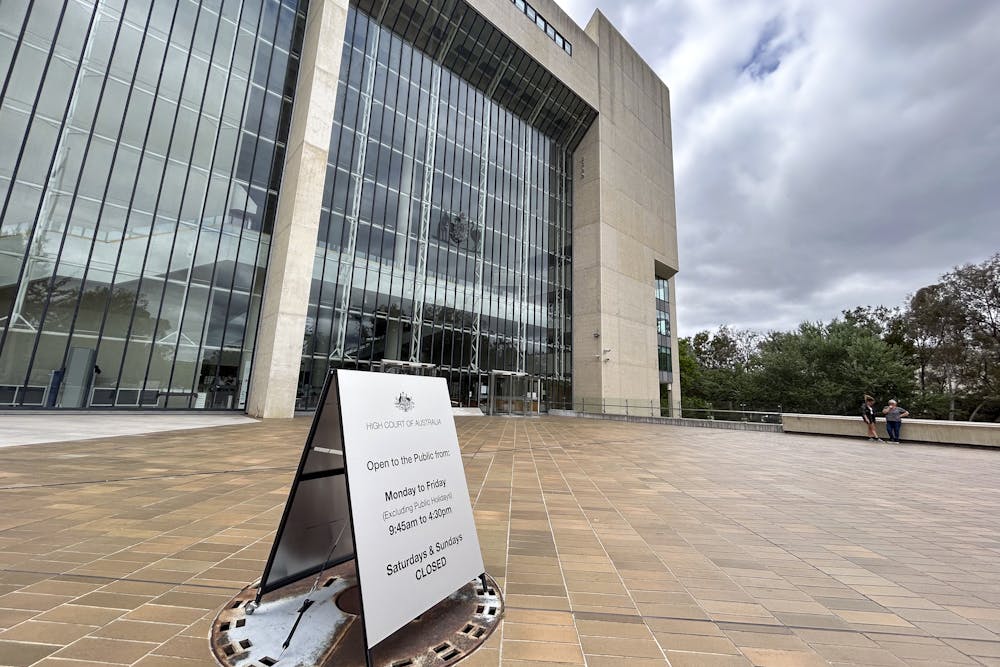 The High Court ruling on November 8 triggered the release of more than 140 people from detention.
Rod McGuirk/AAP
The High Court ruling on November 8 triggered the release of more than 140 people from detention.
Rod McGuirk/AAP
The court’s decision triggered the release of more than 140 people, four of whom have since been arrested for various alleged crimes.
People with no criminal history – including a man who had spent more than a decade in detention after coming to Australia in search of asylum – were also among those released.
The government has already imposed strict conditions on the freed individuals, including ankle bracelets and curfews.
Read more: The High Court has decided indefinite detention is unlawful. What happens now?
What is being missed in the current debate?
Prior to the High Court’s decision, refugees, people seeking asylum, stateless people and other non-citizens without a valid visa were regularly subject to indefinite mandatory detention. As of August 2023, Australia held 1,056 people in immigration detention; the average duration of detention was 708 days.
Unlike prisons, immigration detention centres are officially administrative and not for punishment. That is, people are not held in these facilities as part of a criminal sentence, but to facilitate health, security and identity checks, and to enable visa processing or removal from the country.
In the almost 30 years since Australia introduced indefinite mandatory detention, tens of thousands of people have been subject to this policy. Among those detained have been thousands of children, whose detention continues to be permitted under Australian law.
Conditions in detention are often punitive, and have been subject to regular international criticism.
Read more: 'Futile and cruel': plan to charge fees for immigration detention has no redeeming features
The current debate about immigration detention glosses over these realities. It obscures the profound humanitarian implications of the High Court’s ruling.
It also ignores the urgent need for further reform to ensure innocent people (including children) are not unduly punished. And it rationalises ongoing incarceration - beyond the terms of a criminal sentence - as a valid response to non-citizens who have already served their time.
Update: The legislation passed the House of Representatives late on Wednesday night.
Authors: Michelle Peterie, Research Fellow, University of Sydney


















