

5 expert tips on how to look after your baby in a heatwave
- Written by: Karleen Gribble, Adjunct Associate Professor, School of Nursing and Midwifery, Western Sydney University
Extreme heat events are becoming more frequent and intense in Australia. This can cause illness or worsen existing conditions. During hot weather, hospital admissions and deaths increase.
Babies are among those particularly vulnerable.
Looking after a baby during extreme heat takes a little planning and a lot of patience. Here are five practical tips.
Read more: Extreme weather is landing more Australians in hospital – and heat is the biggest culprit
Why are babies particularly at risk?
Babies are more vulnerable to extreme heat for several reasons.
They have a higher metabolic rate than older children and adults, so their body generates more internal heat.
They also have a larger surface area compared with the volume of their body. So they adsorb heat more easily from the environment.
Their sweat glands are not fully developed. So they cannot lose heat by sweating as easily as older children and adults.
Babies also have to rely on adults to keep them safe when the weather is hot. They cannot move to a cooler place or drink more fluids without help from their parents or caregivers.
1. Plan ahead
Knowing if hot weather is coming allows you to prepare and avoid, or reduce, your baby’s exposure to heat.
So keep an eye on forecasts from the Bureau of Meteorology (including its heatwave warning service). Your local ABC radio station broadcasts emergency information, and you can search for emergency conditions on the ABC website.
Read more: Worried about heat and fire this summer? Here's how to prepare
2. Keep your home cool
On hot days, close windows, blinds and curtains early in the day and keep outside doors shut. If you live in a multi-storey building, stay downstairs where the air will be cooler.
Air conditioning will keep you cool if you have it. Staying in one part of the house and closing doors to the rest, can make air conditioning more effective and reduce your energy use. Take care to ensure rooms do not become too cold and ensure air flow from air conditioners or fans is not directed at your baby. That’s because babies also have difficulty regulating their temperature in the cold and their temperature can quickly drop.

Power blackouts are common during extreme heat events. So, think about what you’ll do if you can’t use air conditioning because of a blackout.
If you cannot keep cool at home, try to find somewhere you can go that is air conditioned. This could be a public building, such as a library or shopping centre, or the home of a friend or relative.
Some communities have “heat havens” or “heat shelters” where vulnerable people, including pregnant women and families with babies, can go during extreme heat.
Read more: Evacuating with a baby? Here's what to put in your emergency kit
3. Take care if you need to go out
If you do have to go out, ensure your baby is sheltered from the sun and heat as much as possible.
Use a sunshade on car windows to protect you baby from direct sunlight. Never leave a baby or young child in a parked car.
You can help keep your baby cool in their pram by covering it with a light, damp cloth and spraying it with water every 15-20 minutes. Don’t let the cloth dry out completely because this can increase the temperature in the pram.
Once the day starts to cool down, playing with water in a shady spot outside is a great way to cool down. Always supervise babies in or near water.
4. Offer babies extra fluids
Babies need extra fluids during hot weather, but their pattern of feeding can change when it’s hot.
For breastfed babies this often means they start fussing or crying at the breast after just a few minutes, then want to breastfeed again as soon as 30-40 minutes later.
Mothers may worry their breasts have run out of milk, but they haven’t. These short feeds provide milk that is higher in water than a longer breastfeed.
Just like adults, babies don’t want to eat a full meal when they’re hot. Once the day starts to cool down, most babies will have several longer, more satisfying feeds.
Similarly, formula-fed babies will often take less milk at a feed during the heat of the day but look for another feed sooner than usual.
Instead of trying to make a baby finish a whole bottle, try splitting their usual feed into two. If the baby finishes the first bottle, you can top it up from the second bottle or keep it in the fridge and warm it up again when they start looking hungry again. Just like breastfed babies, they will usually be looking for slightly bigger feeds as the day starts to cool.
Do NOT give babies under six months old water as this can make them very ill. Their kidneys are not mature and cannot handle the extra water.
You can tell your baby is getting enough fluids if they have five heavy, wet disposable nappies in 24 hours, their urine is pale yellow and doesn’t have a strong smell.
If this isn’t happening, your baby needs more fluids and you need to offer more frequent feeds.
 For older babies, try offering watermelon or strawberries.
Dudaeva/Shutterstock
For older babies, try offering watermelon or strawberries.
Dudaeva/Shutterstock
From six months, babies can be given small amounts of cooled boiled water in addition to breastmilk or formula. You can also offer foods containing lots of water, such as watermelon or strawberries, or iceblocks made with breastmilk, formula or diluted fruit juice. Chewing on a cold, wet face washer is another way older babies can get extra fluids.
Remember to look after yourself when the weather gets hot. Have a glass of water at least every time your baby feeds. If you are breastfeeding and the heat makes skin contact uncomfortable for you and your baby, you can put a light cloth or damp hand-towel between you, or you can lie down to feed so your baby is next to your body instead of on it.
Read more: Health Check: how do I tell if I'm dehydrated?
5. Prepare for sleep
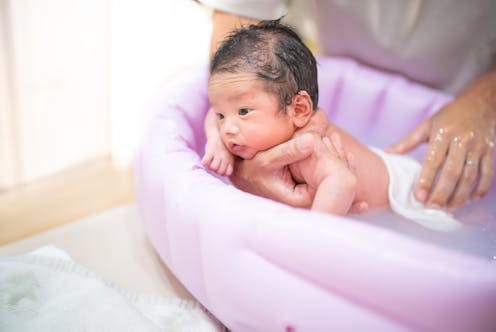
Everyone struggles to sleep in hot weather. A lukewarm bath may help your baby cool off enough to fall asleep. However, avoid cold baths as your baby’s temperature may drop too much.
Nobody sleeps well on hot nights and we all need to catch up on sleep when the weather cools.
In extreme heat, if your baby won’t feed well, is limp or floppy, has dull sunken eyes and a sunken soft spot in the skull (fontanelle), seek medical treatment straight away. In an emergency, call 000.
Authors: Karleen Gribble, Adjunct Associate Professor, School of Nursing and Midwifery, Western Sydney University
Read more https://theconversation.com/5-expert-tips-on-how-to-look-after-your-baby-in-a-heatwave-216906


















