the year's best meteor shower is upon us. And this one will be a true spectacle
- Written by Jonti Horner, Professor (Astrophysics), University of Southern Queensland
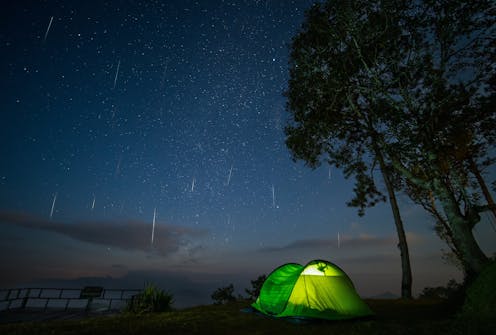
As an astronomer and meteor enthusiast, I’d say it’s the most wonderful time of the year.
Each December sees the return of the Geminid meteor shower – the best natural fireworks display of the year - and people the world over head out to enjoy the show. This year promises to be extra special as the peak of the Geminids falls at new Moon.
The result? The night sky will be beautifully dark from the moment the Geminids first become visible, in the mid-to-late evening, right up until the light of dawn brightens the horizon. And the darker the sky, the better the show.
An appointment with shards of a ‘rock comet’
Each grain of dust that impacts Earth’s atmosphere produces a meteor, burning bright above 80 kilometres high. The bigger or faster the grain, the brighter the resulting flash.
As Earth makes its way around the Sun, it continually passes through streams of dust and debris left behind by asteroids and comets. When it runs into these meteor streams the amount of dust entering the atmosphere increases, and a meteor shower is born.
Read more: Explainer: why meteors light up the night sky
Every year in December, Earth passes through a stream of debris left behind by an asteroid called (3200) Phaethon.
Phaethon is an unusual object. It moves on a highly elongated orbit that takes it much closer to the Sun than Mercury and farther away than Mars. As a result it is alternately baked and frozen – its surface shattering, spewing dust into space.
The dust left behind has spread all around Phaethon’s orbit. Whenever Earth reaches a certain part of the orbit, it passes through the resulting tube of debris, giving birth to the Geminid meteor shower.
It takes Earth several weeks to pass through the debris left behind by Phaethon. For most of that period the Geminids remain a minor event. However, for two or three nights around mid-December, we pass through the densest part of the stream.
From the northern hemisphere, the Geminids produce more than 100 meteors per hour at their best. While the view from Australia isn’t quite as good, a keen-eyed observer can still see more than 50 meteors per hour at the peak – the most spectacular show of the year.
The best time to watch
A meteor shower can only be seen when the part of Earth you’re standing on is facing the stream. That means for the Geminids you won’t see any meteors until the constellation Gemini rises from your location.
The farther north you are, the earlier in the evening the “radiant” will rise. This is the point in the sky from which the meteors appear to radiate. The higher in the sky the radiant is, the further into the stream you’re facing and the more meteors you’ll see.
The best rates will come when the radiant is at its highest, which occurs when it’s due north. The table below indicates the time the radiant will rise on the evening of December 14, and when it will be at its highest (culmination) for all major cities in the early hours of December 15.
The “peak rate” is an estimate of how many meteors you might see in the hour the radiant is at its highest, assuming you have perfect eyesight and a dark, crystal-clear sky. Factors such as light pollution, imperfect eyesight and cloud cover will affect this.
The most meteors will be visible during the four-hour period centred on the culmination of the radiant. The more time passes from the culmination, the fewer meteors you’ll see.
That said, you still stand a chance of seeing some Geminids any time the radiant is above the horizon – with respectable rates as early as one hour after the radiant rises.
Where should I look?
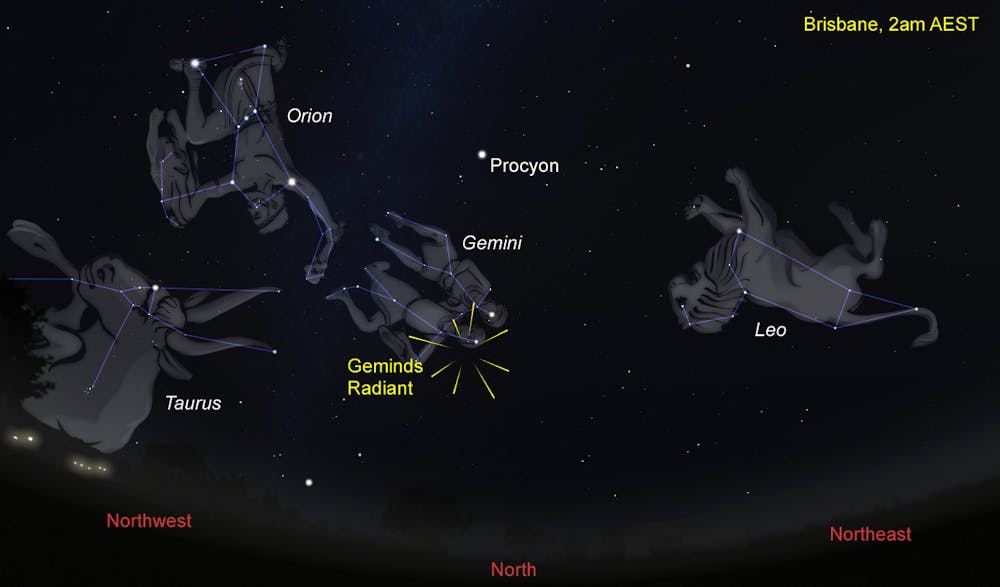
While Geminid meteors can appear anywhere in the night sky, you can always trace their movement back to the radiant in the constellation Gemini.
If you look directly at the radiant, you’ll see the meteors almost head-on; if you look away from it, you’ll see them entering the atmosphere above you, rushing to the horizon.
From experience, we’ve found the best way to spot meteors is to find and face the radiant, and then turn so you’re looking at a spot about 45 degrees to the radiant’s left or right.
What does this mean? In the few hours after the radiant rises, it will be in the northeastern part of the sky, so you’d be best served looking to the north or the east (45 degrees to the left or right of the radiant).
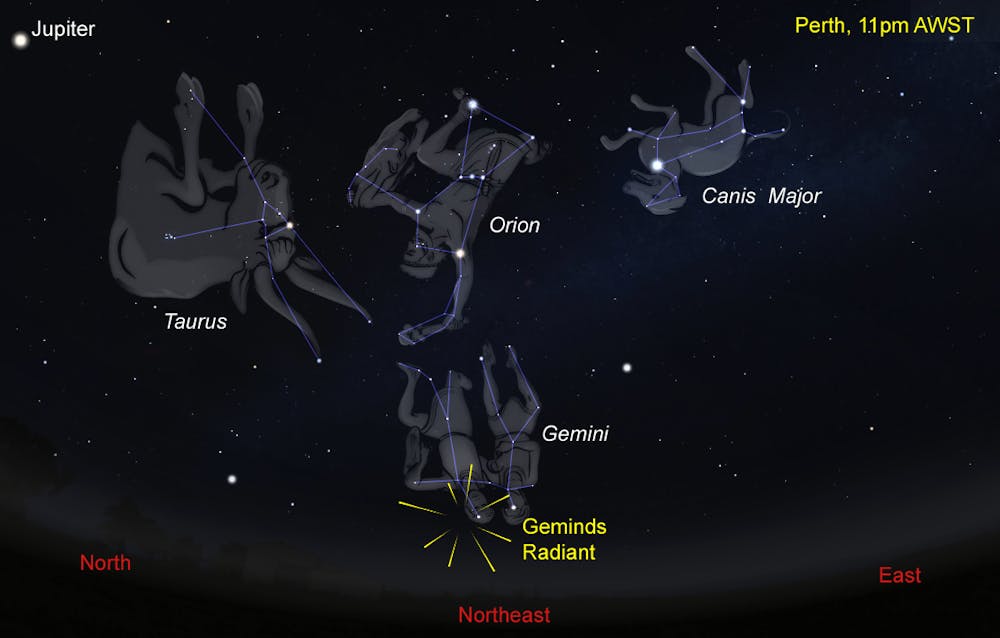 As the radiant rises, look towards Taurus in the north or Canis Major in the east to spot meteors.
Museums Victoria/Stellarium
As the radiant rises, look towards Taurus in the north or Canis Major in the east to spot meteors.
Museums Victoria/Stellarium
When the radiant is at its highest, it’ll be due north – so the best view for the shower will be to the northeast or northwest. Finally, as you move towards dawn, the radiant will be in the northwest, so you’d want to look to the west or north.
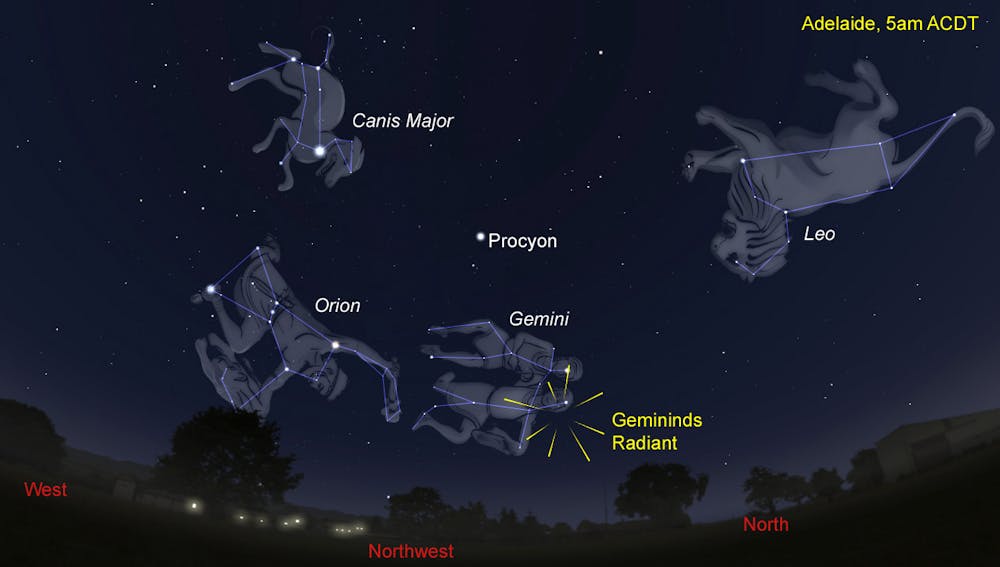 By sunrise the Geminids radiant is low in the northwest, so it’s best to look to the north or west to catch the last of the meteors before the sky brightens.
Museums Victoria/Stellarium
By sunrise the Geminids radiant is low in the northwest, so it’s best to look to the north or west to catch the last of the meteors before the sky brightens.
Museums Victoria/Stellarium
Ideally, you want to be looking up at about a 45 degree angle from the ground. Lying down is best, and standing is a sure recipe for a sore neck! Whether you look left or right is up to you, but we’d suggest looking at whichever side has a darker sky (less light pollution).
Location is key
The Geminids are a fantastic treat – and like most treats they’re more fun when shared! For the best experience, grab your friends or loved ones and head out somewhere nice and dark.
With summer in full swing in Australia, it may be the perfect time to take a camping trip. To find an ideal viewing spot, check out this amazing map of Australia’s most (and least) light-polluted locations.
Authors: Jonti Horner, Professor (Astrophysics), University of Southern Queensland