

From sexual liberation to fashionable heels, new research shows how women are changing North Korea
- Written by: Bronwen Dalton, Professor, Head of Department of Management, UTS Business School, University of Technology Sydney
Kang* was 20 years old when she left her official job as a potato researcher in North Korea. She wanted to join the women who had taken up illicit market activities, first to survive the “Arduous March” (as the famine years of the mid-1990s were known), then to build better lives for themselves and their families outside the tight controls of the government.
Kang began trading goods like rice, metals and petroleum to generate an income well beyond what she could have expected from state-sanctioned employment. Eventually, before reaching South Korea in 2013, her most lucrative business was a brokerage service for young women who wished to work in factories in China.
Kang was one of the women who took part in the research for our new book, North Korea’s Women-led Grassroots Capitalism. As she told us,
What was most rewarding about the work was the money. I could pay for my younger sister’s university tuition, as well as my stepchildren’s. I could even buy [Workers’] Party membership for my husband, eventually making him a party secretary. I felt myself maturing through businesses.
It was as if we were like party officials providing for their children. I could make all that possible with the money I earned.
The emergence of grassroots capitalism in North Korea, through women like Kang, provides a cautionary tale for patriarchal societies everywhere: underestimate women at your peril.
Ironically, we found in our research that by seeking to exclude women from the public sphere and formal economy, North Korea’s government has actually spurred them to become entrepreneurs, with cascading effects on society.
How did this happen? North Korean authorities continue to oppress the public with a terror and surveillance culture aimed at containing the spread of capitalism. But it is men who have been their main focus – not women.
North Korea’s women, underestimated and operating in the shadows, have become increasingly adept at circumventing official monitoring and controls to create the space to drive significant economic and social change.
Our book explores the complex ways in which North Korean women have exercised their agency through everyday life. Our research was based on 52 interviews with North Korean female defectors, NGOs and several field trips to North Korea and northeast China. Far from stereotypical brainwashed automatons or helpless victims needing protection, we found that North Korea’s women are strong, resilient and creative.
Through acts of covert resistance, they have been driving change in family relationships, women’s sexuality and reproductive issues, and women’s cultural identities.
1) Women are driving grassroots capitalism
Women have become active players in the emerging informal economy centred on local markets, which pre-COVID accounted for roughly 80% of household income and more than 60% of people’s food and basic needs.
In short, North Koreans depend on women’s labour, both in the household and the marketplace, to survive.
In most North Korean families, women have become the main breadwinners. This has created more opportunities for women – and challenges for those who seek to control them, including the state.
2) Gender roles are shifting
Women have been driving changes that are destabilising two fundamental pillars of North Korea: socialism and deep-rooted patriarchy.
Women’s involvement in market activities has given them access to scarce resources, including money, and a level of public visibility and social interaction previously reserved for men.
Economic independence and a greater say in domestic decision-making have strained long-established family dynamics and challenged broader social norms. As Seol* explains:
As the rations waned, women took more initiative and went out and worked outside the home. It was the men who stayed home. We began to expect that men should cook and do domestic work. I think women and men reversed roles.
3) A sexual revolution is underway
The way women experience and approach sexuality, relationships and marriage has become far more complex. This includes delaying marriage and more divorces. Non-traditional relationships are also flourishing, such as premarital and extramarital couplings (which have led to growing numbers of single mothers) and older women married to younger men. A young woman named Bae* told us:
As I make a lot of money, I have high standards for a husband. While busy with money-making, I don’t have time to think about marriage or get married.
Meanwhile, younger party-affiliated, city dwellers are adopting more liberal attitudes to dating and sex and more romantic views of relationships. As Joo* said:
Many young people are dating in public right now. After watching South Korean dramas, young ladies call their boyfriend ‘oppa’ (or ‘brother’) like South Koreans. The young couples are going around with their arms around each other’s shoulders.
Some women have also been strategically engineering relationships with Chinese men as a means of settlement in China, to ensure their safety.
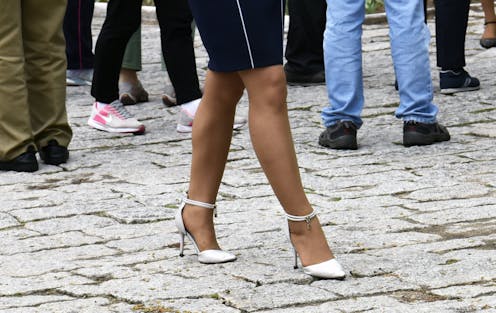
4) It’s all about the heels
While appearing to conform to patriarchal versions of femininity, women are actually constructing a new version of the ideal, hyper-feminine, North Korean woman. This is typically a means to access material goods and social rewards.
Through fashion choices and conspicuous consumption, these women are playing a key role in how status is now determined in North Korea. For example, high heels are de rigeur. Bae said:
Women are obsessed with high heels. Probably because we girls are short. Whether women live in the countryside or in the mountains, we prefer these shoes, even on unpaved roads.
Like their South Korean counterparts, the younger generation has become more interested in slender bodies and long straight hair. More women have undertaken not only double eyelid surgery, but also dimple surgery or nose surgery. Another woman, Gho, told us:
We young people are just like South Koreans. We watch South Korean TV dramas in secret and wear pants like South Koreans do [laughter], and we dye our hair yellow like South Koreans do.
Through these actions, women are challenging narrowly conceived, domestic ideals of wives and mothers and creating new sets of social expectations and constructions of femininity.
The way Paik* describes her decision to dye her hair and wear earrings is an example of how women are also emulating the country’s fashionable first lady Ri Sol-ju:
Officials used to inspect everybody wearing earrings. But then Ri Sol-ju appeared wearing earrings and now the authorities can’t do much about it. People started becoming rebellious. In North Korea, dyeing hair is not allowed. […] These days, a lot of people dye their hair.
5) New propaganda versions of the ideal woman
The state has responded to this social change by shifting the way it presents the “ideal” woman in its propaganda.
For example, it is now promoting women who embody an attractive and dynamic blend of old and new, of loyalty and modernity - including the leader’s sister, wife and now daughter. For example, Ri regularly appears in Prada, Christian Dior and Chanel, or in looks inspired by these designers.
By doing this, the regime is seeking to co-opt social trends to maintain its legitimacy.
(*For security reasons, we use pseudonyms for the North Korean women who took part in this research.)
Authors: Bronwen Dalton, Professor, Head of Department of Management, UTS Business School, University of Technology Sydney


















