Working out what makes a good community where young children can thrive
- Written by: Sharon Goldfeld, Deputy Director, Center for Community Child Health Royal Children's Hospital; Co-Group Leader, Policy and Equity, Murdoch Children's Research Institute; and Professor, Department of Paediatrics, University of Melbourne
The international research is clear. Stimulating and positive environments early in life provide optimal foundations for children’s ongoing development into adulthood. This in turn makes a difference to the productivity of society at large.
Communities are important environments in which young children grow and develop. There is limited research, however, on how communities can best influence early childhood development.
Read more: A city that forgets about human connections has lost its way
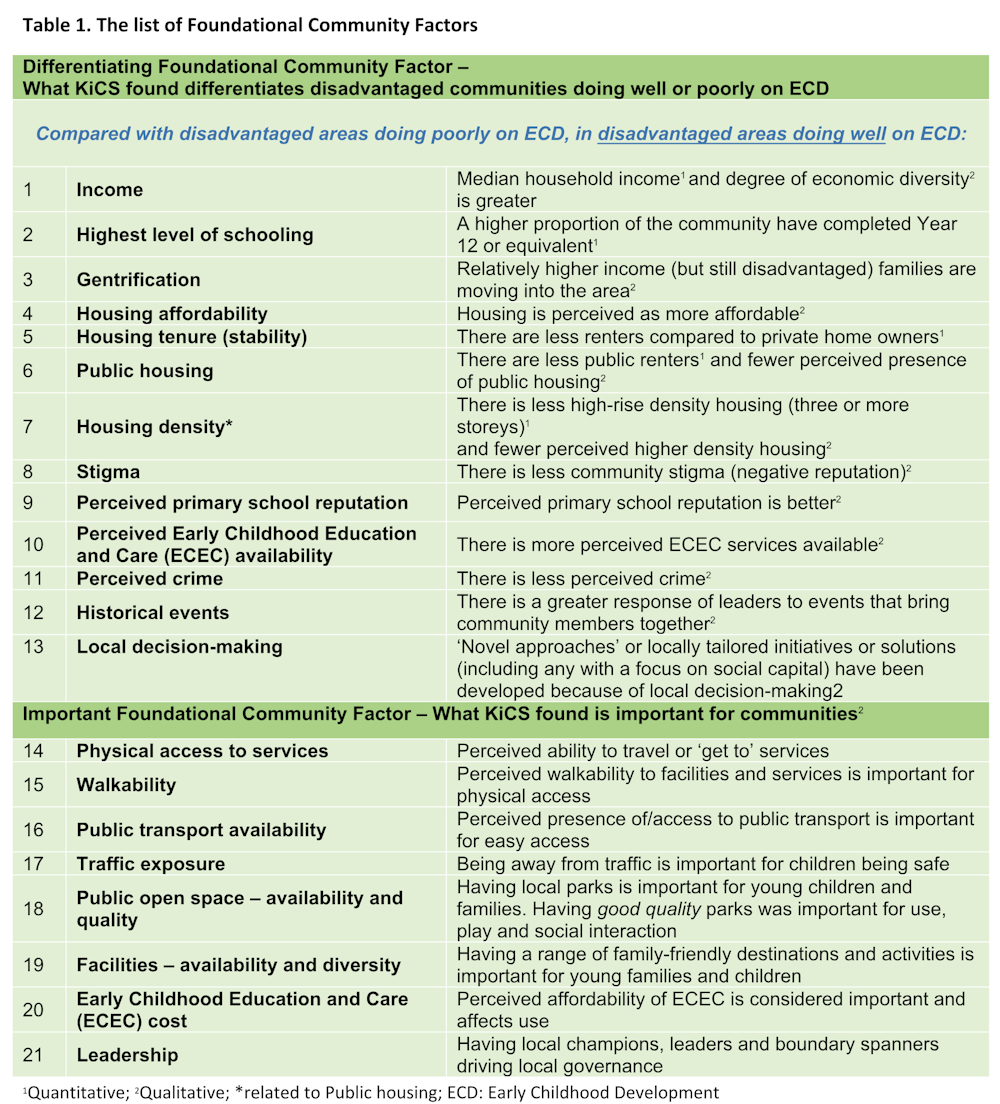
To address this evidence gap, the Kids in Communities Study (KiCS) set out to investigate the influence of community-level factors on young children’s development. This research has identified a promising set of factors (listed in table 1) that lay the foundations of a good community for early childhood development.
 What we currently know is that by the time Australian children start school, those in more disadvantaged communities have three times the level of developmental vulnerability compared with those who are most advantaged (18.4% vs 6.7%). In simple terms, young children living in Australia’s poorer areas are already on a more disadvantaged trajectory. The evidence suggests these trajectories are challenging to change once established.
What is it about where you live that makes a difference?
The design of communities can impact the healthy development of children. In particular this involves family access to resources to promote good development.
International research shows that disadvantaged communities with limited resources and opportunities can generate poor child development outcomes. And these can then persist from one generation to the next.
Conversely, there are also many factors that can promote healthy child development, even in low-income communities. These factors include parents and families who actively participate in the community, active community organisations, and neighbourhoods that are safe to walk in and have good places to play.
Read more:
Young people want walkable neighbourhoods, but safety is a worry
As Australia faces increasing pressure to accommodate population growth, well-designed communities offer real potential as a platform for impact. Indeed, there is interest globally – e.g. “child-friendly cities” – and in Australia – e.g. “collective impact” – in place-based approaches. This is stimulating the policy agenda at all levels of government.
This policy agenda recognises “communities” as central for delivering better and more equitable early childhood development. However, this enthusiasm is hampered by the limited available evidence about the most effective ways communities can support good early childhood development.
The Kids in Communities Study
The Kids in Communities Study investigated the potential influence of community-level factors in five domains on early childhood development. These domains are:
physical environment
social environment
socio-economic factors
access to services
governance.
What we currently know is that by the time Australian children start school, those in more disadvantaged communities have three times the level of developmental vulnerability compared with those who are most advantaged (18.4% vs 6.7%). In simple terms, young children living in Australia’s poorer areas are already on a more disadvantaged trajectory. The evidence suggests these trajectories are challenging to change once established.
What is it about where you live that makes a difference?
The design of communities can impact the healthy development of children. In particular this involves family access to resources to promote good development.
International research shows that disadvantaged communities with limited resources and opportunities can generate poor child development outcomes. And these can then persist from one generation to the next.
Conversely, there are also many factors that can promote healthy child development, even in low-income communities. These factors include parents and families who actively participate in the community, active community organisations, and neighbourhoods that are safe to walk in and have good places to play.
Read more:
Young people want walkable neighbourhoods, but safety is a worry
As Australia faces increasing pressure to accommodate population growth, well-designed communities offer real potential as a platform for impact. Indeed, there is interest globally – e.g. “child-friendly cities” – and in Australia – e.g. “collective impact” – in place-based approaches. This is stimulating the policy agenda at all levels of government.
This policy agenda recognises “communities” as central for delivering better and more equitable early childhood development. However, this enthusiasm is hampered by the limited available evidence about the most effective ways communities can support good early childhood development.
The Kids in Communities Study
The Kids in Communities Study investigated the potential influence of community-level factors in five domains on early childhood development. These domains are:
physical environment
social environment
socio-economic factors
access to services
governance.
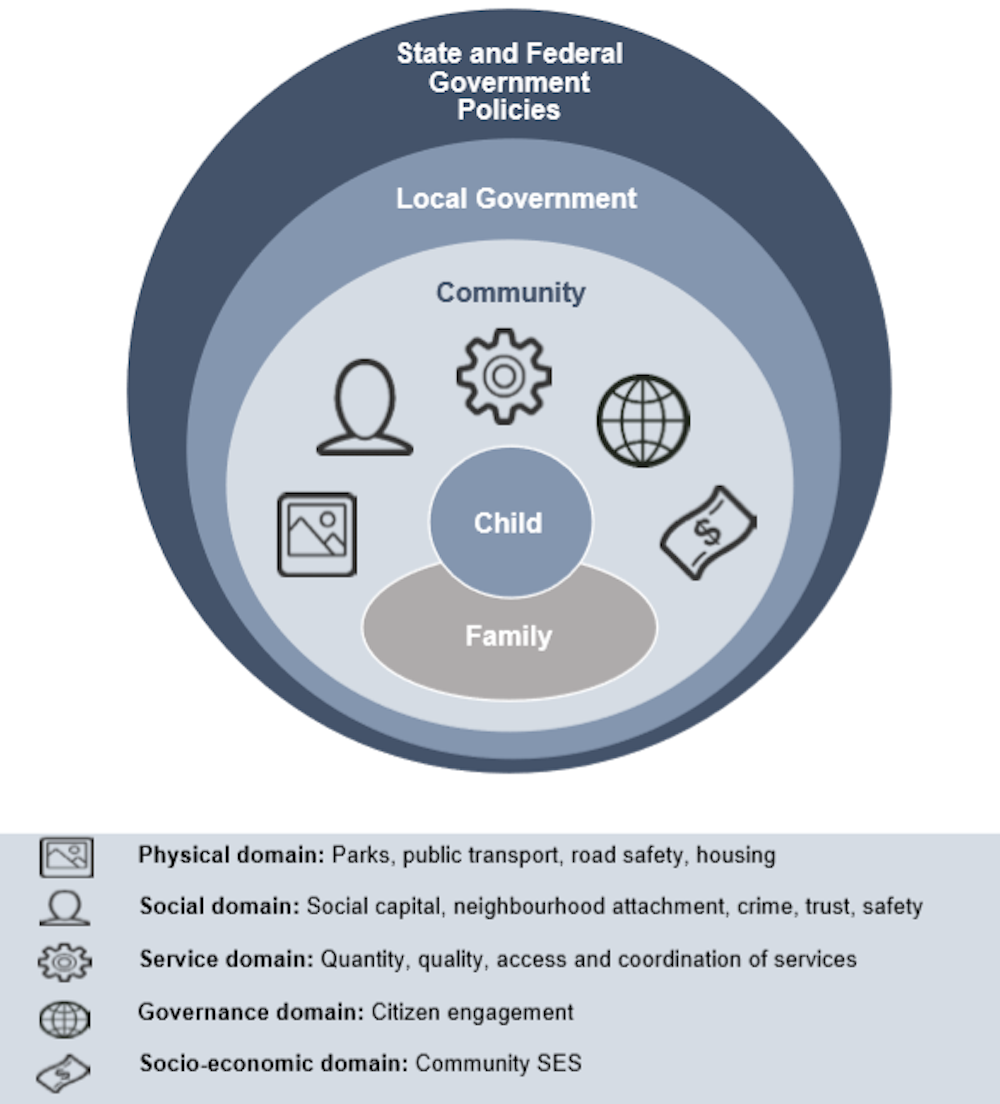 The Kids in Communities Study (KICS) conceptual framework.
Author provided
A mix of surveys, focus groups and interviews were conducted with community members (families, service providers, stakeholders). The results were combined with data from 25 Australian urban and regional communities. This mixed methods approach was essential to better understand local context and make sense of the data.
We were particularly interested in understanding why some communities, when matched by disadvantage, showed better (“off-diagonal”) or as expected (“on-diagonal”) child development outcomes relative to their socio-economic profile. This is measured by the Australian Early Development Census. Teachers complete this census every three years for all children starting school.
Foundational community factors: using data to drive action
From this work, KiCS identified the set of foundational community factors associated with early childhood development. These are the factors that lay the foundations of a good community for early childhood development.
Foundational community factors can help better understand what helps or hinders early childhood development at the community level. They provide a source of local information that can contribute to developing interventions that move beyond the individual level, which have shown limited sustained success, to the broader community level (e.g. place-based initiatives), which has the potential to benefit many children and families in the long term.
They are a combination of factors that showed a difference in disadvantaged communities that had “good” versus “poor” early childhood development outcomes (differentiating factors), as well as those that most KiCS communities perceived as important for families with young children (important factors). Table 1 shows which foundational community factors were related to these outcomes.
Foundational community factors are important; they allow us to move beyond anecdotal information to a discussion grounded in evidence about how the community is tracking to inform place-based initiatives.
These factors help communities strengthen stakeholder engagement and can inform policy recommendations using the best local data. Examples include informing and involving local residents and organisations, discussing key “shared” issues, identifying priorities, planning and implementing community interventions, and monitoring change over time.
This can empower communities to better understand and recognise their resources and opportunities to improve early childhood development. That in turn helps to direct effort into areas that make the most sense.
The full technical report on Foundational Community Factors for Early Childhood Development: A report on the Kids in Communities Study is available here.
For the manual of data collection please email: kics.study@mcri.edu.au.
The Kids in Communities Study (KICS) conceptual framework.
Author provided
A mix of surveys, focus groups and interviews were conducted with community members (families, service providers, stakeholders). The results were combined with data from 25 Australian urban and regional communities. This mixed methods approach was essential to better understand local context and make sense of the data.
We were particularly interested in understanding why some communities, when matched by disadvantage, showed better (“off-diagonal”) or as expected (“on-diagonal”) child development outcomes relative to their socio-economic profile. This is measured by the Australian Early Development Census. Teachers complete this census every three years for all children starting school.
Foundational community factors: using data to drive action
From this work, KiCS identified the set of foundational community factors associated with early childhood development. These are the factors that lay the foundations of a good community for early childhood development.
Foundational community factors can help better understand what helps or hinders early childhood development at the community level. They provide a source of local information that can contribute to developing interventions that move beyond the individual level, which have shown limited sustained success, to the broader community level (e.g. place-based initiatives), which has the potential to benefit many children and families in the long term.
They are a combination of factors that showed a difference in disadvantaged communities that had “good” versus “poor” early childhood development outcomes (differentiating factors), as well as those that most KiCS communities perceived as important for families with young children (important factors). Table 1 shows which foundational community factors were related to these outcomes.
Foundational community factors are important; they allow us to move beyond anecdotal information to a discussion grounded in evidence about how the community is tracking to inform place-based initiatives.
These factors help communities strengthen stakeholder engagement and can inform policy recommendations using the best local data. Examples include informing and involving local residents and organisations, discussing key “shared” issues, identifying priorities, planning and implementing community interventions, and monitoring change over time.
This can empower communities to better understand and recognise their resources and opportunities to improve early childhood development. That in turn helps to direct effort into areas that make the most sense.
The full technical report on Foundational Community Factors for Early Childhood Development: A report on the Kids in Communities Study is available here.
For the manual of data collection please email: kics.study@mcri.edu.au.
Authors: Sharon Goldfeld, Deputy Director, Center for Community Child Health Royal Children's Hospital; Co-Group Leader, Policy and Equity, Murdoch Children's Research Institute; and Professor, Department of Paediatrics, University of Melbourne