Who we care about is limited – but our research shows how humans can expand their ‘moral circle’
- Written by James Kirby, Associate Professor in Psychology, The University of Queensland

A cost-of-living crisis, the ongoing impact of COVID, climate change, and numerous global conflicts and refugee crises. When it feels like so many people are doing it tough, how do we decide where to direct our compassion?
In a world that seems increasingly fractured, we wanted to find out if people can bridge the divide between “us” and “them” – to grow their feelings of wanting to help others, who would be typically beyond their “moral circle”.
We discovered that a surprisingly short period of compassion training can expand how much someone cares about people far beyond their immediate circle.
Measuring who matters most to us
Not all moral connections are equal. If the person suffering is our child, our partner, our friend, we are quick to help. But when faced with the suffering of a complete stranger, or someone on the other side of the planet, our motivation to help is likely reduced.
Taking this further, what if the person suffering was actually someone we disliked, or even someone who may have caused harm to others? Would we care then?
Philosophers such as Peter Singer have developed the popular term “moral circle” to refer to those we consider worthy of our concern and those we do not. Typically we prioritise the moral needs of our family and ingroup (the social group we belong to) first, and we care much less about those different or distant to us.
Read more: How we decide who and what we care about – and whether robots stand a chance
Researchers have found we order groups in this fairly predictable way: family/friends, ingroup, revered, stigmatised, outgroup, animals (high sentience), environment, animals (low sentience), plants, and villains.
Research also shows Australia is not particularly high in terms of moral expansiveness – the size of one’s moral circle. In a 2022 study, Australia ranked 32nd on a moral expansiveness scale (MES), with countries like Canada, France and China ranking much higher.
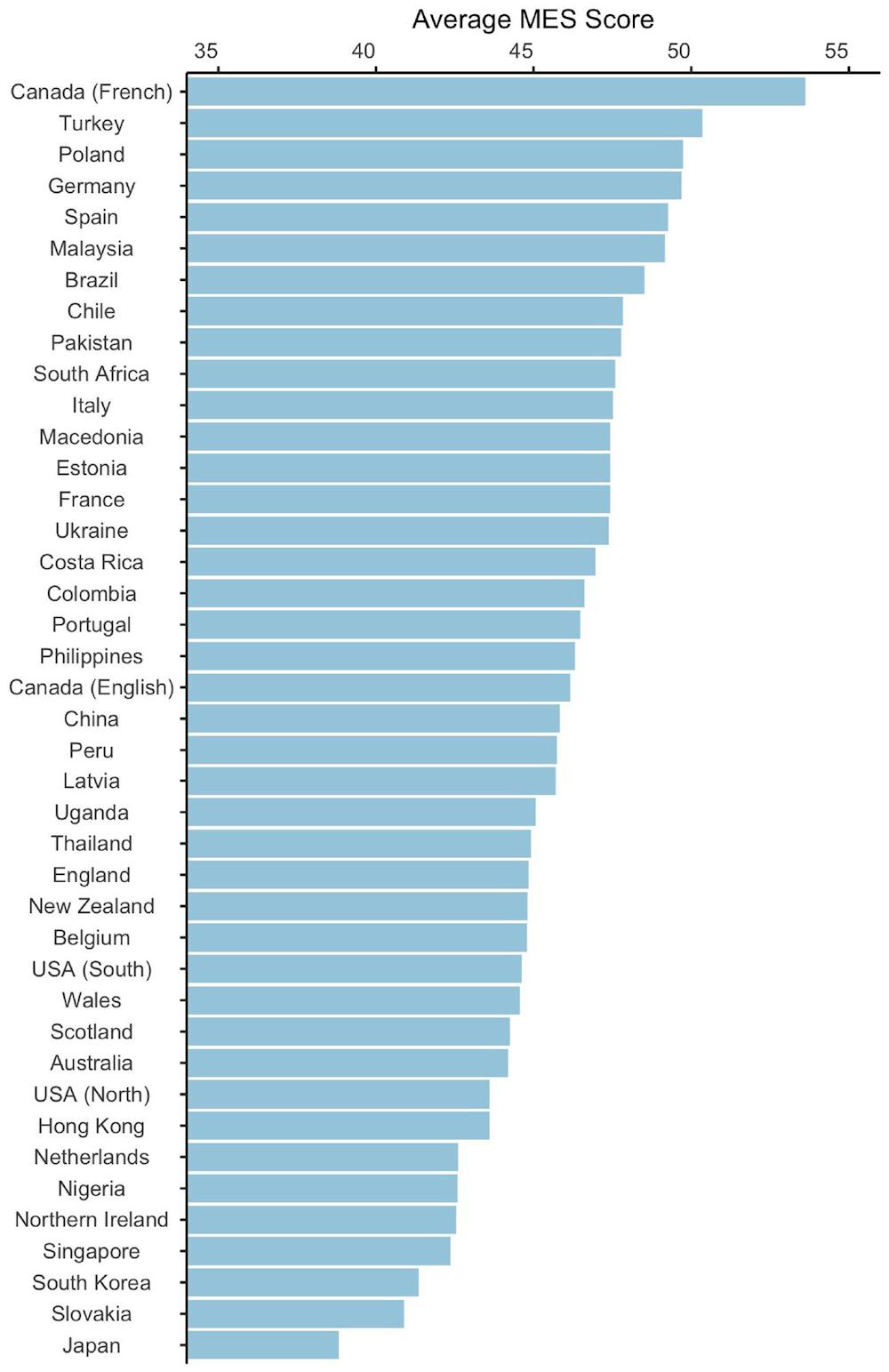
But are our moral boundaries fixed, or can we move up the moral expansiveness ladder? The question of whether our moral concern for others is stable or zero sum (that is, “my concern for someone comes at the expense of another”) is an empirical one.
Can we expand our moral circles?
When thinking about ways to grow our moral circle, things like empathy and mindfulness may come to mind. But our work shows that compassion is stronger than both at predicting the size of one’s moral circle.
Our work also shows that compassion predicts our willingness to help those we dislike. And other research shows compassion training increases feelings of closeness toward a disliked person.
Building on this, our latest research found that a brief compassion training intervention can increase our moral expansiveness.
In this study, 102 participants were randomly assigned to complete a brief two-hour seminar on compassion training, or to a control group who didn’t attend a seminar.
In the seminar, we focused on defining compassion. The message was: things like anger, anxiety and sadness are normal human emotions, but we have a responsibility to learn and practice how to work with these feelings in helpful and supportive ways.
 Participants in the moral expansiveness study spent two weeks listening to audio exercises.
Aleksandr Pobeda/Shutterstock
Participants in the moral expansiveness study spent two weeks listening to audio exercises.
Aleksandr Pobeda/Shutterstock
Participants then had two weeks to continue to practice what we did in the intervention by listening to guided audio exercises, which were a combination of compassionate breathing and imagery exercises, as well as meditations.
Compassion meditations typically follow a set structure. We begin by expressing compassion to a target – someone we like – but then expand out to other targets, such as strangers or disliked others, to other sentient beings like animals, and to elements of the natural environment, such as coral reefs or forests.
We found that two weeks after the program, participants who had completed compassion training has greater moral expansiveness towards family and revered groups in society (for example, charity workers).
At the three month follow-up, these outcomes improved further. Moral concern for others had increased across the board, including towards outgroup members (such as political opponents), stigmatised members of society, animals, plants, the environment – and even towards supposed “villains” in our society (for example, convicted criminals).
This shows compassion and moral expansiveness are closely connected. We don’t know for sure, but the improved results at the three month mark may have been due to continuing the audio exercises, or perhaps due to a “sleeper effect” – it takes time for people to shift their moral view.
A hopeful future?
The year 2024 is full of big choices, with 4 billion people eligible to vote on who should lead their country.
Election years often spiral into divisions of “us” and “them”, with “we” the public having to choose between the people and policies we hope will improve our world.
Compassion might offer one way to ensure we don’t fall into the trap of turning against one another. We can all recognise the right for people and sentient creatures to live a life free of suffering.
And if compassion helps guide us in our decisions and actions, and even expand our moral sensibilities, we may be better placed to tackle some of the big challenges we are facing – and ensure those who are suffering most don’t get left behind.
Authors: James Kirby, Associate Professor in Psychology, The University of Queensland