

Animals keep eating precious plants – we used ‘smell misinformation’ to keep them away
- Written by: Patrick Finnerty, PhD candidate - Behavioural Ecology and Conservation Research, University of Sydney
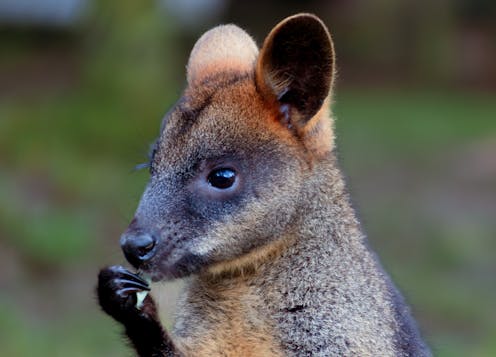
In places where we need to protect valuable plants – whether for ecological or economic reasons – local herbivores can cause significant damage.
Current solutions often involve killing the problem animals. But this is increasingly unacceptable due to animal welfare concerns and social pressures. Physical barriers such as fences can be expensive, and aren’t always practical. We need other options.
Recently, our team discovered that herbivores – plant-eating mammals – primarily use their sense of smell to tell which plants they want to eat or avoid.
In our study published today in Nature Ecology & Evolution, we show how we can use this reliance on smell to nudge wallabies away from vulnerable native tree seedlings. We artificially created and deployed the key smells of a shrub wallabies avoid.
Herbivore-induced headaches
Hungry plant eaters are a concern for conservationists, farmers and foresters alike. They can devastate revegetation efforts and post-fire recovery, destroying more than half the seedlings in these areas.
Every year, they cause billions of dollars of damage in forestry and agriculture. Herbivores also pose a risk to the long-term survival of many threatened plant species.
The most effective control strategies will likely work with a herbivore’s natural motivations – understanding and harnessing what drives the animal to find or avoid certain plants.
Previously, research had primarily focused on what herbivores were eating, but had never really asked how they find the food in the first place.
Our approach puts a new twist on “olfactory (smell) misinformation” or “chemical camouflage” approaches. In recent studies, these methods have substantially reduced invasive predators eating threatened bird eggs in New Zealand, and house mice eating agricultural wheat grain in Australia.
Read more: How to fool a mouse: ‘chemical camouflage’ can hide crops and cut losses by over 60%
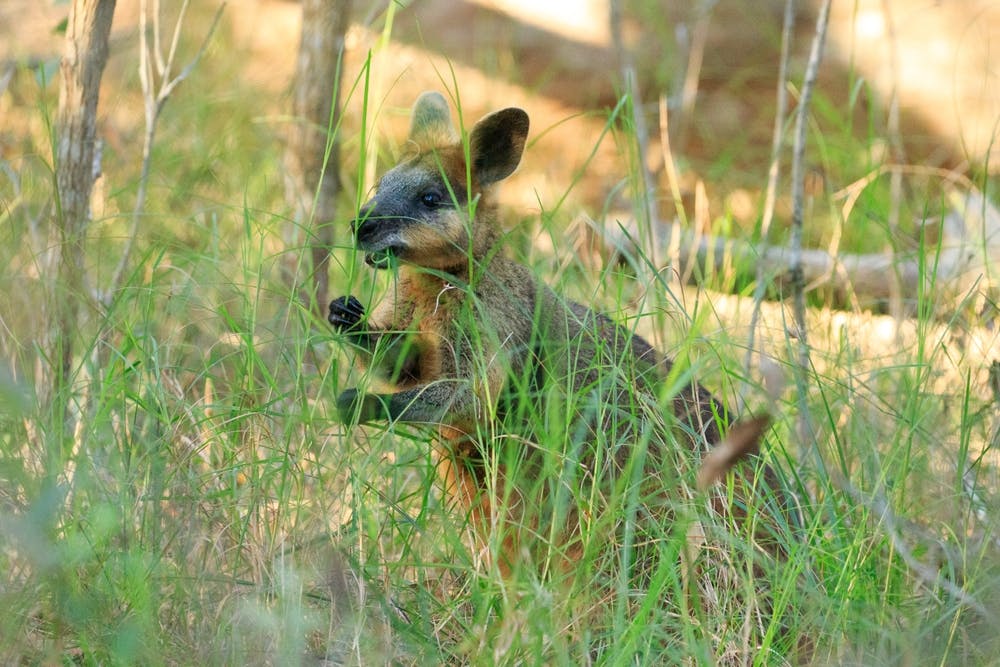
A landscape of smells
In navigating a scent landscape, herbivores use odour to recognise and select among plants and plant patches. Odour is key in guiding the foraging of marsupials in Australia, elephants in Africa and Asia, and deer in the United States.
With this in mind, we explored whether the smell of a plant they don’t like could be enough to nudge animals away from highly palatable native tree seedlings.
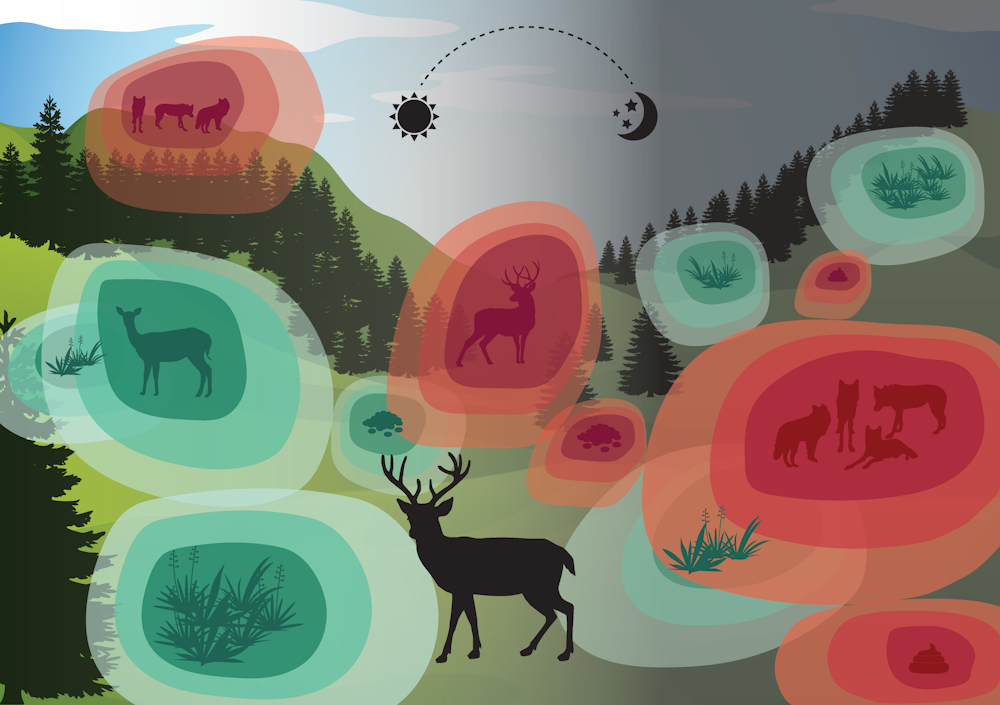 Mammalian herbivores use their noses to navigate complex smell landscapes where odour is emitted from food, predators, competitors and potential mates.
Finnerty et al., BioScience, 2022
Mammalian herbivores use their noses to navigate complex smell landscapes where odour is emitted from food, predators, competitors and potential mates.
Finnerty et al., BioScience, 2022
To test this idea, we focused on swamp wallabies foraging in a eucalypt woodland in eastern Australia. Studies have shown having too many swamp wallabies around can limit the number of eucalypt seedlings that survive to become trees. Swamp wallabies also have a fantastic sense of smell – they can find just a few eucalypt leaves buried underground among complex vegetation.
Using an approach we recently developed, we found the key scent compounds of a plant we know wallabies avoid – the native shrub Boronia pinnata.
We then mixed these compounds together to create “informative virtual neighbours”. They were “informative” as our mix of compounds mimicked what a wallaby would recognise as Boronia pinnata, “virtual” as we were not actually deploying the real shrub, and “neighbours” as we placed these smells in the bush next to eucalypt seedlings we were trying to protect.
In our study, a virtual neighbour was a small glass vial with a few millilitres of the mixture, with a tube pierced through the lid so the smell could waft out.
Using odours instead of real plants is a type of olfactory misinformation – it sends a deceptive message to the animals.
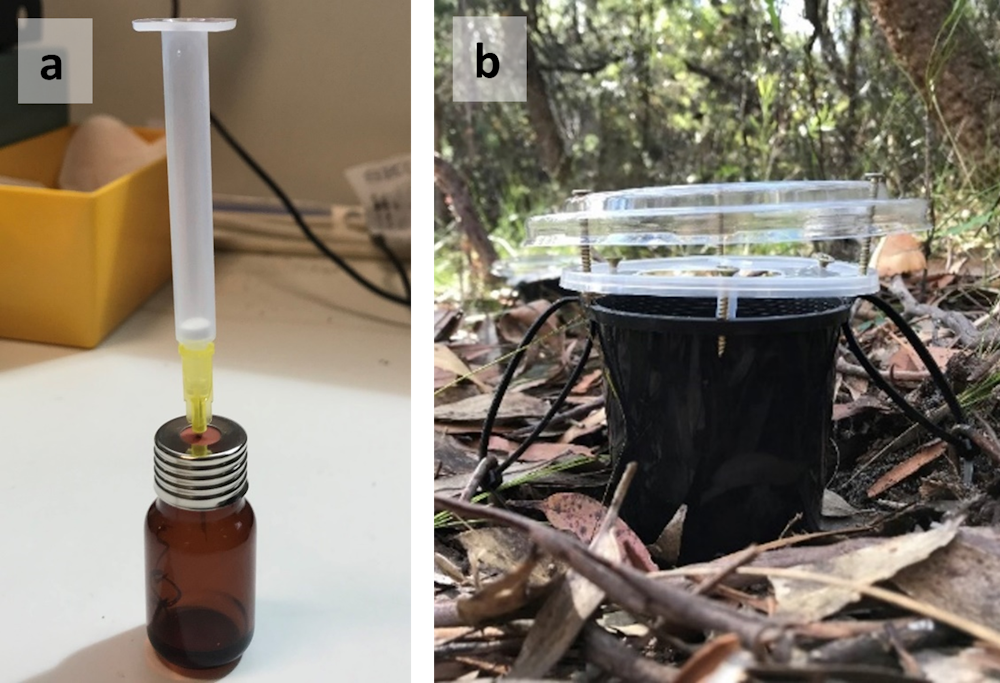 We deployed the virtual neighbour vials in custom-built contraptions that secured vials to the ground and provided protection from the weather.
Finnerty et al., Nature Ecology & Evolution, 2024
We deployed the virtual neighbour vials in custom-built contraptions that secured vials to the ground and provided protection from the weather.
Finnerty et al., Nature Ecology & Evolution, 2024
Real and virtual neighbours
We also compared if virtual neighbours were as good as the real thing in protecting eucalypt seedlings from being eaten by wallabies.
Five virtual neighbour vials or real Boronia pinnata plants were spaced evenly around single eucalypt seedlings the wallabies would find highly palatable. (We also had two types of controls: a seedling with nothing around it, and a seedling surrounded by five empty vials.)
Using remote cameras for 40 days, we recorded how long it took wallabies to find and munch on the eucalypt seedlings.
The results were staggering. Seedlings were 20 times less likely to be eaten when surrounded by virtual neighbours than for both controls. This was equivalent to using real B. pinnata plants, but better because vials don’t compete with seedlings for water and other resources.
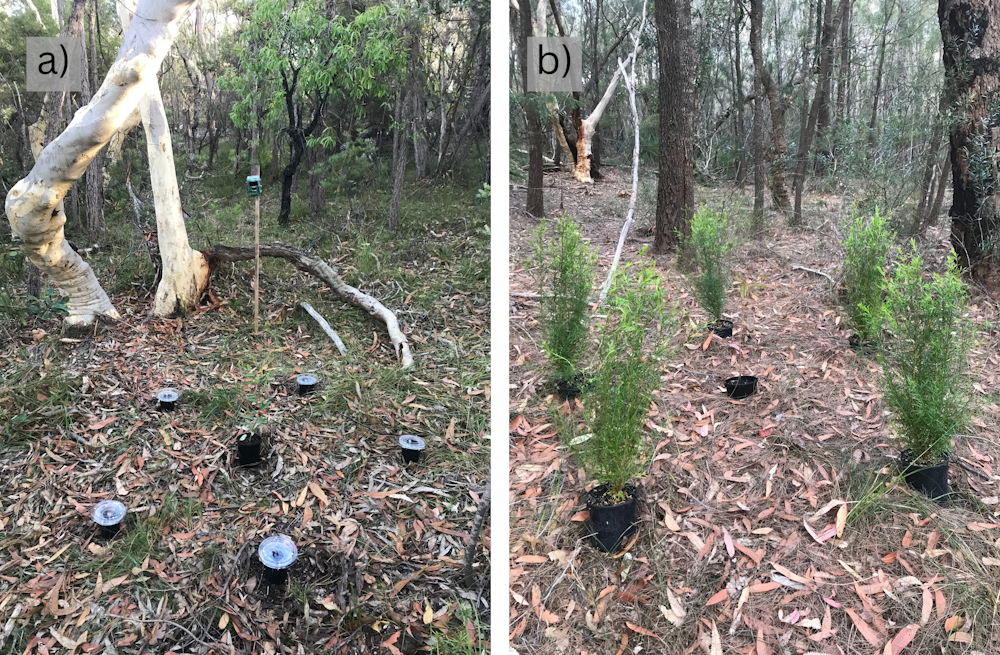 A single eucalypt seedling surrounded by five virtual neighbours (a) and five real plant neighbours (b).
Finnerty et al., Nature Ecology & Evolution, 2024
A single eucalypt seedling surrounded by five virtual neighbours (a) and five real plant neighbours (b).
Finnerty et al., Nature Ecology & Evolution, 2024
A highly effective approach
The success of our study indicates we could use this approach as a new management tool – one that works by influencing the animals’ behaviour rather than trying to get rid of them.
We believe the concept behind developing virtual neighbours is directly transferable to any herbivore, mammal or otherwise, that uses plant odour to forage.
All herbivores avoid some plant species. With future development, we can deploy smelly virtual neighbours as a non-deadly and cost-effective tool to reduce the problems caused by overzealous herbivores.
We acknowledge all other co-authors who contributed to this work: Catherine Price, Malcolm Possell and Cristian Gabriel Orlando from the University of Sydney, and Adrian Shrader from the University of Pretoria. We thank Paul Finnerty for assistance in designing and constructing virtual neighbour holders.
Authors: Patrick Finnerty, PhD candidate - Behavioural Ecology and Conservation Research, University of Sydney


















