

Hidden depths: why groundwater is our most important water source
- Written by Emma Kathryn White, PhD Candidate, Infrastructure Engineering, University of Melbourne
Vivid scenes of worried Cape Town residents clutching empty water vessels in long snaking queues are ricocheting around the globe. Everyone is asking, “How did this happen?” Or, more precisely, “Can it happen in my city?” The importance of effective water management has been shoved, blinking, into the limelight.
In Australia we’re watching somewhat nervously, grateful to have been spared the same fate – for now, at least. Experts tell us that the key is “water divestment” – that is, don’t put all your eggs in one basket (or, perhaps more appropriately, don’t get all your water from the same tap).
Perth is held up as a shining example of Australia’s success in water divestment. The city now relies partly on desalination and crucially gets almost 70% of its supply from groundwater.
Read more: The world's biggest source of freshwater is beneath your feet
Groundwater, the great salvation of parched cities and agricultural development, is the world’s largest freshwater resource. The volume of fresh water in all the world’s lakes, rivers and swamps adds up to less than 1% of that of fresh groundwater – like putting a perfume bottle next to a ten-litre bucket.
What’s more, because it’s underground, it is buffered somewhat from a fickle climate and often used to maintain or supplement supply during times of drought.
Yet caution is required when developing groundwater. Sinking wells everywhere, Beverley Hillbillies style, is unwise. Instead, robust groundwater management is required – defining clearly what we want to achieve and what are we prepared to lose to get it.
Despite the common perception of its abundance, groundwater is not inexhaustible. Its management is fraught with minefields greater and more enigmatic than those of surface waters. It is, after all, much easier to spot when a reservoir is about to run dry than a subterranean aquifer.
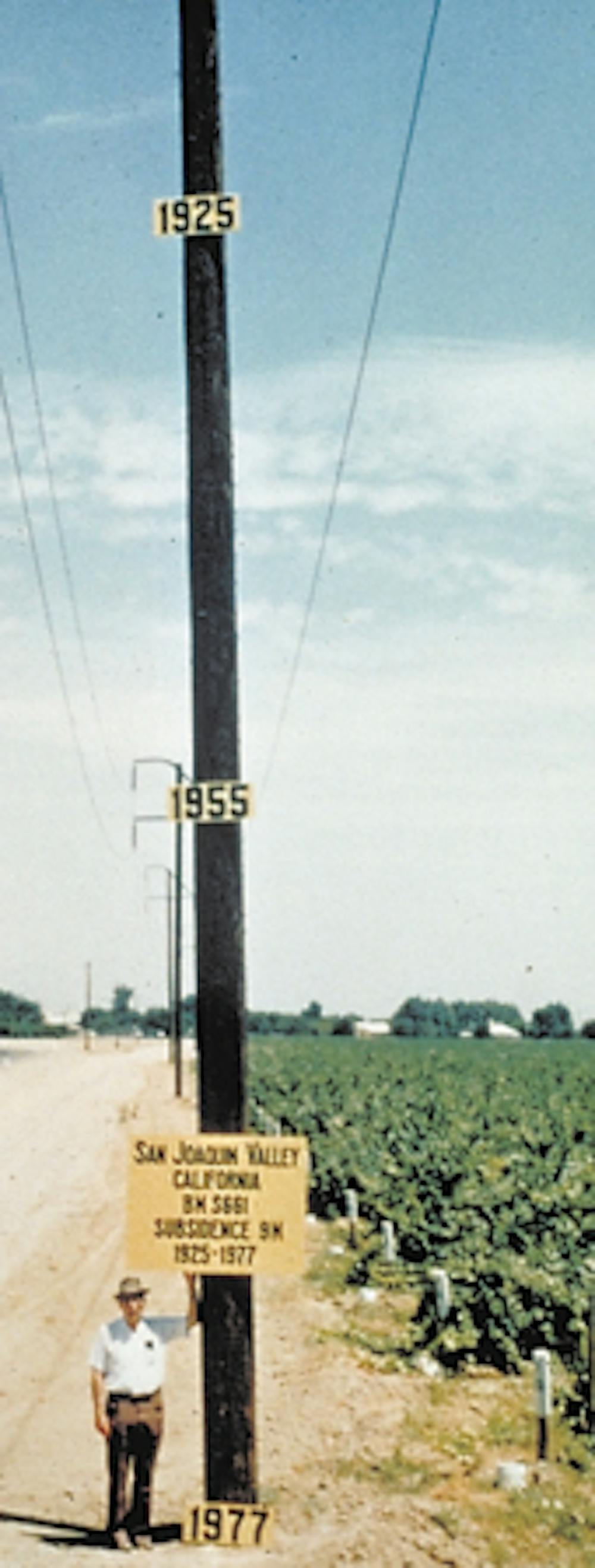 Subsidence can be surprisingly rapid, as in the case of this example in California’s San Joaquin Valley.
USGS
Subsidence can be surprisingly rapid, as in the case of this example in California’s San Joaquin Valley.
USGS
Only when aquifer depletion is already quite advanced do we begin to see the tell-tale signs at the surface: metres and metres of subsidence, huge cracks in roads, and dried-up wetlands clogged with dead trees and dried-out bird carcasses.
For the most part, however, groundwater remains out of sight, hidden beneath many metres of soil and rock. We only remember it is there when something goes wrong, such as a drought, at which point people begin raving about groundwater, location, yield, salinity, stygofauna – wait, what?
Actually hardly anyone cares about stygofauna; most people have never heard of these tiny subterranean creatures, and you will certainly never see one as a state emblem. Mound springs? What are they? Clearly being underground has left groundwater with an image problem.
There was much media coverage of water theft from the Murray River, with broadcast journalists reporting breathlessly from tinnies, and dramatic footage of huge pumps sucking swirling brown water from a sluggish river. Film of groundwater pumps sedately slurping water is much harder to get, because bores tend to be on private property, often hidden inside little tin shacks and kind of boring, really.
Groundwater just doesn’t capture the public imagination. Great reservoirs and rivers are evocative of wilderness and adventure; they almost make you want to build a little raft and float lazily away, Huck Finn style. But the thing is, groundwater feeds many great rivers, supplying base-flow, so when we suck water out of wells, in many instances we may as well be sucking out of rivers.
Despite this connectivity, in many regions groundwater and surface water are managed separately. This is akin to treating to your left hand as a separate entity to your right. Regulation of groundwater lags behind that of surface water and, in many parts of the world including the United States, China, India and Australia, groundwater is overexploited and pumped prolifically, leading to severe social and environmental impacts.
Mound springs support unique and endemic ecosystems and bubbling clear cold water, a welcome sight for dusty travellers. And as for the aforementioned stygofauna, well, what could be cooler than a blind cave eel?
Read more: Squeezed by gravity: how tides affect the groundwater under our feet
Groundwater will become increasingly important as a water source as we grapple with growing cities and burgeoning populations, not to mention climate change, which is projected to reduce rainfall across eastern Australia.
It is crucial that we ensure our groundwater management is effective and robust in the face of drought. It is no longer enough just to write management plans; we must put them to the test by running our groundwater models through a range of future climate and management frequency scenarios. We need increased investment in groundwater management planning, and for management to be conducted in conjunction with surface water management.
With many cities’ water supplies drying up before our eyes, we also need to remember to think about the water we cannot see.
Authors: Emma Kathryn White, PhD Candidate, Infrastructure Engineering, University of Melbourne
Read more http://theconversation.com/hidden-depths-why-groundwater-is-our-most-important-water-source-91484


















