

Why Christians prefer classical music and non-believers like heavy metal
- Written by Haydn Aarons, Senior Lecturer in Sociology, Australian Catholic University
When Prime Minister Scott Morrison bizarrely used a Fatman Scoop track embedded in a tweet, and then quickly retracted it, he shed perhaps unwitting light on the moral dimensions of our musical taste.
Morrison’s tweet used a section of the rap song with the cheerful lyrics “You got a hundred dollar bill, get your hands up! You got a fifty dollar bill, get your hands up!”. However, as many social media users pointed out, the lyrics become much more explicit in the following lines. Morrison retracted the tweet, stating that it was “just not OK”.
It may be that Morrison’s religious beliefs played a role in this incident. My research shows there are major differences in musical taste between religious and non-religious people, and between deeply religious and less committed religious people.
Read more: Why Scott Morrison's white, male music playlists matter
These patterns represent forms of moral evaluation, based on the perceived reputations of genres such as rock, rap, and heavy metal. Highly committed Christians, for example, are far more likely to consume “highbrow” genres and attend classical music concerts. They also avoid, in much greater proportions, genres such as rock, blues, and pop.
Data reveal that regular church attendees are more than twice as likely to avoid live music venues such as nightclubs, pubs, and concerts. Of those who never attend religious services, 44.6% go to venues often, compared with only 20.6% for regular church attendees.
More theologically conservative Christian groups are also much more likely to shun popular forms of music than the non-religious. Evangelical groups, for example, were five times less likely to listen to or state a preference for rock, heavy metal, and alternative rock than the non-religious.
Conversely, Christians and committed churchgoers lead the way for highbrow genres such as classical music and opera. Of regular church attendees, 43% regularly attended classical music concerts and operas, compared with 29% of those who never attend church.
The greater differences in musical preference between the religious and non-religious are at the extremes. Avoiding rock, heavy metal, and alternative rock perhaps suggests moral aversion based on a perceived incitement to sex and violence associated with the lyrical content. Classical music is less explicit on such themes, and has also been central to some Christian liturgy.
Religion in my study also combines with class and education to produce taste patterns. These reflect an older Australian sectarian and social cleavage between Protestant and Catholic (Protestants are more in favour of highbrow genres, although Catholics are more highbrow than those who are not religious). Religious musical taste seeks to define moral boundaries through symbolically distancing some groups from others, much as class-based patterns maintain prestige and privilege.
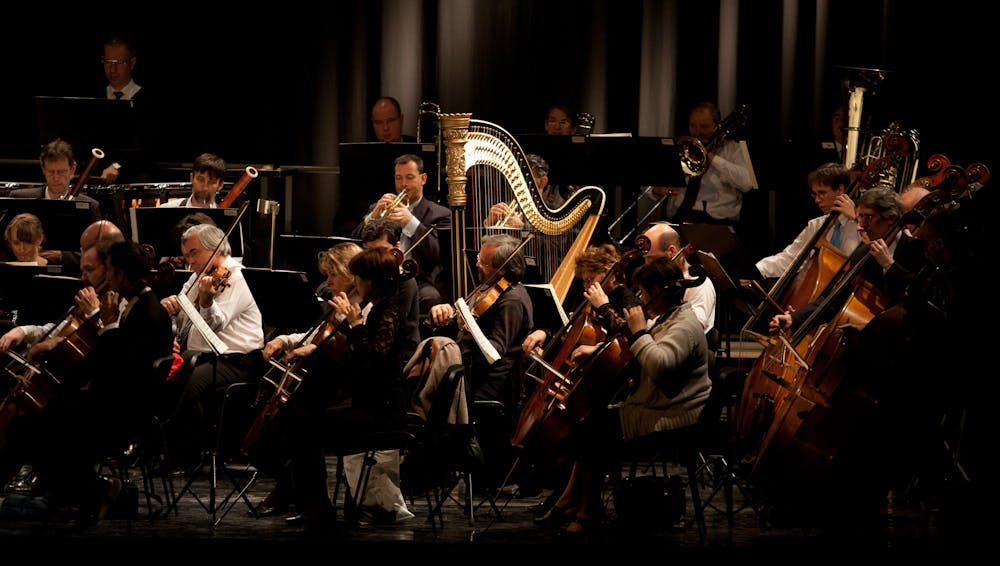 Non-believers are less likely to attend classical music concerts.
Shutterstock
Non-believers are less likely to attend classical music concerts.
Shutterstock
We usually think of musical taste in terms of class or education, using crude terms like “highbrow” or “lowbrow”. These divisions matter because they reveal our symbolic distance from each other, which in turn can produce real economic consequences. For instance, people who are thought to have “good taste” are likely to get better jobs.
Kath and Kim’s satirical take on “bad taste” led to plummeting sales of chardonnay. But, as my research and the Fatman Scoop incident demonstrate, taste also has a moral dimension.
We can see moral judgments at work in many areas of culture, from video games to film to visual art. We’re also seeing morality at work in the response to the #metoo movement, as audiences vote with their feet against artists who offend their values.
But there are dangers in mixing morals and music. Jazz, rock, heavy metal and blues have often been demonised (literally as “the devil’s music”) for their potential to incite particular passions. These genres were eventually appropriated by religious groups themselves, but my research suggests discomfort remains still in their secular guises.
Music in general has been moralised, feared, and suppressed by various authorities – both religious and secular – for its perceived power to arouse certain kinds of emotion, particularly in the young. There is a long tradition of such cultural politics that has sought to guard sexual integrity, quell violent impulses, and curb political protest, from Plato’s suspicion of certain music in The Republic through to rock music’s status as illegal in contemporary Iran.
Morality and music today tends to be confined to the private sphere. As in many other areas of cultural life, most people, including the religious, prefer an open society where people are free to listen to what they like, taste differences notwithstanding.
While there are standards (such as derived by classification bodies such as Classification Australia) that should delimit expression, access to culture, including the “devil’s music”, should be permitted.
Authors: Haydn Aarons, Senior Lecturer in Sociology, Australian Catholic University

















