

The National Electricity Market wasn’t made for a renewable energy future. Here’s how to fix it
- Written by: Vikki McLeod, PhD Graduate, Centre for Clean Energy Technologies and Practices, Queensland University of Technology
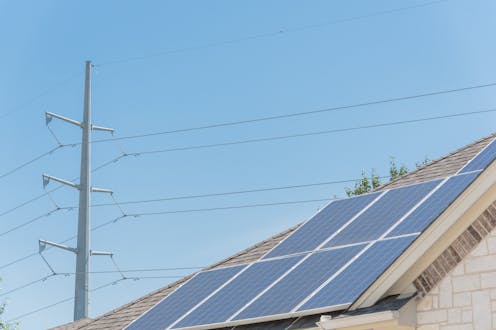
Rooftop solar is Australia’s cheapest source of electricity. The consumer can get electricity from rooftop solar at less than a fifth of the average cost per kwh of buying it from a retailer.
Unsurprisingly, rooftop solar output is growing fast. In 2022, one-in-three homes had solar panels. Total rooftop solar capacity exceeded 30 gigawatts, compared to the remaining 21GW of coal generation.
Rooftop solar photovoltaic (PV) systems will soon supply half of our electricity demand. At times of the day, they already supply close to 100% of electricity demand and in some regions can briefly meet all demand.
This means renewable energy is displacing the electricity traded through the wholesale market and supplied via the transmission system. The National Electricity Market (NEM) is the wholesale market where large generators and retailers buy and sell electricity to supply the eastern and south-eastern states. It was never designed to cope with large amounts of renewable energy feeding into the grid at large, medium and small scales.
The market’s design doesn’t allow for harnessing the full economic and technical potential of the millions of consumer-owned generators, known as distributed energy resources (DERs). Comprehensive market reforms are urgently needed to achieve an energy transition at least cost to energy users.
What are the challenges of reform?
The National Electricity Market has operated largely in its current form since the 1990s. It was designed for large fossil-fuelled power stations, but many of these are on the way out.
Millions of rooftop solar systems are now connected to the grid. The market needs to change to a system that can manage and co-ordinate these small renewable energy generators.
To minimise disruption, a reformed market has to be able to accommodate and value the electricity and power system services that these millions of distributed energy resources can provide. They offer flexibility and can help balance supply and demand, thus improving grid stability.
Between 2019 and 2023, the former Energy Security Board (ESB) and regulators were tasked with delivering a new market design for the clean energy transition. Reforms to better integrate variable renewable generation included:
The Energy Security Board also proposed a two-sided market to allow energy users to actively trade electricity. The design of the reform fell short, but the intent remains valid. This reform needs to be revisited.
The electricity market rules define what commodities are valued and traded, how they are to be traded and by whom. These rules are embedded in thousands of pages of legislation. Each change takes about two years to progress.
These incremental market and policy patches fall short of the systemic change needed for a clean energy future. The whole National Electricity Market and its processes must be redefined.
The current focus of attention is on the large scale. What is being overlooked is the potential of small-scale and local generation to supply electricity where it is needed. This oversight creates a risk of building too much transmission infrastructure at great cost.
The opportunity of energy market reform is that the millions of small, privately owned, behind-the-meter generators could economically provide a big share of Australia’s future electricity and power system services.
Read more: Think of solar panels more like apple trees – we need a fairer approach for what we use and sell
Government must lead the transformation
The clean energy transition is a national priority. Change on this scale requires governments to work together to deliver economic productivity, affordable energy and climate action.
A clear set of principles is needed to guide these changes. The principles from the National Energy Transformation Partnership agreement between federal, state and territory governments are a good place to start. It recognises consumers’ needs as central to the transformation, and that a strong economy depends on affordable, clean and secure energy sources.
The agreement also recognises the role electricity networks and demand-side participation will play in the energy transition. The demand side includes all the small, behind-the-meter, grid-connected, rooftop solar systems and interruptible uses of electricity such as hot-water systems.
Reforming the electricity market is complex work. It requires an in-depth knowledge of governance and regulatory frameworks, commercial realities and consumer needs.
Putting energy users at the heart of these complex reforms requires a holistic systems thinking approach to policy and regulatory design. Such an approach takes into account how all parts of a complex system interact.
With the consumer having such a key role, the focus, planning and investment in these smaller energy sources must be on par with that given to the large generators.
Renewable Energy Zones – areas with the greatest potential to develop renewable energy projects – have shown that, with the right policy settings, billions of dollars of investment can be mobilised. The same level of focus on policy settings and market reforms is needed at the small scale of “Community Energy Zones”.
Each zone must be able to accommodate the unique characteristics of its energy users. It must create an investment environment that supports a local ecosystem of skills, trades and community benefit, ultimately leading to a zero-emission community. It must also support technological and business innovation and allow distribution networks to transition to a smart grid at low risk and low cost.
Learning from successful examples overseas such as smart local energy systems (UK) and Viable Cities (Sweden) will be crucial.
Authors: Vikki McLeod, PhD Graduate, Centre for Clean Energy Technologies and Practices, Queensland University of Technology


















