

Australian homes are getting bigger and bigger, and it’s wiping out gains in energy efficiency
- Written by: Kate Wingrove, PhD Candidate at the Sustainable Buildings Research Centre, University of Wollongong
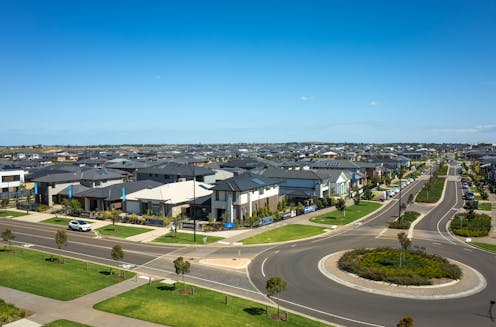
New Australian homes are being designed bigger and so require more energy for heating and cooling, wiping out potential gains in energy efficiency, according to our new research. The increasing energy demand is inconsistent with global efforts to tackle climate change and suggests Australia’s housing energy policy requires a radical rethink.
For more than 20 years, Australia’s building energy regulations have focused on energy efficiency. This reflects policy trends around the world.
In building regulations, energy efficiency is measured as the energy required to heat or cool one square metre of floorspace. Energy efficiency can be improved with features such as good orientation, insulation and double-glazing on windows. Homes designed to a higher energy efficiency standard do indeed require less energy for heating and cooling.
But what happens if we build a bigger house, or more houses: does energy efficiency policy still encourage less energy use in homes? Our research shows in Australia, the answer is no. A policy focus on energy efficiency has not led to falls in the predicted energy requirements for heating and cooling – either for individual homes or the new home sector as a whole.
Increasing floor areas
Around the world, apartment living is becoming more common. But detached homes remain the dominant housing type in many developed nations, including Australia, the United States and Canada.
House size differs markedly around the world, ranging from 9m² per person in India, to about 84m² per person in Australia. Globally, floor area per person is increasing.
Our study set out to examine the significance of this increase when it comes to home heating and cooling energy requirements in Australia.
Read more: Future home havens: Australians likely to use more energy to stay in and save money
What we found
Our study involved more than 580,000 new homes in Australia designed between 2018 and 2022.
First, we looked at official dwelling approval data. We then examined certificates issued under the Nationwide House Energy Rating Scheme or NatHERS. This gave us the thermal performance star-ratings of the new homes, their energy efficiency for heating and cooling and their conditioned floor areas – that is, floor areas typically heated and cooled, excluding spaces such as laundries and garages.
From this, we calculated the predicted energy each home would require each year for heating and cooling.
We found a home designed in 2022 had a 7.6% larger conditioned floor area than a home designed in 2018. And a home designed in 2022 was predicted to require 10% more energy for heating and cooling than a home designed four years earlier.
This differed between jurisdictions. For example, predicted energy requirements for a new home in Western Australia fell by 11% over the period, while in Queensland and the Australian Capital Territory it increased by 17%.
Collectively, we found the predicted energy requirement for heating and cooling of all new homes in Australia was 5.6% more in 2022 than in 2018. This figure ranged from a fall of 21% in the Northern Territory to an increase of 34% in South Australia.
These increases occurred despite 97.5% of new homes meeting the state-based minimum energy efficiency regulations.
Understanding the star-rating system
Between 2018 and 2022, new homes had to be designed to a minimum 6-star energy rating under the NatHERs scheme. However, the policy is implemented by state-based regulations, which in some jurisdictions allows homes to be designed below 6-stars.
In the study period, 18% of new homes in Australia were designed to a 5-5.9 star rating, as permitted within the jurisdictions of Queensland, the Northern Territory and New South Wales. In all other states and territories, the majority of new homes were designed at 6-star or above.
Nationally, just 11% of new homes were designed at a higher standard of 7-10 stars. This ranged from 35% in the Australian Capital Territory to just 5% of new homes in Victoria.
Improvements to Australia’s housing energy efficiency policy came into effect in 2023. However these do not directly address the impact of floor area on heating and cooling energy requirements, and state-based regulations remain inconsistent.
Aussie homes are getting bigger
Our analysis showed new Australian homes continue to get bigger. New homes in Victoria and NSW had the largest conditioned floor areas, while Tasmania had the smallest.
New homes with lower a star-rating tended to be bigger: the average 5-star home in NSW had more than double the conditioned floor area of the average 7-star home in Tasmania.
Larger homes also inherently require more materials to build than smaller homes – and these materials require energy to produce. However this concept, known as embodied energy, was beyond the scope of our study.
Time for a rethink
Our research showed at a household, state and national scale, the emission reduction benefits of improving a home’s energy efficiency may be undermined if policy does not consider floor area.
Demand for new housing in Australia will continue to rise as the population grows. So it’s even more important to ensure we get the settings right on home energy policy. Such an overhaul will be complex, involving building regulations, urban planning and social policies.
Renewable energy can significantly reduce greenhouse gas emissions from energy used by new homes. However, to make our net-zero goals feasible, achieving reductions in the energy required by each home is a crucial first step.
Work is also needed on how to encourage people to build smaller homes – a home sufficient for their needs, but no larger. Unless Australia re-examines the scale of its new homes, energy efficiency policy will fail to deliver genuine reductions in energy use.
Authors: Kate Wingrove, PhD Candidate at the Sustainable Buildings Research Centre, University of Wollongong


















