

Loyalty programs may limit competition, and they could be pushing prices up for everyone
- Written by: Alexandru Nichifor, Associate Professor, Faculty of Business and Economics, University of Melbourne, The University of Melbourne
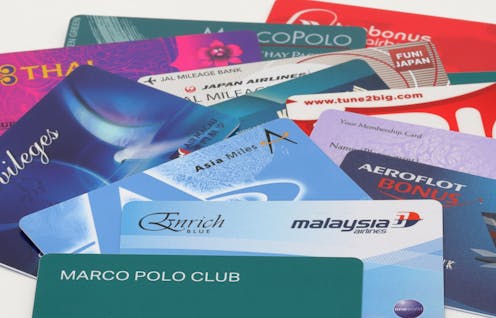
Loyalty programs enable firms to offer significantly lower prices to some of their customers. You’d think this would encourage strong competition.
But that isn’t always what actually happens. New research shows that paradoxically, by changing the way companies target customers, loyalty programs can sometimes reduce price competition. The research also points to solutions.
A win-win proposition?
Joining a loyalty program is supposed to be a win-win. You – the customer – get to enjoy perks and discounts, while the company gains useful commercial insights and builds brand allegiance.
Read more: What do TikTok, Bunnings, eBay and Netflix have in common? They’re all hyper-collectors
For example, a hotel chain loyalty program might reward travellers for frequent stays, with points redeemable for future bookings, upgrades or other benefits. The hotel chain, in turn, records and analyses how you spend money and encourages you to stay with them again.
Such programs are commonplace across many industries – appearing everywhere from travel and accommodation to supermarket or petrol retailing. But they are increasingly coming under scrutiny.
In 2019, the Australian Competition and Consumer Commission (ACCC) cautioned consumers about the sheer volume of personal data collected when participating in a loyalty program, and what companies can do with it.
Hidden costs – such as having to pay a redemption fee on rewards or losing benefits when points expire – are another way these schemes can harm consumers.
But a larger question – how loyalty programs impact consumers overall – remains difficult to settle, because their effect on competitiveness is unclear. As the ACCC’s final report notes, on the one hand:
Loyalty schemes can have pro-competitive effects and intensify competition between rivals leading to competing loyalty discounts and lower prices for consumers.
But on the other hand:
Loyalty schemes can also reduce the flexibility of consumers’ buying patterns and responsiveness to competing offers, which may reduce competition.
How a two-speed price system can hurt everyone
A new economic theory research working paper, coauthored by one of us (Kominers), suggests that on competitive grounds alone, loyalty programs can sometimes harm all consumers – both ordinary shoppers and the program’s own members.
It’s easy to see how the ordinary shopper can be worse off. Since a firm’s loyalty program enables it to offer discounted prices to its members, the firm can raise the base prices it offers to everyone else. Those not participating in the program pay more than they otherwise would have, and the firm can respond by saying “join our program!” instead of having to lower its price.
But sometimes, even the program’s own members can end up worse off.
When a given customer’s loyalty status is not visible to a firm’s competitors – as is the case in many loyalty programs today – it’s hard for those competitors to identify them and entice them to switch.
The main way to compete for those customers becomes to lower the base price for everyone, but this means missing out on the high base margins achieved through the existence of your own loyalty program – remember, having a loyalty program means you can charge non-members more.
It’s often more profitable for firms to just maintain high base prices. This, in turn, reduces overall price competition for loyal customers, so firms can raise prices for them, too.
What’s the solution?
Despite these effects on competition, loyalty programs still offer benefits for consumers and an opportunity for brands to form closer relationships with them.
So, how do we preserve these benefits while enabling price competition? The research suggests an answer: making a customer’s loyalty status verifiable, transparent and portable across firms. This would make it possible for firms to tailor offers for their competitors’ loyal customers.
Read more: You can't trust the price-comparison market, as iSelect's $8.5 million fine shows
This is already happening in the market for retail electricity. While there aren’t loyalty programs there per se, a consumer’s energy consumption profile, which could be used by a competitor to calibrate a personalised offer, is known only to their current electricity supplier.
To address this, in 2015, the Victorian government launched a program encouraging households to compare energy offers. This process involved first revealing a customer’s energy consumption profile to the market, and then asking retailers to compete via personalised offers.
By opening information that might have otherwise been hidden to the broader market, this approach enabled firms to compete for each other’s top customers, in a way that could be emulated for loyalty programs.
Such systems in the private sector could build upon “status match” policies at airlines. These allow direct transfer of loyalty status, but currently rely on a lengthy, individual-level verification process.
For example, a design paradigm known as “Web3” – where customer transactions and loyalty statuses are recorded on public, shared blockchain ledgers – offers a way to make loyalty transparent across the market.
This would enable an enhanced, decentralised version of status match: a firm could use blockchain records to verifiably identify who its competitors’ loyal customers are, and directly incentivise them to switch.
Both startups and established firms have experimented with building such systems.
What next?
New academic research helps us model and better understand when loyalty programs could be weakening supply side competition and undermining consumer welfare.
A neat universal solution may prove elusive. But targeted government or industry interventions – centred on increasing the transparency of a customer’s loyalty status and letting them move it between firms – could help level the playing field between firms and consumers.
Authors: Alexandru Nichifor, Associate Professor, Faculty of Business and Economics, University of Melbourne, The University of Melbourne


















