

Australia’s Eurovision entry this year is the first to sing in First Nations language: meet Electric Fields
- Written by: Myfany Turpin, Associate Professor, Ethnomusicology, Linguistics and Ethnobiology, University of Sydney
The act representing Australia at this year’s Eurovision contest has sadly not qualified for the grand final. Yet for Zaachariaha Fielding and Michael Ross, the duo that makes up Electric Fields, it’s far from a sad ending:
We’re still buzzing. We feel like we did a killer performance and we felt like rock stars. And that audience, I tell you, it was just absolutely giving. It’s going to be a memory that will be embedded with us for the rest of our lives.
While they haven’t qualified, Electric Fields has made history by being the first Australian Eurovision contestant whose entry includes First Nations language.
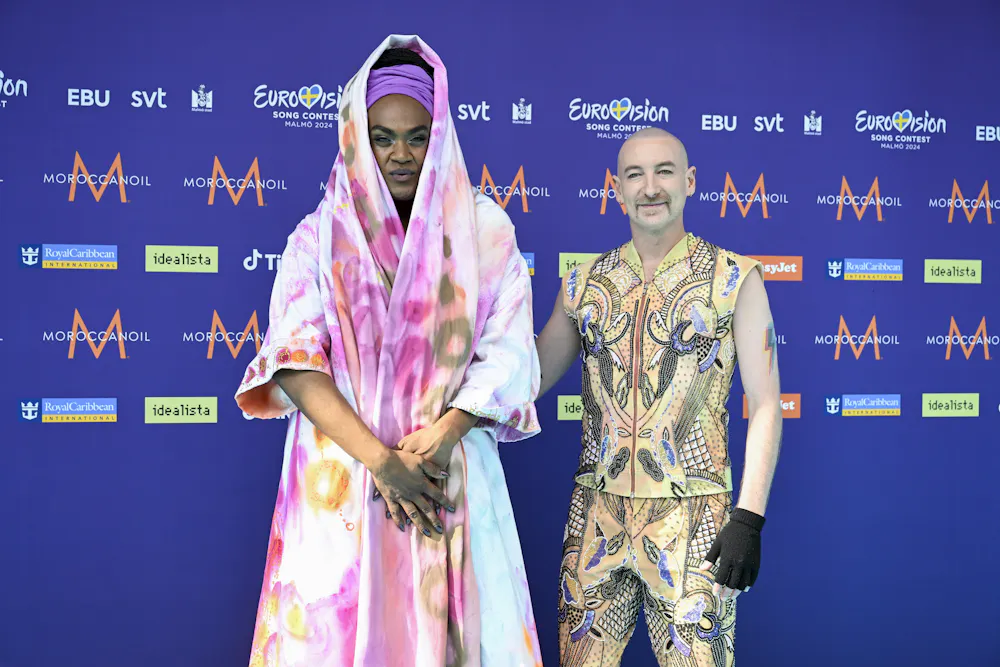
So who are Electric Fields?
The South Australian electronic dance music duo represented Australia in Malmö, Sweden, with their 2024 release One Milkali (One Blood). The track is global in its references to the gods, planets, atoms and billions of people, united in having “one blood”. But it’s also local in its use of language variety.
While much of the lyrics are in English, an international language, some are from an Australian language. The phrase milkaḻi kutju “one blood” and milkaḻila “we are blood”, inform the chorus and the title. These are words of both Pitjantjatjara and Yankunytjatjara, two closely related languages spoken by some 4,000 Aṉangu, Aboriginal people whose homelands have been divided by the South Australian, Northern Territory and Western Australian borders.
Read more: The state of Australia's Indigenous languages – and how we can help people speak them more often
Electric Fields vocalist Zaachariaha Fielding hails from Mimili, a remote community in far-north South Australia. Today, Pitjantjatjara/Yankunytjatjara together make up one of the most widely spoken Australian First Nations languages. Aṉangu have been able to pass on their language continuously since colonisation, both for historical reasons and as a result of tireless efforts by the community.
Globally, 4,000 speakers isn’t many, though. In fact, all Indigenous Australian languages are endangered and many communities struggle to find spaces where they can use and pass on their languages. Contemporary music is one such place where First Nations languages are increasingly being found.
Songs almost always require repetition and play with grammar in a way that’s not found in speech. One Milkali is no exception, with the word milkaḻi (blood) heard no less than 30 times.
The lyric milkaḻila (we are blood) also uses this same word, but with the pronoun ending -la meaning “we”. This type of repetition and variation makes song an excellent medium for language learning and artistic writing. Popular music can spur listeners to want to know more in a way than speech can’t.
Other songs by the duo are sung completely in Pitjantjatjara/Yankunytjatjara. For example, Anpuru Maau Kutjpa incorporates a ceremonial singing style known as inma, which is common to a number of language varieties across the Western Desert region of Australia.
Like inma, the song uses a rhythmic-text sung in unison, which repeats over a much longer descending melody, ending in a repeated tonic or “home pitch”. As the lyrics repeat, they match with a different part of the melodic line. By using words common to many groups, ceremonial songs appeal to a broad audience, as if to say: we sing in the same language, we are unified.
Another way songs can appeal to people through language is by moving between between different languages. One Milkali switches between English and Pitjantjatjara/Yankunytjatjara, demonstrating what the song is about: a contemporary world where “borders blur”, and of which Aṉangu are a part.
Many Aṉangu, especially young people, move fluently and creatively between English and Pitjantjatjara/Yankunytjatjara. Multilingual people often switch languages or speech registers when they talk, in a process known as code-switching. Code-switching happens for various reasons, including to fit in, especially when we want to appeal to people.
The use of the yiḏaki instrument (traditionally used only in northern Australia) in the song also blurs the boundaries between the desert and the Top End, acting as an icon of Indigenous music that speaks to the world.
The artwork that accompanied Electric Fields’ Eurovision performance was also made by Fielding and speaks to this spirit of exchange. The work references song grounds near Fielding’s home of Mimili, where traditional inma is performed. Fielding has described this as “a place that’s like the Sydney Opera House for the [Aṉangu Pitjantjatjara Yankunytjatjara (APY)] Lands!”
First Nations representation in music
While Electric Fields has helped take Aboriginal language to the world stage, they are certainly not the only contemporary act to sing in First Nations languages.
In 1983, desert rock band Warumpi Band made Australian music history when they released the first rock song in an Indigenous language (Pintupi), Jailanguru Pakarnu (Out from Jail). Since then, many First Nations artists have composed, recorded and performed songs in First Nations languages.
Artists from the top end of the Northern Territory – such as Yothu Yindi and Baker Boy, who sing in Yolŋu Matha, and Emily Wurramara, who sings in Anindilyakwa – express great pride in their cultural identity.
Ripple Effect Band, an all-women rock band from the Western Arnhem Land community of Maningrida, are distinctive because they sing in five First Nation languages: Ndjébbana, Kune, Na-kara, Burarra and Kuninjku, reflecting the multilingual nature of their region.
Band member Patricia Nja-wakadj Gibson sees language as connected to community, Country and spiritual ancestors. She says:
Singing in our languages, connects us to our ancestors. We think about where we come from. Our song Ngúddja shows how our languages come from the wind, blowing across the land. It connects all the different languages and the different people from different countries. It brings us together, making us powerful and strong.
The use of First Nation languages in song can contribute to social change by modelling cultural exchange and understanding. And by selecting Electric Fields to sing One Milkali at Eurovision, we present an Australian national identity that celebrates diversity through acknowledging First Nation perspectives and languages.
Authors: Myfany Turpin, Associate Professor, Ethnomusicology, Linguistics and Ethnobiology, University of Sydney


















