

annoying campaign tricks that are legal
- Written by: Graeme Orr, Professor of Law, The University of Queensland
“Make Australia Great.” So began several million text messages, sent last week from Clive Palmer’s United Australia Party. Palmer’s bumptious campaign techniques actually predated those of Donald Trump.
But now he is aping Trump’s slogans and nationalism, if with a less reactionary, more third-way ethos. The chances of Palmer rising again, like the proverbial political soufflé, are remote. But what of his campaign methods?
Mass texting (I’ll dub it “mexting”) is nothing new in electoral politics. Fifteen years ago it proved controversial, during a local election on the Gold Coast. Late night texts were sent to target young voters while they were out on the town.
The message – which came from nightclubs, urging voters to keeping licensed venues open all hours – was lost in a backlash. In those days people paid not just per text they sent, but often to receive them as well.
Mobiles have since become more ubiquitous, intimate fixtures, and we no longer pay to receive messages, nor do many of us pay for individual texts.
Palmer’s party admits to receiving more than 3,000 complaints (which he claims were robo-calls by trade unions), and he says there’s more to come. But why risk alienating the very people you are reaching out to? And how, if at all, does the law regulate such in-your-face campaign techniques?
The law on ‘mexting’?
For once, the legal how is easier than the political why. The national Spam Act of 2003 regulates unsolicited electronic messages via telephone and email. But only commercial messages, about goods and services or investments, are prohibited.
Social and political advocacy is not treated as suspect. On the contrary, it is encouraged. The Privacy Act, in particular, lets MPs and parties collect data on citizens’ views, to better personalise their messages.
Exempting politicians from privacy laws is based on the philosophy that freedom of political communication is vital to Australia’s democratic process.
Read more: Australia should strengthen its privacy laws and remove exemptions for politicians
Even when government agencies, charities or political parties offer services or solicit donations or membership, they are given a free hand. All they have to do is include a link about who authorised the message.
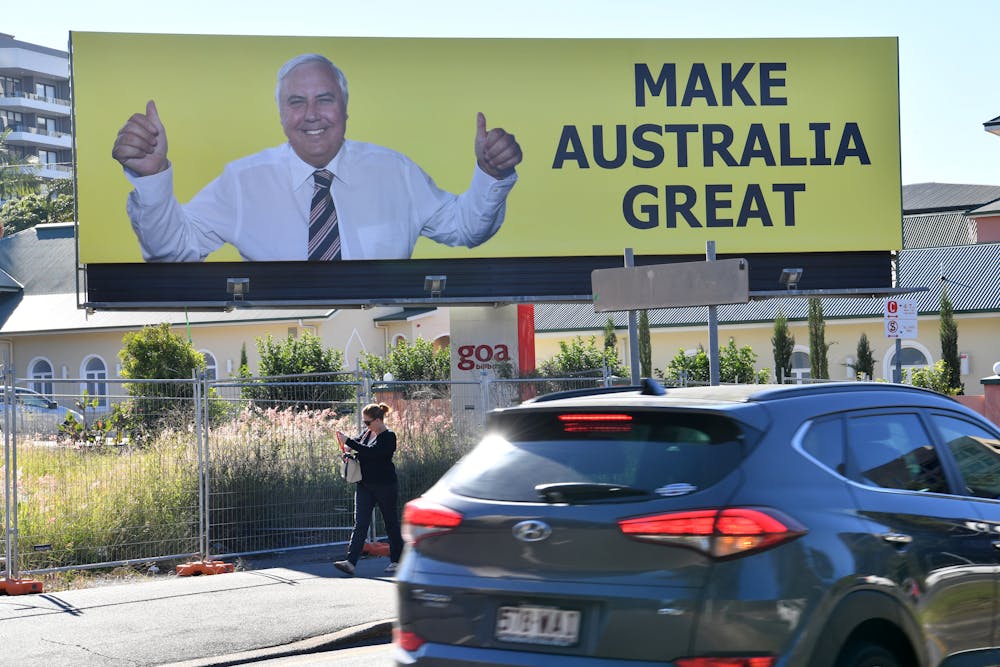 Palmer parroting Trump.
Darren England/AAP
Palmer parroting Trump.
Darren England/AAP
The licence to advocate, provided it is not done anonymously, is an old one under electoral law in English-speaking democracies. The obligation to “tag” messages enables the speaker to be traced and helps us discount the source of political opinions.
Read more: Don't be distracted by an SMS in the same-sex marriage survey debate
That is merely a rule about form, not manner or content. When it comes to manner, there are laws against offensive messages via mass media – whether broadcast or sent by post. (Good luck enforcing that rule in the back passages of the internet.)
There are also, famously, rules against discriminatory “hate” speech.
When it comes to content, you need to avoid defaming people. But there is no general requirement of truth, in the media or in politics, outside rules against misleading parliament, and a limited offence of materially false, paid, election-time ads in South Australia.
At the 2016 general election, the Labor Party dismayed the government and many observers, by mexting as part of its so-called “Mediscare” campaign. The texts looked like they came from Medicare itself. The trick led to a tightening of rules and a new offence of “impersonating” a Commonwealth body.
Other in-your-face campaign methods
Mexting sits in a long line of in-your-face campaign methods. The century old tradition of handing out flyers lives on, as letterboxes in marginal electorates will surely testify later this year.
Another was the “soap box” speech, trundled around shopping precincts via a loudspeaker on the back of a ute. In the middle of last century it was so typical that, as a young candidate, Gough Whitlam is said to have campaigned this way via a boat, to reach outlying suburbs not well serviced by roads.
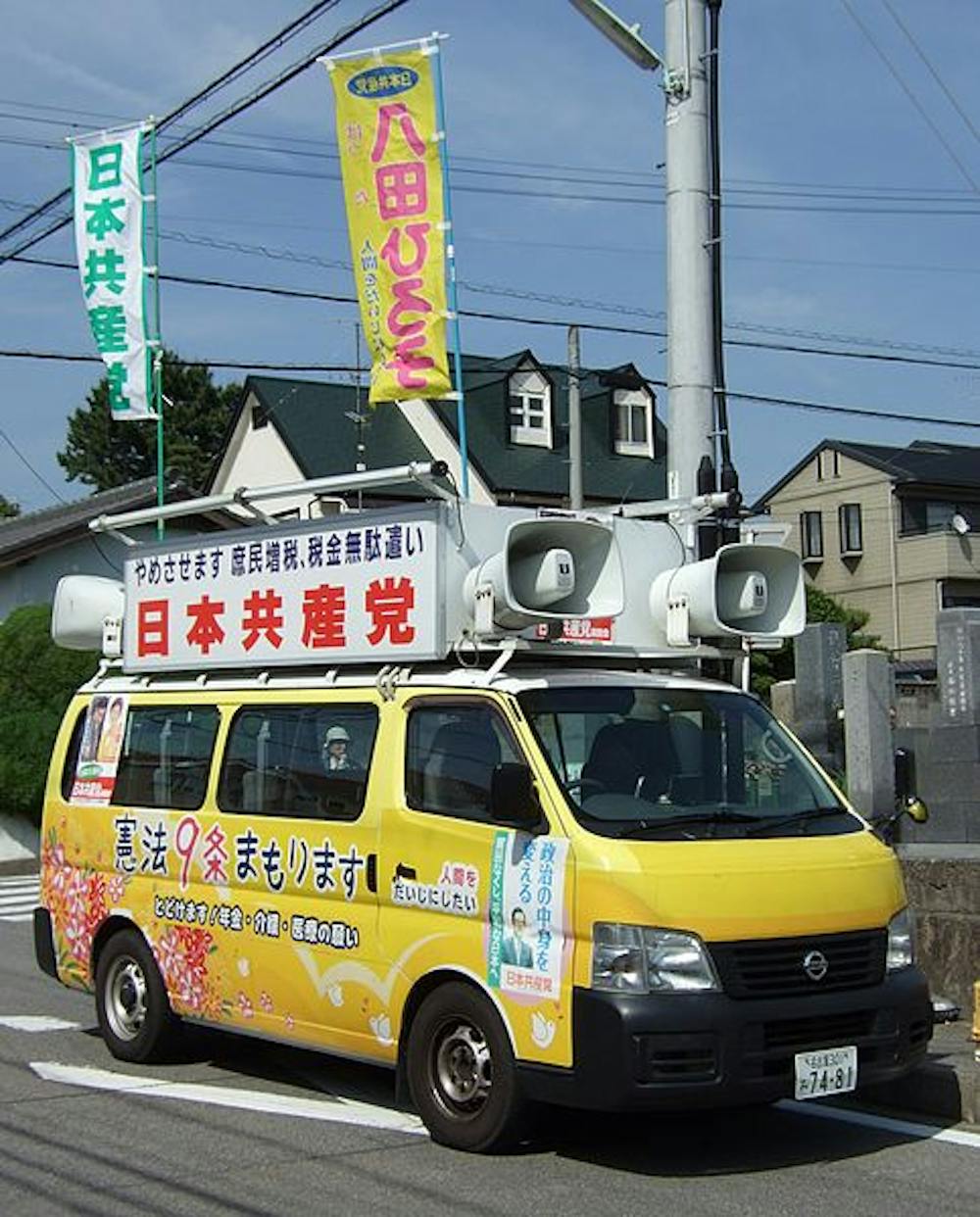 Sound trucks show the ‘soap box’ method of campaigning is still used in Japan.
Wikimedia Commons
Sound trucks show the ‘soap box’ method of campaigning is still used in Japan.
Wikimedia Commons
It is all but dead today in Australia, but lives on in the “sound trucks” of Japan.
More recent innovations are the ubiquitous “direct-mail” – a personalised if expensive variant of letterbox stuffing. Plus the “robo-call”, where a pre-recorded message is automatically dialled to thousands of telephones. I well recall picking up my landline, over dinner in 2007, to hear John Howard greet me. He happily ploughed on despite my unflattering response.
As for how, practically, a campaign assembles thousands of valid mobile numbers… well, Palmer’s party says it has no list. It may have hired a marketing firm to send out the texts. Commercial entities, notoriously, collect and trade files of phone numbers, postal and email addresses, and more.
Still, why? A cynic might say that for Palmer, any notoriety is good notoriety. His gambit has people talking about him again. Minor parties expect to alienate people: their goal is to attract a few percent of the vote.
Why major parties employ such tactics is another matter. They have to build broader coalitions of voters. But there is a cost-benefit analysis at work. Electronic messaging can reach swathes of people more cheaply than broadcast advertising, which in any event lacks the reach it once had. And negative advertising, like Mediscare, tends to work.
As it is, modern parties lack mass memberships and cannot rely primarily on organic influence or door-knocking by activists.
So while spamming, in text or audio, seems perverse – and is unlikely to be as effective as targeted or viral messaging on social media, or community-based campaigning – it won’t disappear.
For my part, I won’t grumble about a text from Mr Palmer popping up in my pocket. It beats his huge yellow billboards in terms of a blight on our public spaces.
Authors: Graeme Orr, Professor of Law, The University of Queensland



















