

Nuclear subs are coming to Australia. Now the Coalition wants reactors, too. We’re not ready for it
- Written by: Ian Lowe, Emeritus Professor, School of Environment and Science, Griffith University
For decades, Australia has exported uranium – but not used it, other than in the Lucas Heights research reactor. But change is coming.
We now face a rapidly deepening commitment to the nuclear industry, through nuclear submarines (bipartisan support) or nuclear reactors (Coalition support).
The Albanese government was quick to accept the Coalition’s AUKUS deal, which looks likely to bring the first nuclear-powered submarine to our ports in about eight years.
Nuclear subs offer strong military deterrence. But they come with a hard problem: how to manage the especially nasty radioactive waste at the end of a submarine’s life.
Last night, Opposition Leader Peter Dutton pulled both together in his budget reply speech, asking:
Why is the technology which is safe for our submariners unsafe for our citizens?
The Coalition is giving us clear indications it will take a plan to build nuclear power stations to next year’s election, though it is coy on where.
That would face a string of hurdles, not just changing Commonwealth and state laws currently banning nuclear power, but also needing to find communities willing to have a nuclear reactor. Like it or not, nuclear is appearing in Australia’s future for the first time.

How did we get here?
Nuclear power has never been cost-effective in Australia. When the industry was starting in the US and UK in the 1950s, each Australian state had its own power grid, each too small scale for nuclear reactors.
The short-lived Gorton government proposed one on Commonwealth land at Jervis Bay, but the tenders for the project showed it was uneconomic.
Worldwide, the disastrous nuclear accidents at Chernobyl in 1986 and Fukushima in 2011 have led to understandable resistance from communities slated for a reactor.
Then there’s the almost intractable problem of radioactive waste.
In Australia, successive governments have failed to find permanent storage for our low-level waste from nuclear medicine and research, much of it from the Lucas Heights research reactor. The most recent plan to store waste at Kimba, in South Australia, failed last year.
If this waste is buried under a few metres of earth, the radiation levels at the surface are not significantly above the background levels we all live with.
Even so, no community has yet been willing to have that waste buried in their area.
First Nations groups on remote Country are well aware of the damage done to people and natural areas by British nuclear weapons tests at Emu Fields and Maralinga in South Australia in the 1960s, so they are very reluctant to accept even low-level waste.
 Australia has long struggled to find safe storage even for low level waste from nuclear medicine or our Lucas Heights research reactor.
Australian Nuclear Science and Technology Organisation/AAP
Australia has long struggled to find safe storage even for low level waste from nuclear medicine or our Lucas Heights research reactor.
Australian Nuclear Science and Technology Organisation/AAP
What’s the issue with nuclear submarine waste?
Last year, Defence Minister Richard Marles said a waste dump would be located on current or future defence land. This might avoid some community pushback but is unlikely to quell fears.
This week, a Labor-chaired parliamentary committee called for the government to rule out accepting high-level waste from the submarines – specifically, the reactors and spent fuel from decommissioned submarines.
After fifty years of using this technology, many countries are still struggling with what to do with the resulting waste. Finland will soon open the world’s first deep geological nuclear waste storage, a facility meant to last a million years. But countries such as the United States cannot find an acceptable location.
Because the submarine reactors use highly enriched, weapons-grade nuclear fuel, the waste is much nastier even than the “high-level waste” from nuclear power stations, with high levels of radioactive isotopes of cobalt and nickel.
Neither the US nor the United Kingdom have a long-term solution for dealing with their own nuclear sub waste.
Those countries could, under the wording of the draft AUKUS laws, argue for their waste to be stored in Australia, too.
This would be unpopular. When the 2016 South Australian Royal Commission proposed storing high-level waste from overseas nuclear power stations as a new source of revenue, a citizens’ jury rejected the plan, concluding the risks were unacceptable.
Realistically, our government will do what US and UK governments have done for decades: store the waste temporarily and kick the can down the road.
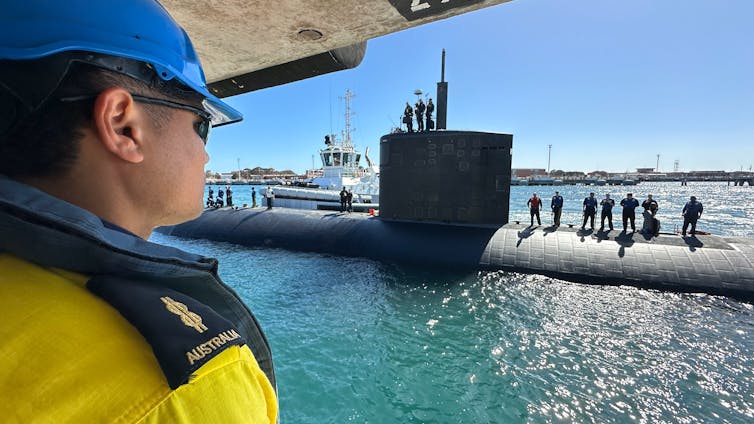
 Australia will have nuclear submarines within a decade. This photo shows the March 2024 visit of the US nuclear sub, USS Annapolis, to the HMAS Stirling naval base in Perth.
U.S Embassy Australia/Flickr, CC BY-NC-ND
Australia will have nuclear submarines within a decade. This photo shows the March 2024 visit of the US nuclear sub, USS Annapolis, to the HMAS Stirling naval base in Perth.
U.S Embassy Australia/Flickr, CC BY-NC-ND
What about nuclear power?
Since losing office in 2022, the Coalition has become pro-nuclear power. Political analysts see this positioning as a way for the Liberal and National parties to slow the renewable build, prolong coal power for the decades needed to build nuclear power, and attack Labor.
But while the politics are clear, the Coalition’s position on nuclear is opaque.
For a few months late last year, the Coalition was in favour of “small modular reactors” rather than the expensive and slow-to-build large reactors built in the northern hemisphere. That plan ran into two problems. First, these reactors are still a gleam in the eyes of nuclear technologists. They do not yet exist. The American design promoted by the Coalition was cancelled due to cost blowouts.
The second problem is there really are economies of scale with nuclear reactors. France and the UK have concentrated on large reactors because doubling the size of reactors does not double the cost of generating electricity.
Even so, large reactors are now struggling to be economically competitive, even in countries such as France with significant cross-subsidies from nuclear weapons programs.
Old nuclear reactors which have written off the cost of construction are being closed because the operating and maintenance costs make their power more expensive than can be obtained from solar farms and wind turbines.
This year, the Coalition has switched back to old-fashioned large reactors.
Electricity from nuclear reactors costs three to four times as much as what can be provided by solar farms or wind turbines. Even adding storage to firm renewables leads to a price tag less than half that of nuclear. Reactors often take decades to build.
It is difficult to see the electoral appeal of a platform promising extra risks, more expensive energy and a slow build.
Where does that leave us? It’s very unlikely Australia will ever have nuclear power. But it is very likely we will have to grapple with the spectre of high-level nuclear waste for the first time.
Read more: Nuclear power makes no sense for Australia – but it's a useful diversion from real climate action
Authors: Ian Lowe, Emeritus Professor, School of Environment and Science, Griffith University


















