

Fury Road was a pioneering portrayal of disability. Furiosa is a letdown
- Written by: Katie Ellis, Professor in Internet Studies, Curtin University
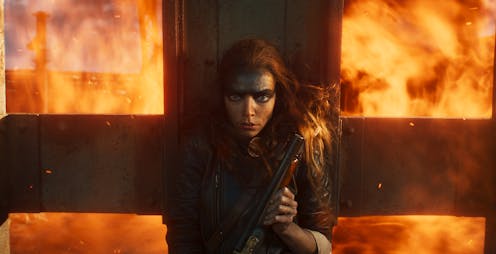
Furiosa, the latest instalment of the Mad Max franchise, has arrived a decade after the release of George Miller’s groundbreaking reboot Fury Road (2015).
As we demonstrated in our 2019 book, Miller and the ongoing Mad Max saga used representations of disability, gender, trauma and mythology to propel the films into cult status, global markets and international fandom, while sensitive to shifting sensibilities within the zeitgeist.
Max (Mel Gibson) in the earlier films reflected an era of generation X machismo. Furiosa in Fury Road, played by Charlize Theron, represented a more inclusive form of heroism – a postfeminist celebration of teamwork.
The overtaking of a male action hero with a disabled female protagonist was a widely celebrated feature of Fury Road, and something we had never seen before in action cinema.
Furiosa promised to give us the impairment origin story and explain the experiences that shaped Furiosa to become the strong, disabled female leader in Fury Road.
Unfortunately, aside from some clever references to Max’s own madness origin story, the film’s focus on Furiosa’s amputation exploits disability, and closes down the related commentary and critique previously expanded in each progressive Mad Max film.
Haunted by the past
Miller and his co-writers have consistently presented the movies’ principal antagonists as survivors of deeply traumatic events.
In the 1979 first film, Max recognises his emerging, vengeful mania, saying spending too much time on the road will make him “a terminal crazy”.
As he spends more time in the Wasteland, becoming that terminal crazy, characters in the second and third films chide him for maintaining his antisocial grief and vengeful rage.
As Max further withdraws from society, the films chronicle patriarchy at its extremes, and the breakdown of post-apocalyptic society. Max’s inner traumas are reflected on his body as physical impairments.
By Fury Road, Max (Tom Hardy) is artfully shown suffering from post-traumatic stress disorder, repeatedly haunted by guilt and experiencing hallucinations.
Powerfully, also in Fury Road, the cause of Furiosa’s disability is neither revealed nor spoken of. Her lack of one arm is never presented as a particular struggle or disadvantage. The focus is on her heroism and leadership; her emotions range from raw fury to compassion.
Fury Road’s prequel, Furiosa (now played by Anya Taylor-Joy) barely registers emotion at all: part survival mechanism, but also post-trauma mutism and hypervigilance.
A brief dream montage of her traumatic experiences ends with a startled fight or flight reflex. But there is little to empathise with.
The film promised to offer an insight into Furiosa’s motivations. By focusing mostly on the lead up to the amputation – instead of developing her inner world – audiences are deprived of an opportunity to really understand this character.

Furiosa launches herself into increasingly dangerous situations and threats to her body and life, teasing the inevitable: when will she lose her arm?
Compared with the complex representations of disability, gender and leadership in Fury Road, in which Furiosa’s strength and evolving leadership is communicated through her emotive facial expressions and empathy for others, this Furiosa remains one-dimensional.
This is such a departure from the innovation in disability and gender representation in Fury Road. The film obscures more than reveals.
A narrative prosthesis
Cultural disability theorists David Mitchell and Sharon Snyder write of a tendency in film and popular literature to use disability as a “narrative prosthesis”:
as a crutch upon which narratives lean for their representational power, disruptive potentiality, and analytic insight.
When disability is used as a narrative prosthesis, the story focuses on disability as a tragedy, or on overcoming the tragedy of an impaired body.
Furiosa’s impairment origin story is the crutch upon which this film relies. This focus comes at the expense of representations of disability and trauma explored throughout the previous films’ subtexts.
 Furiosa’s impairment origin story comes at the expense of representations of disability and trauma.
Jasin Boland/Warner Bros. Pictures
Furiosa’s impairment origin story comes at the expense of representations of disability and trauma.
Jasin Boland/Warner Bros. Pictures
Miller’s critique of the rising road toll in the 1970s inspired the first two films.
As the series progressed, the films provided commentary on catastrophe, capitalism and survivalism, showcasing tyrannical leaders who forgo the health of the planet and its people for the sake of profit and power.
Fury Road turned its lens towards disabled and traumatised characters – there is rarely a scene without them. The characters with disabled and ageing bodies hold the promise for a new beginning, suggesting alternatives to violent, despotic overlords.
For the most part in Furiosa, these broader narratives are missing. The drama hinges on the possibility the next scene could be the moment Furiosa will lose her arm.
To regress from a complex representation of disability and gender in Fury Road to an exploitative fascination with how and when Furiosa acquires this impairment – rather than who it allowed her to become – is disappointing.
Fury Road asked us to expand our understanding of disability. Furiosa feeds on voyeuristic anticipation.
Furiosa’s end titles are interrupted with brief iconic clips from Fury Road. Such arresting imagery only serves to emphasise the former film’s potency and resonance at the expense of the latter.
Authors: Katie Ellis, Professor in Internet Studies, Curtin University


















