

By not mining vital minerals, NZ is ‘offshoring its own environmental footprint’ – is that fair?
- Written by: Martin Brook, Associate Professor of Applied Geology, University of Auckland, Waipapa Taumata Rau
When Resources Minister Shane Jones recently unveiled his draft strategy for mineral mining, it was quickly criticised by the Labour opposition as “taking New Zealand backwards”. One environmental group even called it a “love letter to mining companies”.
But the government’s ambition to double the sector’s export value to NZ$2 billion by 2035, with flow-on effects for local employment and regional economies, deserves a broader debate.
In particular, New Zealanders opposed to mineral mining must ask whether it is ethically fair and reasonable to effectively outsource the risks of mining to other countries, while benefiting from the modern technologies those minerals make possible.
The government’s mining strategy aims to produce a list of “critical minerals” for exploration. The International Energy Agency identifies minerals such as copper, lithium, nickel, cobalt and rare earth elements as essential components in many of today’s rapidly growing clean energy technologies – from wind turbines and electricity networks to electric vehicles.
Indeed, according to the United Nations Environment Programme, these critical minerals are increasingly necessary for decarbonising energy systems. One of the three pillars of the draft minerals strategy is the delivery of minerals “for a clean energy transition”. How we source those minerals is an important question.
Environmental impacts of mining
New Zealand has a rich mining history, with a wide variety of resources still extracted from underground and opencast mines. There is also a long history of opposition to mining, especially in national parks and on conservation land, as well as on privately owned hill country.
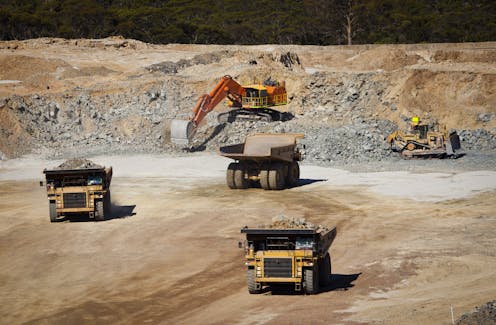
And there are legitimate concerns about the environmental, social and governance implications of mining. First, it can have devastating environmental effects, especially the extraction of high-value critical minerals that often require enormous “strip ratios” and generate huge volumes of waste rock tailings that must be stored.
Put simply, the strip ratio represents the amount of waste material (also known as overburden) that must be moved to extract a given amount of ore. For example, an overburden thickness of 100 metres and an ore thickness of 50 metres would yield a strip ratio of 2:1.
The actual concentration (known as the “grade”) of the target metal within the ore is the other factor to consider. For example, copper ore usually contains about 0.5% to 2% copper. A high-grade ore may be extracted from a mine with a high strip ratio, potentially generating enormous volumes of waste rock.
The waste is crushed, liquidised into slurry and pumped behind tailings dams, where it desiccates over time. Tailings dams are constructed to grow in height over decades as the mine progresses.
Effective management is integral to the safety of a mine and any downstream population. Tailings dam failures can lead to high-velocity flood disasters. But the well managed and stable tailings storage facility at OceanaGold’s Martha mine at Waihi shows what can be achieved with sufficient engineering and environmental regulation.
Offshoring our environmental footprint
Second, mineral extraction has caused and fuelled decades of unrest and civil war in some countries. The minerals most associated with funding conflict – the “three Ts” of tin, tungsten and tantalum – are present in many everyday products such as smartphones and laptops. Tantalum in particular is listed as a “conflict mineral” by the European Union.
According to the US Geological Survey, the source of tantalum has dramatically changed in recent years. In 2000, Australia produced 45% of global tantalum concentrates, but by 2014 this had dropped to 4%, offset by extraction in the mineral-rich but war-torn Katanga province of the Democratic Republic of Congo.
New Zealand is hardly in the same category. But the country’s mineral deposits are often found in mountainous areas, formed by the heat and pressure associated with tectonic processes over millions of years. Often these upland areas are beautiful national parks.
At the same time, New Zealand will need to use extracted minerals – either from its own mining operations or those of other countries – to make the transition to green energy and maintain present standards of living.
By not exploring the mineral mining potential in its own backyard, while simultaneously consuming those minerals from other sources, New Zealand is conveniently offshoring its own environmental footprint.
To assume foreign landscapes and environments are more expendable raises serious ethical and moral questions that need to be addressed within the current debate over the government’s draft mining strategy.
Reciprocity and obligation
One response might be for New Zealand, where it can, to look at extracting and exporting minerals within its own strict safety and environmental regulations. This would help share the global environmental burden of mineral extraction in a more sustainable way.
Such an approach (which might also be applied to the countries from which we source minerals) also fits with the Māori ethic of reciprocity, tauutuutu. This has been applied to modern economic and environmental thinking, and defined as:
an indigenous concept that places an ethical obligation on communities and enterprises to emphasise balance, reciprocity, and symbiosis in their social and environmental relationships.
Behavioural economics has shown that reciprocal behaviour builds trust, which is crucial for long-term relationships. Countries that embrace reciprocity are better positioned to navigate complex global challenges, achieve UN sustainable development goals, build resilient supply chains, and work toward a green future that energy transition will allow.
In anticipation of the critical minerals list the government has requested, New Zealand needs to consider how it can meet the demands of a new economy, practically as well as morally and ethically.
Authors: Martin Brook, Associate Professor of Applied Geology, University of Auckland, Waipapa Taumata Rau


















