

Yes, carbon capture and storage is controversial – but it’s going to be crucial
- Written by: Tianyi Ma, Distinguished Professor in Chemistry and Renewable Energy, RMIT University
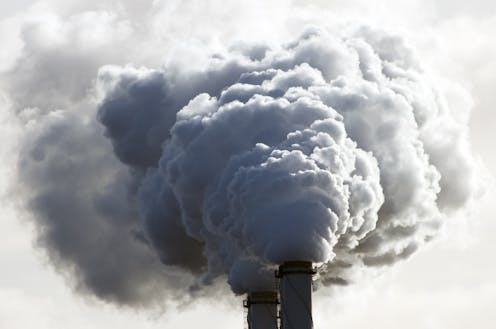
Renewable energy sources such as wind and solar are vital tools to help us make cuts to the 36 billion tonnes of greenhouse gases we emit each year.
But renewables alone can’t get us to net zero. Sectors such as cement, steel and chemical manufacturing produce significant carbon dioxide emissions difficult to eliminate through renewable energy alone.
This is why carbon capture, utilisation and storage has a place. This technology – invented by the oil and gas industry – is the best solution we have at present to capture these emissions at their source, before they can escape to the atmosphere.
Environmentalists have long been sceptical of carbon capture, warning it could be used to prolong fossil fuel dependence. That’s a matter for policy – the science is clear. We will need to capture carbon for the time being.
While essential, the roll out of carbon capture is sluggish. As a new report shows today, we’re removing just two billion tonnes of CO₂ from the atmosphere each year – and almost all of that is by planting trees. Carbon capture accounts for less than 0.1% so far.
How does carbon capture and storage work?
The technology was first used in the 1920s to separate carbon dioxide out from methane in fossil gas deposits.
By the 1970s, it had found use in boosting oil recovery – if you separate out the CO₂, you can pump it back down into the oil field and get more out. To date, the world’s largest carbon capture operation is in Western Australia, where Chevron is pumping carbon dioxide filtered from natural gas back underground%20facility%20on%20Barrow%20Island.). This history is why there’s been so much scepticism about the technology.
This is not entirely fair. The technology itself is neutral. If we detach it from its history, we can better assess its worth.
What carbon capture and storage offers is the ability to capture carbon dioxide emitted by the manufacture of cement and iron/steel. Together these account for about 15% of the world’s emissions total (8% and 7.2% respectively).

Once we capture carbon dioxide, we can use it in industrial processes such as chemical synthesis and food preservation. This approach can cut emissions while adding value, if waste CO₂ can be used for valuable products.
Alternatively, it can be stored in deep underground in stable geological formations such as porous sandstone capped with impermeable rock, or salt caverns, either natural or human-made. Here, it should stay for hundreds of years as gas. In some locations, carbon dioxide can react with minerals to form stable carbonates, effectively turning CO₂ into rock.
Carbon capture and storage can be added reasonably easily to existing infrastructure such as fossil fuel power plants, oil and gas fields and gas compression stations, offering a transitional pathway towards clean energy.
Retrofitting existing plants with capture and storage technology can significantly reduce emissions without the need to immediately decommission still-functional power plants.
What if carbon capture is a fig leaf?
Critics of carbon capture argue the technology will likely be used to prolong the use of fossil fuels rather than phase them out as quickly as possible. In this view, carbon capture would be used by fossil fuel plant operators and companies as a way to make coal or gas “green”, and delay the full transition.
This concern is valid. There is a risk leaders in fossil-fuel intensive industries might see capture and storage as a way to continue their operations with less pressure to innovate or reduce their reliance on fossil fuels, just as some have embraced carbon offsets to avoid fundamental change.
But again, this doesn’t mean we should discard the technology. While we now have good options for making electricity without emissions, we don’t yet have many options in tackling industrial emissions. While methods of making steel and cement without fossil fuels are emerging, change is slow and the problem of climate change is urgent.
Authorities from the Intergovernmental Panel on Climate Change to the International Energy Agency see an unavoidable role for carbon capture and storage.
The European Union’s Green Deal emphasises the role of carbon capture in cutting industrial emissions, while the United States has introduced tax credits and funding to accelerate its adoption.
Australia’s government last year invited companies to explore ten offshore sedimentary basins for possible carbon storage. But not everywhere is suitable – Queensland’s government recently banned the technology anywhere inside the Great Artesian Basin, due to concerns over the impact of the gas on groundwater.
How can we make best use of the technology?
For carbon capture and storage to grow to the size we need, it will need effective policy support such as tax credits, subsidies, and funding for research and development to drive innovation and cut costs.
In my research, I have worked with industry partners to find ways of making carbon capture useful. If a waste product has value, there’s an immediate incentive to capture it. For instance, I’ve worked on converting carbon dioxide into “solar fuels” such as green methane and methanol.
 Pure carbon dioxide is useful in some industrial processes, and has a market value.
John Minchillo/AP
Pure carbon dioxide is useful in some industrial processes, and has a market value.
John Minchillo/AP
We might think the future of energy will be solar, wind and storage. But it’s not going to be that simple. Fossil fuels will be harder to wean ourselves off than we realise. We’ll need green hydrogen for industrial uses and to make ammonia for green fertilisers. And we’ll have to ramp up carbon capture and storage for industrial emissions.
We might not like the idea of carbon capture and storage, but we will need it if we are going to get serious about net zero. At present, there’s nothing else like it for hard-to-abate sectors. What we must avoid is using it to prop up fossil fuels.
Authors: Tianyi Ma, Distinguished Professor in Chemistry and Renewable Energy, RMIT University


















