There are ‘forever chemicals’ in our drinking water. Should standards change to protect our health?
- Written by: Ian A. Wright, Associate Professor in Environmental Science, Western Sydney University
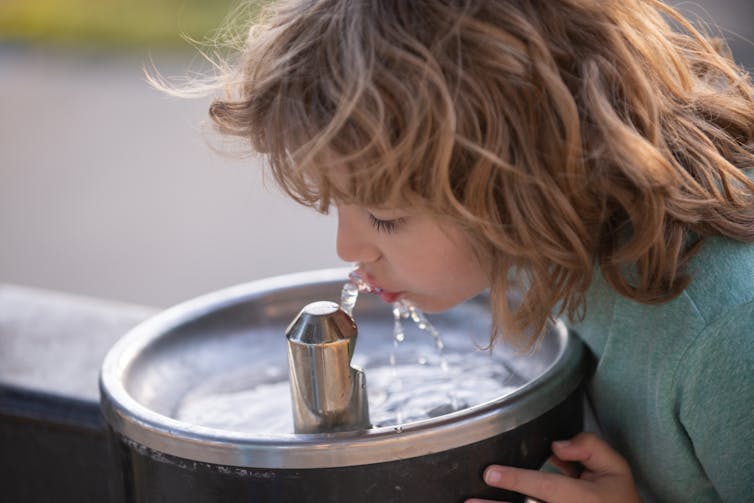
Today’s news coverage reports potentially unsafe levels of “forever chemicals” detected in drinking water supplies around Australia. These include human-made chemicals: perfluorooctane sulfonate (known as PFOS) and perflurooctanic acid (PFOA). They are classed under the broader category of per- and polyfluoroalkyl substances or PFAS chemicals.
The contaminants found in our drinking water are the same ones United States authorities warn can cause cancer over a long period of time, with reports warning there is “no safe level of exposure”.
In April, the US Environmental Protection Agency (USEPA) sent shock waves through the water industry around the world when it announced stricter advice on safe levels of PFOS/PFOA in drinking water. This reduced limits considered safe in supplies to zero and gave the water industry five years to meet legally enforceable limits of 4 parts per trillion.
So, should the same limits be enforced here in Australia? And how worried should we be that the drinking in many parts of Australia would fail the new US standards?
What are the health risks?
Medical knowledge about the human health effects of PFOS/PFOA is still emerging. An important factor is the bioaccumulation of these chemicals in different organs in the body over time.
Increased exposure of people to these chemicals has been associated with several adverse health effects. These include higher cholesterol, lower birth weights, modified immune responses, kidney and testicular cancer.
It has been very difficult to accurately track and measure effects of different levels of PFAS exposure on people. People may be exposed to PFAS chemicals in their everyday life through waterproofing of clothes, non-stick cookware coatings or through food and drinking water. PFAS can also be in pesticides, paints and cosmetics.
The International Agency for Research on Cancer (on behalf of the World Health Organization) regards PFOA as being carcinogenic to humans and PFOS as possibly carcinogenic to humans.

Our guidelines
Australian drinking water supplies are assessed against national water quality standards. These Australian Drinking Water Guidelines are continuously reviewed by industry and health experts that scan the international literature and update them accordingly.
All city and town water supplies across Australia are subject to a wide range of physical and chemical water tests. The results are compared to Australian water guidelines.
Some tests relate to human health considerations, such as levels of lead or bacteria. Others relate to “aesthetic” considerations, such as the appearance or taste of water. Most water authorities across Australia make water quality information and compliance with Australian guidelines freely available.
What about Australian PFOS and PFOA standards?
These chemicals can enter our drinking water system from many potential sources, such as via their use in fire-fighting foams or pesticides.
According to the Australian Drinking Water Guidelines, PFOS should not exceed 0.07 micrograms per litre in drinking water. And PFOA should not exceed 0.056 micrograms per litre. One microgram is equivalent to one part per billion.
The concentration of these chemicals in water is incredibly small. And much of the advice on their concentration is provided in different units. Sometimes in micrograms or nannograms. The USEPA uses parts per trillion.
In parts per trillion (ppt) the Australian Guidelines for PFOS is 70 ppt and PFOA is 560 ppt. The USEPA’s new maximum contaminant levels (enforceable levels) are 4 ppt for both PFOS and also PFOA. Previous news reports have pointed out Australian guidelines for these chemicals in drinking water are up to 140 times higher than the USEPA permits.
 The US Environmental Protection Agency announced PFAS limits for drinking water in April.
Joshua A. Bickell/AP
Yikes! That seems like a lot
Today’s news report cites PFOS and PFOA water tests done at many different water supplies across Australia. Some water samples did not detect either chemicals. But most did, with the highest PFOS concentration 15.1–15.6 parts per trillion from Glenunga, South Australia. The highest PFOA concentration was reported from a small water supply in western Sydney, where it was detected at 5.17–9.66 parts per trillion.
Australia and the US are not alone. This is an enormous global problem.
One of the obvious challenges for the Australian water industry is that current water treatment processes may not be effective at removing PFOS or PFOA. The Australian Drinking Water Guidelines provide this advice:
Standard water treatment technologies including coagulation followed by physical separation, aeration, chemical oxidation, UV irradiation, and disinfection have little or no effect on PFOS or PFOA concentrations.
Filtering with activated carbon and reverse osmosis may remove many PFAS chemicals. But no treatment systems appear to be completely effective at their removal.
Removing these contaminants might be particularly difficult for small regional water supplies already struggling to maintain their water infrastructure. The NSW Auditor General criticised the planning for, and funding of, town water infrastructure in regional NSW back in 2020.
Where to from here?
The Australian water industry likely has little choice but to follow the US lead and address PFOS/PFAS contamination in drinking water. Along with lower thresholds, the US committed US$1 billion to water infrastructure to improve detection and water treatment. They will also now require:
Public water systems must monitor for these PFAS and have three years to complete initial monitoring (by 2027) […]
As today’s report notes, it is very difficult to find any recent data on PFOS and PFOA in Australian drinking water supplies. Australian regulators should also require ongoing and widespread monitoring of our major city and regional water supplies for these “forever chemicals”.
The bottom line for drinking tap water is to keep watching this space. Buying bottled water might not be effective (2021 US research detected PFAS in 39 out of 100 bottled waters). The USEPA suggests people can reduce PFAS exposure with measures including avoiding fish from contaminated waters and considering home filtration systems.
Authors: Ian A. Wright, Associate Professor in Environmental Science, Western Sydney University