

Modern human DNA contains bits from all over the Neanderthal genome – except the Y chromosome. What happened?
- Written by: Jenny Graves, Distinguished Professor of Genetics and Vice Chancellor's Fellow, La Trobe University
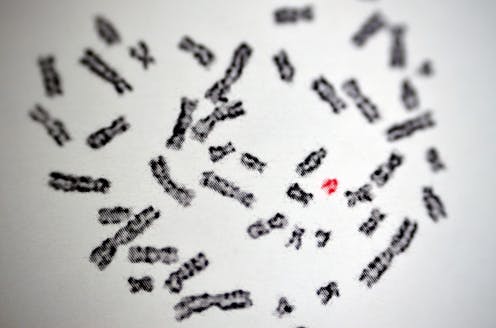
Neanderthals, the closest cousins of modern humans, lived in parts of Europe and Asia until their extinction some 30,000 years ago.
Genetic studies are revealing ever more about the links between modern humans and these long-gone relatives – most recently that a rush of interbreeding between our species occurred in a relatively short burst of time around 47,000 years ago. But one mystery still remains.
The Homo sapiens genome today contains a little bit of Neanderthal DNA. These genetic traces come from almost every part of the Neanderthal genome – except the Y sex chromosome, which is responsible for making males.
So what happened to the Neanderthal Y chromosome? It could have been lost by accident, or because of mating patterns or inferior function. However, the answer may lie in a century-old theory about the health of interspecies hybrids.
Neanderthal sex, genes and chromosomes
Neanderthals and modern humans went their separate ways somewhere between 550,000 and 765,000 years ago in Africa, when Neanderthals wandered off into Europe but our ancestors stayed put. They would not meet again until H. sapiens migrated into Europe and Asia between 40,000 and 50,000 years ago.
Scientists have recovered copies of the full male and female Neanderthal genomes, thanks to DNA from well-preserved bones and teeth of Neanderthal individuals in Europe and Asia. Unsurprisingly, the Neanderthal genome was very similar to ours, containing about 20,000 genes bundled into 23 chromosomes.
Like us, they had two copies of 22 of those chromosomes (one from each parent), and also a pair of sex chromosomes. Females had two X chromosomes, while males had one X and one Y.
Y chromosomes are hard to sequence because they contain a lot of repetitive “junk” DNA, so the Neanderthal Y genome has only been partially sequenced. However, the large chunk that has been sequenced contains versions of several of the same genes that are in the modern human Y chromosome.
In modern humans, a Y chromosome gene called SRY kickstarts the process of an XY embryo developing into a male. The SRY gene plays this role in all apes, so we assume it did for Neanderthals as well – even though we haven’t found the Neanderthal SRY gene itself.
Interspecies mating left us with Neanderthal genes
There are lots of little giveaways that mark a DNA sequence as coming from a Neanderthal or a H. sapiens. So we can look for bits of Neanderthal DNA sequence in the genomes of modern humans.
The genomes of all human lineages originating in Europe contain about 2% Neanderthal DNA sequences. Lineages from Asia and India contain even more, while lineages restricted to Africa have none. Some ancient Homo sapiens genomes contained even more – 6% or so – so it looks like the Neanderthal genes are gradually fading out.
Most of this Neanderthal DNA arrived in a 7,000-year period about 47,000 years ago, after modern humans came out of Africa into Europe, and before Neanderthals became extinct about 30,000 years ago. During this time there must have been many pairings between Neanderthals and humans.
At least half of the whole Neanderthal genome can be pieced together from fragments found in the genomes of different contemporary humans. We have our Neanderthal ancestors to thank for traits including red hair, arthritis and resistance to some diseases.
There is one glaring exception. No contemporary humans have been found to harbour any part of the Neanderthal Y chromosome.
What happened to the Neanderthal Y chromosome?
Was it just bad luck that the Neanderthal Y chromosome got lost? Was it not very good at its job of making males? Did Neanderthal women, but not men, indulge in interspecies mating? Or was there something toxic about the Neanderthal Y so it wouldn’t work with human genes?
A Y chromosome comes to the end of the line if its bearers have no sons, so it may simply have been lost over thousands of generations.
Or maybe the Neanderthal Y was never present in interspecies matings. Perhaps it was always modern human men who fell in love with (or traded, seized or raped) Neanderthal women? Sons born to these women would all have the H. sapiens form of the Y chromosome. However, it’s hard to reconcile this idea with the finding that there is no trace of Neanderthal mitochondrial DNA (which is limited to the female line) in modern humans.
Or perhaps the Neanderthal Y chromosome was just not as good at is job as its H. sapiens rival. Neanderthal populations were always small, so harmful mutations would have been more likely to accumulate.
We know that Y chromosomes with a particularly useful gene (for instance for more or better or faster sperm) rapidly replace other Y chromosomes in a population (called the hitchhiker effect).
We also know the Y chromosome is degrading overall in humans. It is even possible that SRY was lost from the Neanderthal Y, and that Neanderthals were in the disruptive process of evolving a new sex-determining gene, like some rodents have.
Was the Neanderthal Y chromosome toxic in hybrid boys?
Another possibility is that the Neanderthal Y chromosome won’t work with genes on other chromosomes from modern humans.
The missing Neanderthal Y may then be explained by “Haldane’s rule”. In the 1920s, British biologist J.B.S. Haldane noted that, in hybrids between species, if one sex is infertile, rare or unhealthy, it is always the sex with unlike sex chromosomes.
In mammals and other animals where females have XX chromosomes and males have XY, it is disproportionately male hybrids that are unfit or infertile. In birds, butterflies and other animals where males have ZZ chromosomes and females have ZW, it is the females.
Many crosses between different species of mice show this pattern, as do feline crosses. For example, in lion–tiger crosses (ligers and tigons), females are fertile but males are sterile.
We still lack a good explanation of Haldane’s rule. It is one of the enduring mysteries of classic genetics.
But it seems reasonable that the Y chromosome from one species has evolved to work with genes from the other chromosomes of its own species, and might not work with genes from a related species that contain even small changes.
We know that genes on the Y evolve much faster than genes on other chromosomes, and several have functions in making sperm, which may explain the infertility of male hybrids.
So this might explain why the Neanderthal Y got lost. It also raises the possibility that it was the fault of the Y chromosome, in imposing a reproductive barrier, that Neanderthals and humans became separate species in the first place.
Authors: Jenny Graves, Distinguished Professor of Genetics and Vice Chancellor's Fellow, La Trobe University


















