

Common products, like perfume, paint and printer ink, are polluting the atmosphere
- Written by: Jenny Fisher, Senior Lecturer in Atmospheric Chemistry, University of Wollongong
Picture the causes of air pollution in a major city and you are likely to visualise pollutants spewing out of cars, trucks and buses.
For some types of air pollutants, however, transportation is only half as important as the chemicals in everyday consumer products like cleaning agents, printer ink, and fragrances, according to a study published today in Science.
Air pollution: a chemical soup
Air pollution is a serious health concern, responsible for millions of premature deaths each year, with even more anticipated due to climate change.
Read more: Climate change set to increase air pollution deaths by hundreds of thousands by 2100
Although we typically picture pollution as coming directly from cars or power plants, a large fraction of air pollution actually comes from chemical reactions that happen in the atmosphere. One necessary starting point for that chemistry is a group of hundreds of molecules collectively known as “volatile organic compounds” (VOCs).
VOCs in the atmosphere can come from many different sources, both man-made and natural. In urban areas, VOCs have historically been blamed largely on vehicle fuels (both gasoline and diesel) and natural gas.
Fuel emissions are dropping
Thanks in part to more stringent environmental regulations and in part to technological advances, VOCs released into the air by vehicles have dropped dramatically.
In this new study, the researchers used detailed energy and chemical production records to figure out what fraction of the VOCs from oil and natural gas are released by vehicle fuels versus other sources. They found that the decline in vehicle emissions means that – in a relative sense – nearly twice as much comes from chemical products as comes from vehicle fuel, at least in the US. Those chemicals include cleaning products, paints, fragrances and printer ink – all things found in modern homes.
The VOCs from these products get into the air because they evaporate easily. In fact, in many cases, this is exactly what they are designed to do. Without evaporating VOCs, we wouldn’t be able to smell the scents wafting by from perfumes, scented candles, or air fresheners.
Overall, this is a good news story: VOCs from fuel use have decreased, so the air is cleaner. Since the contribution from fuels has dropped, it is not surprising that chemical products, which have not been as tightly regulated, are now responsible for a larger share of the VOCs.
Predicting air quality
An important finding from this work is that these chemical products have largely been ignored when constructing the models that we use to predict air pollution – which impacts how we respond to and regulate pollutants.
The researchers found that ignoring the VOCs from chemical products had significant impacts on predictions of air quality. In outdoor environments, they found that these products could be responsible for as much as 60% of the particles that formed chemically in the air above Los Angeles.
The effects were even larger indoors – a major concern as we spend most of our time indoors. Without accounting for chemical products, a model of indoor air pollutants under-predicted measurements by a whopping 87%. Including the consumer products really helped to fix this problem.
Read more: We can't afford to ignore indoor air quality – our lives depend on it
What does this mean for Australia?
In Australia we do a stocktake of our VOC emissions to the air every few years. Our vehicle-related VOC emissions have also been dropping and are now only about a quarter as large as they were in 1990.
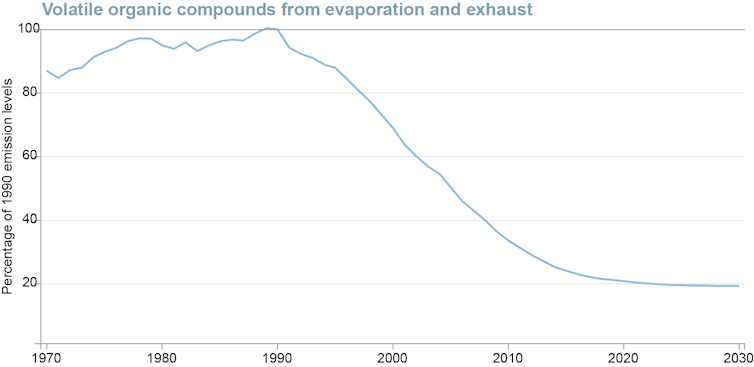 Historical and projected trends in Australia’s road transport emissions of VOCs.
Author provided, adapted from Australia State of the Environment 2016: atmosphere
Historical and projected trends in Australia’s road transport emissions of VOCs.
Author provided, adapted from Australia State of the Environment 2016: atmosphere
Nonetheless, the most recent check suggests most of our VOCs still come from cars and trucks, factories and fires. Still, consumer products can’t be ignored – especially as our urban population continues to grow. Because these sources are spread out across the city, their contributions can be difficult to estimate accurately.
We need to make sure our future VOC stocktakes include sources from consumer products such as cleaning fluids, indoor fragrances and home office items like printing ink. The stocktakes are used as the basis for our models, and comparing models to measurements helps us understand what affects our air quality and how best to improve it. It was a lack of model-to-measurement agreement that helped to uncover the VW vehicle emissions scandal, where the manufacturer was deliberately under-estimating how much nitrogen gas was being released through the exhaust.
If we can’t get our predictions to agree with the indoor measurements, we’ll need to work harder to identify all the emission sources correctly. This means going into typical Australian homes, making air quality measurements, and noting what activities are happening at the same time (like cooking, cleaning or decorating).
Read more: Heading back to the office? Bring these plants with you to fight formaldehyde (and other nasties)
What should we do now?
If we want to keep air pollution to a minimum, it will become increasingly important to take into account the VOCs from chemical products, both in our models of air pollution and in our regulatory actions.
In the meantime, as we spend so much of our time indoors, it makes sense to try to limit our personal exposure to these VOCs. There are several things we can do, such as choosing fragrance-free cleaning products and keeping our use of scented candles and air fresheners to a minimum. Research from NASA has also shown that growing house plants like weeping figs and spider plants can help to remove some of the VOCs from indoor air.
And of course, we can always open a window (as long as we keep the outdoor air clean, too).
Authors: Jenny Fisher, Senior Lecturer in Atmospheric Chemistry, University of Wollongong


















