

Australia needs large-scale energy production – here are 3 reasons why offshore wind is a good fit
- Written by: Ty Christopher, Director Energy Futures Network, University of Wollongong
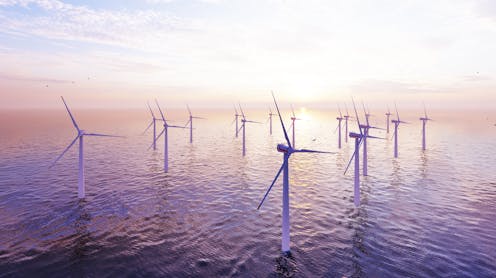
On the weekend, an area 20km off the Illawarra coast south of Sydney became Australia’s fourth offshore wind energy zone. It’s the most controversial zone to date, with consultation attracting a record 14,211 submissions – of which 65% were opposed.
The zone’s declaration has inflamed fierce debate over the pathway to decarbonisation, particularly in industrial regions. The Illawarra hosts heavy industries such as Australia’s largest steel manufacturer, BlueScope Steel.
In response to the announcement, National Party Leader David Littleproud declared Australia doesn’t need “large-scale industrial windfarms”. He argues the focus should instead be on household solar and battery storage.
So what is the role of offshore wind in our future energy mix? Here we argue offshore wind energy has three main advantages: scale, availability and proximity. It’s just what Australia needs.
1. Scale
Offshore wind has substantial energy-production potential. A single 100-turbine project is capable of generating up to 1.5 gigawatts (GW) of energy and the Illawarra zone could contain two projects (2.9GW).
To put this in perspective, Eraring, Australia’s largest coal-fired power station near Lake Macquarie in New South Wales, also produces 2.9GW.
Because offshore wind is more consistent than either onshore wind or rooftop solar, it is the most practical way to provide time-sensitive renewable energy grid security for large energy users.
This high-capacity, consistent energy source is particularly crucial for Australia’s industrial decarbonisation efforts. BlueScope Steel, for example, estimates it will need approximately 15 times its current energy consumption to transition to green steel-making operations in the Illawarra region.
2. Availability
Offshore wind blows more consistently than onshore wind. We can quantify this by comparing so-called “capacity factors”.
The capacity factor is the actual output of a power station over a given period of time, divided by the theoretical power that could be generated if the plant operated at full output for the same period of time.
Onshore wind has a capacity factor of 30%, meaning 1GW of onshore wind farms can be relied upon to deliver 0.3GW of output at any time.
Offshore wind has a capacity factor of at least 50%.
For reference, coal plants in Australia, due to their age and condition, have a capacity factor of 60% and this falls further every year.
It is a common myth that coal is reliable. The reliability of Australian coal fired generators is currently at an all time low and falling.
The Coalition’s plan for nuclear power plants announced on Wednesday might look like an alternative answer to the energy availability challenge. But the plan relies on coal in the meantime and coal-fired power plants have a limited lifespan. It’s highly unlikely those nuclear power stations could be built in time to take over from coal.
The International Atomic Energy Agency publishes a step-by-step guide to going nuclear. This internationally recognised manual says it takes 10–15 years for a country to go from initial consideration of the nuclear power option to operation of its first nuclear power plant.
So the first big problem with nuclear in Australia is, how do we ensure we have reliable power for the five to ten year gap between when most of the coal exits and the first nuclear power plant could possibly be commissioned?
3. Proximity
Most of Australia’s population and industry is near the east coast. Placing electricity generation near to where it is needed is more efficient. It also avoids having to construct many kilometres of new overhead electricity transmission lines to connect onshore wind farms far inland.
Australia is leading the world in the uptake of home solar panels and batteries. This is definitely worthwhile. But contrary to Littleproud’s suggestion, it’s not the whole solution to Australia’s decarbonisation effort. For example, it won’t solve the problem of the need to electrify heavy industry.
BlueScope has stated that to decarbonise its current steel-making operations, it will need 15 times more electricity. This is the equivalent of the solar exported by a staggering 3.6 million homes – more than one-third of the total number of homes connected to the National Electricity Market.
Putting this into perspective, the Illawarra region has 130,000 homes. By our calculations, the BlueScope steelworks currently uses the same amount of electricity each day as the total solar exported by 240,000 homes – assuming generous export of 10kWh per home and Bluescope’s daily use of 240,000 kWh of energy.
Even if the Illawarra had enough homes exporting solar power to electrify BlueScope’s operations, getting this electricity to where it’s needed is technically impossible. Home solar systems are connected to the lowest capacity part of the energy grid – the wires in the street. We simply don’t have the capacity to move gigawatts of power from rooftop solar to large energy users such as steel and aluminium plants.
Australia needs large-scale energy, including wind
Australia needs large-scale electricity generation. The Coalition has recognised this, and is now promoting large nuclear power plants as well as small modular reactors.
The clean energy transition requires multiple renewable energy sources to meet different needs. There is no “one size fits all” solution – and there is clearly an important role for offshore wind in this mix.
We can expect to see Australia’s first offshore wind farms operating in Victoria’s Gippsland by the end of the decade.
The Coalition remains committed to the Gippsland project. But it has signalled its intention to scrap proposed offshore wind zones in the Illawarra and Hunter, if elected.
This decision would have flow-on effects. An industry is emerging around the pipeline of potential wind energy projects. The latest announcement will almost certainly heighten tensions surrounding the already bitter debates raging in our communities.
Navigating the contested waters of offshore wind
It is common for the media and politicians to frame energy debates as a blunt binary of support versus opposition for different options, such as offshore wind. Yet genuine progress requires respectful dialogue and a commitment to finding common ground.
For the Illawarra, we argue much greater attention must be paid to the methods, models and outcomes of community engagement. We need to involve the community in constructive conversations about the nature, scale and scope of our future energy mix, which may include offshore wind.
Independent scientific research can provide the evidence base for such crucial decisions about the future of our communities and industries.
Authors: Ty Christopher, Director Energy Futures Network, University of Wollongong


















