

Why do dogs have different coats? Experts explain – and give grooming tips for different types
- Written by: Susan Hazel, Associate Professor, School of Animal and Veterinary Science, University of Adelaide
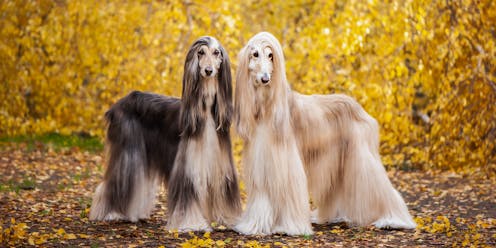
Dog hair comes in many varieties, from shaggy to short, curly to straight. If you live with a dog, you live with their hair – on your couch, in your clothes, it’s everywhere!
Beyond colour, have you ever wondered what’s behind the differences in coat type?
We actually know quite a lot about why dogs have different coats, and it comes down to their genes.
What are the main coat types in dogs?
The three main features of dog coats are how long the hairs are, whether they are curly or straight, and whether they have extra flourishes. The flourishes are called “furnishings”, and can include a hairy moustache and shaggy eyebrows.
Combinations of these three features result in seven different coat types in dogs: short, wire, wire and curly, long, long with furnishings, curly, and curly with furnishings.
We know from a study of more than 1,000 dogs with varying coats that differences in only three genes are responsible for this variety.
The gene responsible for long hair (called FGF5) is recessive, meaning dogs must have two copies of the mutated gene to have long hair. In humans, the same gene has been identified in families with excessively long eyelashes.
Curly coats in dogs are related to a gene called KRT71, which affects keratin, a protein involved in hair formation. Mutations in this gene in cats result in hairless (Sphynx) or curly-haired (Devon Rex) breeds.
The gene responsible for furnishings (RSPO2) is involved in establishing hair follicles. Hair follicles are small pockets in the skin that grow hair.
Variations in these three genes could explain the coat type in most (but not all!) of the dogs tested. For example, the long coat of the Afghan hound is not explained by these three genes. Further study is needed to identify less common mutations and genes controlling the coat in these dogs.
The earliest dog breeds would have been short-haired, as a result of the “wild-type” genes. Later changes would have arisen through mutation and deliberate selection through modern breeding practices.
If all three mutations are present, the dog has a long, curly coat with furnishings. An example is the Bichon Frisé.

What else varies in dog coats?
Dog coat types can also be single or double. In a double-coated breed such as a Labrador, there is a longer coarse layer of hairs and a softer and shorter undercoat. Wolves and ancestral dogs are single-coated, and the double coat is a result of a mutation in chromosome 28.
In the Labrador, the mutation was probably selected for as they were bred to retrieve fishing nets in Canada. The double coat is a great insulator and helps them to stay warm, even in icy water.
Why does it matter what kind of coat a dog has?
We know with climate change our world is going to get hotter. Dogs with a double coat are less able to tolerate heat stress, as their hair prevents heat loss.
In a study of dogs suffering heat-related illness, most of the 15 breeds at higher risk had double coats. The death rate in these dogs was 23%. We can only imagine how it must feel going out on a 40 degree day wearing a thick fur coat.
 Dogs with a double coat will appreciate help to stay cool on warm days, like this wading pool.
Owen Productions / Shutterstock
Dogs with a double coat will appreciate help to stay cool on warm days, like this wading pool.
Owen Productions / Shutterstock
Dogs with a double coat shed more hair than dogs with a single coat. This means even short-haired breeds, like the Labrador retriever, can shed an astonishing amount of hair. If you can’t tolerate dog hair, then a dog with a double-coat may not suit you.
When we think of wool we think of sheep, but in the past woolly dogs were kept for their wool that was woven by Indigenous groups and used to make blankets.
 A dog’s coat affects how much time and effort is needed for grooming.
Kathrineva20 / Shutterstock
A dog’s coat affects how much time and effort is needed for grooming.
Kathrineva20 / Shutterstock
A dog’s coat also affects how much time and effort is needed for grooming. Dogs with long or curly hair with furnishings are likely to need more time invested in their care, or visits to a professional groomer.
Designer dogs (cross-bred dogs often crossed with a poodle, such as groodles), are likely to be curly with furnishings. In a US study, people with designer dogs reported meeting their dogs’ maintenance and grooming requirements was much harder than they expected.
It’s not just bank balances and the time needed that can suffer. If people are unable to cope with the demands of grooming long-haired dogs, lack of grooming can cause welfare problems. A study of animal cruelty cases in New York found 13% involved hair matting, with some hair mats causing strangulation wounds and 93% of affected dogs having long hair.
How can you prevent problems?
If you have a curly- or long-haired breed of dog, it will help to train them to like being brushed from an early age. You can do this by counter-conditioning so they have a positive emotional response to being groomed, rather than feeling anxious. First show the brush or lightly brush them, then give them a treat. They learn to associate being brushed with something positive.
If you take your dog to the groomer, it’s very important their first experience is positive. A scary or painful incident will make it much more difficult for future grooming.
Is your dog difficult to groom or hard to get out of the car at the groomers? It’s likely grooming is scary for them. Consulting a dog trainer or animal behaviourist who focuses on positive training methods can help a lot.
Keeping your dog well groomed, no matter their hair type, will keep them comfortable. More important than looking great, feeling good is an essential part of dogs living their best lives with us.
Authors: Susan Hazel, Associate Professor, School of Animal and Veterinary Science, University of Adelaide


















