

Aboriginal performers have been singing up the streets of Sydney for NAIDOC week since 1959
- Written by: Laura Case, Lecturer in Musicology, Sydney Conservatorium of Music, University of Sydney
Aboriginal and Torres Strait Islander readers are advised this article contains names and images of deceased people.
Following on from the failed referendum, this year’s NAIDOC theme, “Keep the fire burning! Blak, Loud and Proud”, continues NAIDOC’s long-standing practice of responding to current events and looking to the future of the ongoing survival of Indigenous people.
NAIDOC events have always combined advocacy, protest and celebrations of culture through music, dance and art. This year is no exception.
The acronym NAIDOC represents the now old-fashioned sounding National Aborigines and Islanders Day Observance Committee. The name sounds out of date because the organisation, as the National Aborigines Day Observance Committee (NADOC) was established in the late 1950s at the height of the assimilation era.
Organised by church missionary councils in collaboration with the Federal government, the first “Aborigines Observance Day” was scheduled for July 12 1957.

Government and mission assimilation agendas framed many of the activities in the early years, but opportunities to perform publicly at an annual demonstration in Sydney’s Martin Place from 1959, and in a talent quest from 1961, soon became a meeting place for talented musicians and performers.
Here we see the seeds of the thriving Indigenous music scene of the present day.
A stage for talent
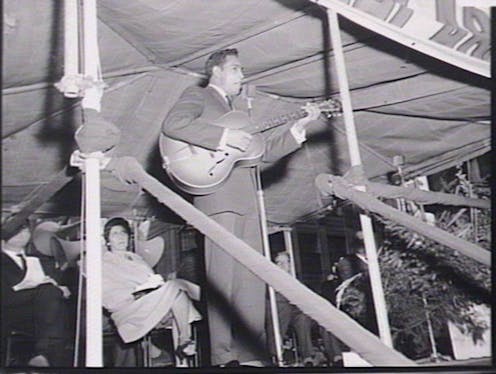
The 1961 and 1962 talent quest stages featured gumleaf players, guitars, piano accordions and homemade instruments including one constructed from an “oil drum, broom handle and two strings”.
Big name country singers Jimmy Little and Candy Williams were featured performers.
To compete in the talent quest, singers and dancers – including Lorna Beulah, Jimmy Little Snr, Eva Mumbler and Joe Timbery – travelled from Aboriginal reserves all over New South Wales.
 Lorna Beulah performs on the 1962 stage in Martin Place, Sydney.
State Library of New South Wales
Lorna Beulah performs on the 1962 stage in Martin Place, Sydney.
State Library of New South Wales
Talent quest winner Beulah subsequently received a scholarship to the NSW State Conservatorium in 1962. She went on to perform in professional touring shows such as the 1965 tour of George Gershwin’s Porgy and Bess as the only Australian singer alongside a cast of African American principals and Māori performers.
Building connections
Feature entertainers and talent quest participants in the 1962 event formed an ensemble for a self-produced one-off “All Coloured Show” the following year featuring Jimmy Little, Dandy Devine, Betty Fisher, Claude (Candy) Williams, Freddie Little and Noel Stanley.
On the eve of Aborigines’ Day 1963, Jimmy Little led a Revue at Sydney’s ANZAC House, featuring emerging stars of both opera and country music: Candy Williams, Lorna Beulah, Harold Blair, Freddie Little, Doug Peters, Col Hardy and Betty Fisher.
 National Aborigines’ Day in 1963, Martin Place, Sydney.
State Library of New South Wales
National Aborigines’ Day in 1963, Martin Place, Sydney.
State Library of New South Wales
Aboriginal performers made the most of these state-organised events to build networks and connect with other Aboriginal musicians across the east coast.
Keeping networks active during the assimilation period set the stage for the transformation of NADOC to an Indigenous-led organisation after the 1967 referendum for constitutional change.
In 1962, The ABC provided the non-Indigenous composer of the ballet Corroboree John Antill as judge of the talent quest. By 1963, Jimmy Little was judge and by 1974, NADOC was fully Indigenous run and led.
Individual, cultural and collective identities
The “I” was added to the organisation’s title in 1991 to acknowledge Torres Strait Islanders.
The current organisation traces its roots back well beyond the first officially named NADOC events. It continues to build on the momentous acts of resistance and commemoration of the 1920s and 30s where Aboriginal rights groups boycotted Australia Day in protest against the status and treatment of Indigenous Australians.
As Aunty Lynette Riley, national NAIDOC co-chair wrote this year:
Our people held a march to protest that the 150 year celebrations basically denied Aboriginal people’s existence, but also the lie that it was a peaceful colonisation of Australia.
Just around the corner from the site of the original moment of colonisation, and from Martin Place where the first talent quest was held, performers will once again gather to celebrate NAIDOC week.
Sydney’s Town Hall, the Sydney Conservatorium of Music and the Art Gallery of NSW form the backdrop for iconic Aboriginal performers this year such as Barkaa, Uncle Roger Knox and students and staff at the Conservatorium. These musicians will celebrate Aboriginal identity and resilience through musical performance.
This year, NAIDOC week offers an opportunity to reset our journey towards the Uluru Statement from the Heart and ongoing calls for a Treaty.
This year’s theme calls us to keep the fire burning by honouring the “enduring strength and vitality of First Nations culture”.
 Young children gathered to watch the celebrations in 1962.
State Library of New South Wales
Young children gathered to watch the celebrations in 1962.
State Library of New South Wales
It is a bold offer to come together and celebrate Indigenous culture and “the unapologetic celebration of Indigenous identity”.
NAIDOC’s online exhibition of historic posters shows protest and optimism have characterised NAIDOC themes since the post-1967 referendum era.
Marches to the Aboriginal tent embassy, commemoration of the “Bringing them Home” report on the Stolen Generations, emphasis on justice, self-determination and Treaty have always been part of the NAIDOC week celebration of culture.
The history of Aboriginal and Torres Strait Islander people transforming a day of mourning born out of protest into a week of cultural celebration brings home the ongoing relevance of NAIDOC.
Aboriginal people have always used music in the creation and preservation of individual, cultural and collective identities. As such, it makes sense that musical performances will continue to operate as an integral part of the demonstrations this year, and in the years to come.
Authors: Laura Case, Lecturer in Musicology, Sydney Conservatorium of Music, University of Sydney


















