

Street vendors' self-help strategies highlight cities' neglect of how the other half survive
- Written by: Redento B. Recio, Postdoctoral Research Fellow - Informal Urbanism (InfUr-) Hub, University of Melbourne
About 2.5 billion people, or half of the global labour force, work in the informal economy, the International Labour Organisation estimates. In developing Asian countries, more than 50% of the urban labour force is in informal work. Street vending is the most visible form of this. Yet no accurate statistics on street vendors are available.
Official planning documents do not include informal trading activities; they are “off the map”. This invisibility largely stems from state rules that consider street vending illegal. Amid the harsh policies, street vendors devise ways to cope with poverty and their insecure livelihood.
Read more: Nigeria should tackle poverty rather than hound hawkers off the streets
In the Baclaran district of Metro Manila, the capital of the Philippines, informal hawkers have resorted to several arrangements to gain financial capital or grow their small enterprises. These hawkers sell clothes, shoes, housewares, toys, gadgets, fresh fruits and vegetables, among other things.
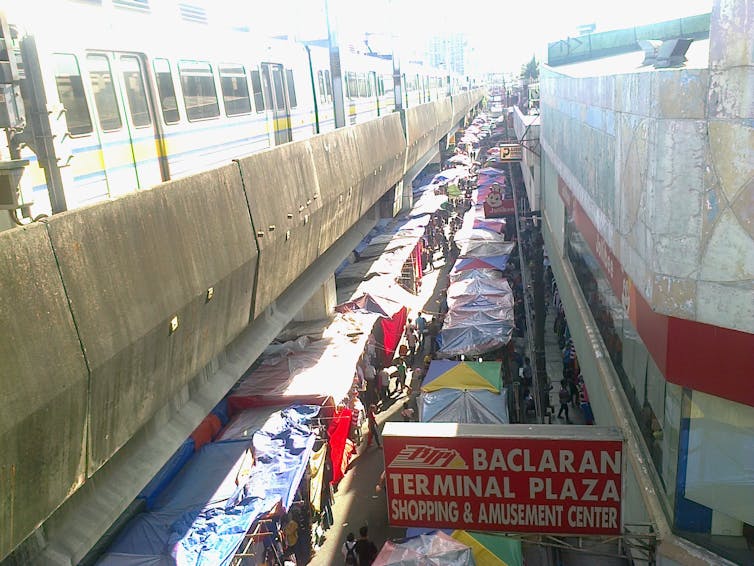 Vendors occupy a street under a rail track.
Redento Recio, Author provided
Vendors occupy a street under a rail track.
Redento Recio, Author provided
Some hawkers who want to avoid shelling out cash resort to the hango (harvest) system. Hango is a consignment agreement between hawkers and their suppliers where the former pays for the goods after a day of vending. Fruit juice vendor Frederic* said:
[Under hango], we could sell without financial capital. In the morning we obtain our goods from the suppliers, and pay them in the evening.
What options do vendors have?
For vendors who need capital, typically in the range of 3,000 Philippine pesos (A$79) to ₱300,000 (A$790), five options are possible.
The first is assistance from family. The second is a credit window from a vendors’ cooperative. But these mechanisms have limitations.
Family assistance is often exclusive to relatives and relies on the financial capacity of the lending individuals. The cooperative assists only those associate members with semi-fixed stalls.
The third scheme is paluwagan (to ease), a mutual savings scheme. During the peak season (September to December), paluwagan allows vendors to put aside extra profits to see them through lean months. The daily share ranges from ₱50 (A$1.30) to ₱1,000 (A$26).
While some vendors fail to join paluwagan due to evictions and poor sales, others initiate it even after the peak season. Vendor Nelly* noted: “For us, it’s all year round because it augments our capital.”
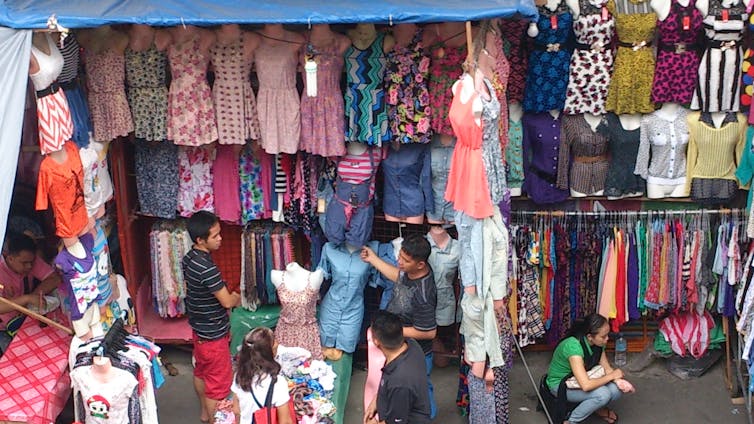 Many vendors borrow from loan sharks to keep a steady supply of stock.
Redento Recio, Author provided
Many vendors borrow from loan sharks to keep a steady supply of stock.
Redento Recio, Author provided
A fourth recourse for the financially strapped is to approach loan sharks and informal lenders. The monthly interest rate is 20%, with a repayment period of up to four months. For some hawkers, the high interest rate and the daily payment add to their financial woes. Vendor Rosie* said:
When we’re unable to vend, we couldn’t pay the loan sharks. That’s a major problem for us. Sometimes, we don’t even have an income to buy rice.
Despite this, many vendors still cling on to loan sharks.
Vendor Sheila* said:
Poor sales force us to borrow from the loan sharks. Otherwise, we would run out of stock. We couldn’t vend if we don’t borrow.
An old vendor, Esperanza*, said:
I always tell [the loan sharks] to visit me every day so I could pay. I don’t renege on my debts from 5-6 lenders (loan sharks) because they have helped me raise my children.
In the absence of pro-poor formal micro-credit institutions in Baclaran, the statements above show how loan sharks have helped vendors survive the uncertainty of street life. Yet, the availability of credit windows at times leads to multiple loans and over-indebtedness.
Read more: How we can protect the women who make most high-quality footballs
Street space for rent
When too deeply in debt, some vendors are compelled to give up their primary asset – their vending space. Vendor leader Nancy* explained:
When they [vendors] have two debt obligations, they look for a third lender until they are forced to give up their space because many [loan sharks] run after them.
This recourse, giving up their vending spaces, represents the hawkers’ fifth mechanism to generate money or pay off their debts: they sell or rent out their claimed spaces.
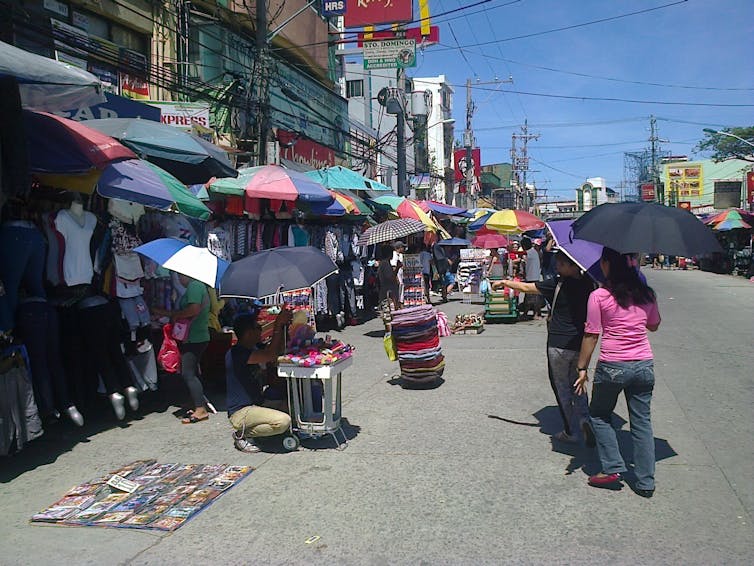 Some vendors rent out their claimed part of the streetscape to cope with financial distress.
Redento Recio, Author provided
Some vendors rent out their claimed part of the streetscape to cope with financial distress.
Redento Recio, Author provided
Barangay (village) official Allen* confirmed this arrangement:
Yes, they are able to ‘sell’ and rent out the streets and sidewalks. We know that these things happen, but we could not stop them since the agreement is mostly verbal.
The rental agreement period commonly lasts for one to two years, with fees ranging from ₱40,000 (A$1,051) to ₱300,000 (A$7,887) based on the size and location of the vending space. Although Allen noted that their barangay refuses to honour any (informal) sale or rental arrangement, in other barangays the agreement becomes valid when the two parties sign a written agreement in front of vendor leaders and barangay officials. Some local officials are even asked to sign the document.
Esperanza, a vendor leader, explained:
They – the renter or buyer, the seller, and the lender – must have written [agreement] … It couldn’t be based on verbal [agreement] alone. There is a ‘legal’ [procedure]. It goes through the barangay. A barangay [official] must sign it. The [vendor] leader acts as a witness. It’s difficult [if there’s no witness] since we’re talking about their livelihood.
Harnessing self-help mechanisms
These various finance-generating schemes are rooted in the insecure street presence of vendors. They reveal the vendors’ dogged determination to survive and improve their lives under conditions where state agencies are unwilling or unable to provide the necessary support and services.
When linked to policymaking, however, strategies like the hango consignment and the paluwagan mutual savings scheme can guide planners in recognising the informal practices that enable traders to earn a living.
Read more: Why lending through community-based organisations makes sense
 Policymakers should pay more attention to informal work.
World Bank
Policymakers should pay more attention to informal work.
World Bank
To support efforts to implement the New Urban Agenda and attain the Sustainable Development Goal 11 (to make cities inclusive, safe, resilient and sustainable), planners and state officials need to consider these self-help mechanisms in designing an inclusive urban governance. This must address the unresponsive formal policies and the precarious conditions in informal work.
* Note: All the names in this article are pseudonyms to protect the research participants’ identity.
Read more: What can the New Urban Agenda and Sustainable Development Goals do for cities?
Authors: Redento B. Recio, Postdoctoral Research Fellow - Informal Urbanism (InfUr-) Hub, University of Melbourne


















