

A galactic ‘comet’ called Terzan 5 just illuminated a 100-year-old puzzle about cosmic rays
- Written by: Mark Krumholz, Professor, Research School of Astronomy and Astrophysics, Australian National University
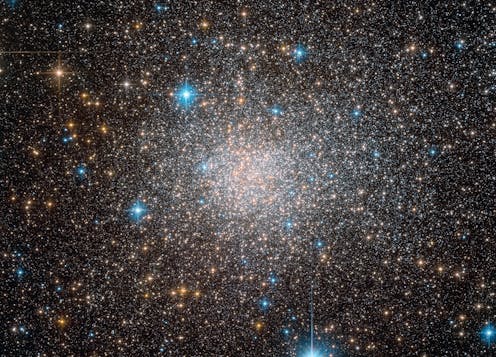
When my colleagues and I set to work on a century-old cosmic mystery, we found an unexpected celestial laboratory in Terzan 5, a dense star cluster currently plunging through our galaxy at breakneck speed.
This stellar oddity has allowed us to study the behaviour of cosmic rays – high-energy particles whose erratic paths through space have baffled astronomers since their discovery in 1912.
By observing radiation produced by Terzan 5’s cosmic rays, we’ve achieved a scientific first: measuring how quickly these particles change direction due to fluctuations in interstellar magnetic fields. Our research is published today in Nature Astronomy.
Fast-moving radiation from outer space
Cosmic rays are something no one expected to be there. When radioactivity was first discovered in the 1890s, scientists thought all sources of radiation were on Earth.
But in 1912, Austrian-American physicist Victor Hess measured the ambient radiation level in a high-altitude balloon and discovered it was much higher than at ground level, even during an eclipse when the Sun was blocked. This meant the radiation had to be coming from space.
Today we know the mysterious radiation Hess discovered as cosmic rays: atomic nuclei and elementary particles such as protons and electrons that have somehow been accelerated to nearly the speed of light. These particles zip through interstellar space, and thanks to their high energies a small fraction of them can penetrate the upper atmosphere, as Hess discovered.
But we cannot easily tell where they come from. Cosmic rays are charged particles, which means their direction of travel changes when they encounter a magnetic field.
The staticky picture of the cosmic ray cosmos
The magnetic deflection effect provides the basic technology for old cathode ray tube (CRT) monitors and televisions, which use it to steer electrons toward the screen to create a picture. Interstellar space is full of magnetic fields, and those fields are constantly fluctuating, deflecting cosmic rays in random directions – sort of like a broken CRT in an old TV that only shows static.
So instead of cosmic rays coming straight to us from their source like light does, they wind up spreading out almost uniformly across the galaxy. Here on Earth we see them coming almost equally from all directions in the sky.
While we now understand this general picture, most of the details are missing. The uniformity of cosmic rays across the sky tells us that cosmic ray directions randomly change, but we have no good way of measuring how fast this process happens.
Nor do we understand the ultimate source of the magnetic fluctuations. Or we didn’t, until now.
Terzan 5 and the displaced gamma rays
That’s where Terzan 5 comes in. This star cluster is a copious producer of cosmic rays, because it contains a large population of rapidly rotating, incredibly dense and magnetised stars called millisecond pulsars – which accelerate cosmic rays up to extremely high speeds.
These cosmic rays don’t make it all the way to Earth, thanks to those fluctuating magnetic fields. However, we can see a telltale sign of their presence: some of the cosmic rays collide with photons of starlight and convert them into high-energy uncharged particles called gamma rays.
Terzan 5 is a ‘globular cluster’ of stars near the heart of our galaxy.The gamma rays travel in the same direction as the cosmic ray that created them, but unlike the cosmic rays, the gamma rays are not deflected by magnetic fields. They can travel in a straight line and reach Earth.
Because of this effect, we often see gamma rays coming from powerful sources of cosmic rays. But in Terzan 5, for some reason the gamma rays don’t exactly line up with the positions of the stars. Instead, they seem to be coming from a region about 30 light-years away, where there is no obvious source.
A galactic-scale ‘comet’
This displacement has been an unexplained curiosity since it was discovered in 2011, until we came up with an explanation.
Terzan 5 is close to the centre of our galaxy today, but it isn’t always. The star cluster is actually moving in a very wide orbit that keeps it far off the plane of the galaxy most of the time.
It just happens to be plunging through the galaxy right now. Because this plunge takes place at hundreds of kilometres per second, the cluster sweeps up a cloak of magnetic fields around itself, like the tail of a comet plunging through the solar wind.

Cosmic rays launched by the cluster initially travel along the tail. We don’t see any of the gamma rays these cosmic rays produce, because the tail isn’t pointed directly at us – these gamma rays are beamed along the tail and away from us.
And here is where the magnetic fluctuations come in. If the cosmic rays stayed well-aligned with the tail, we would never see them, but thanks to magnetic fluctuations their directions start to change.
Eventually, some of them start to point toward us, producing gamma rays we can see. But this takes roughly 30 years, which is why the gamma rays don’t seem to be coming from the cluster itself.
By the time enough of them are pointing at us for their gamma rays to be bright enough to be visible, they have travelled 30 light-years down the magnetic tail of the cluster.
Cosmic rays and interstellar magnetic fields
So thanks to Terzan 5, for the first time we have been able to measure how long it takes magnetic fluctuations to change cosmic ray directions. We can use this information to test theories for how interstellar magnetic fields work and where their fluctuations come from.
This brings us a big step closer to understanding the mysterious radiation from space discovered by Hess more than 100 years ago.
Authors: Mark Krumholz, Professor, Research School of Astronomy and Astrophysics, Australian National University


















