

NZ’s electricity market is a mess. Rolling out rooftop solar would change the game
- Written by: Stephen Poletti, Associate Professor Energy Economics, University of Auckland, Waipapa Taumata Rau
Wholesale prices in the New Zealand electricity market have soared over recent weeks, climbing as high as NZ$1,000 per megawatt hour. North Island pulp and paper plants have temporarily closed down because of the spike in costs.
Associate Energy Minister Shane Jones has accused the big energy generators of profiteering, and said the government was investigating ways to force them to cut prices.
On top of that, Energy Minister Simeon Brown has announced plans to investigate the feasibility of importing liquid natural gas (LNG) to help increase gas-generated electricity supply and lower prices in the process.
This would entail buying or renting a floating LNG terminal and building out complementary infrastructure such as pipelines. That would take a minimum of a year (more likely two or three years) and would be expensive, with imported gas prices considerably higher.
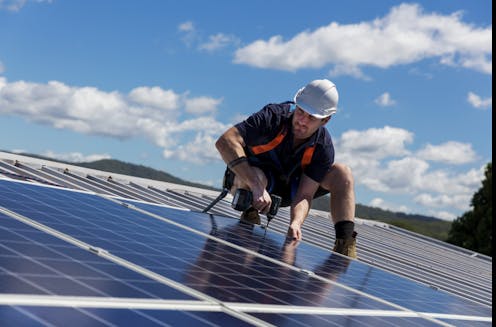
A much better option, we suggest, would be to prioritise the expansion of rooftop solar throughout New Zealand. This could not only add significantly to the overall electricity supply, but also help bring down prices.
Rooftop solar at scale
The immediate cause of the crisis is low hydro-lake levels, combined with a long-term reduction in the supply of natural gas. Exacerbating this is the market power wielded by the big electricity generator-retailer companies (“gentailers”), which are set up to profit during times of scarcity.
Electricity supplied by gas-fired generation has steadily declined. Since 2015, almost 600 megawatts of gas plant capacity has been decommissioned, with no new additions.
The Electricity Authority’s 2023 study, “Ensuring an Orderly Thermal Transition”, found the decline in gas-powered generation will continue. By 2032, this thermal generation is projected to be just 1.4% of total generation, compared to 14% currently.
An updated announcement from the Electricity Authority in June this year says Contact Energy’s largest thermal gas unit will retire this year or next. Furthermore, Genesis Energy has announced plans to use biomass to power some of its gas turbines.
Existing gas generation will increasingly struggle to compete on price with new wind and solar renewables, which are getting cheaper all the time.
Grid-scale renewable electricity supply is expanding gradually. By 2025, there are expected to be 270 megawatts of new geothermal, 786 megawatts of additional solar, and 40 megawatts of new wind power. The combined total would add almost 10% to the country’s yearly electricity production.
To alleviate the energy supply shortfalls primarily attributable to low rainfall, we suggest rapidly expanding cheap solar photovoltaics (PV), specifically rooftop solar for ordinary households. Our soon-to-be-published research suggests such capacity can be expanded quickly and cheaply.
Based on the Australian experience, we estimate modest subsidies for the capital cost of installing solar rooftop systems would add the equivalent of 700 megawatts a year (2% of the total) to the electricity supply. This significant new supply will reduce electricity prices.
NZ’s energy advantage
New Zealand is in the enviable position of already having abundant hydro power capacity. But with increasingly uncertain rainfall due to changing climate patterns, adding widely distributed rooftop solar would mean the country was less vulnerable to lower lake levels.
This would mean the precious water flowing into the hydro lakes could be held back in the dams to meet evening peaks when solar is no longer available.
Other countries – most notably Australia, Italy, Germany, Spain and Portugal – have made much more progress than New Zealand in the expansion of photovoltaics. The European Commission has adopted policies to double rooftop solar over the next four years.
Australia’s energy market operator expects rooftop solar (which already supplies almost three times as much electricity annually as gas generators do) will become the dominant source of electricity supply over the next two decades.
None of those countries have the energy storage advantage New Zealand has. And they are all now having to develop expensive grid-scale battery solutions to store solar power produced in the middle of the day for evening use.
New Zealand’s huge hydro storage advantage means photovoltaics, particularly rooftop systems, can unlock real benefits for customers.
This could mean shifting the management of the legacy hydro assets to provide a high-value product – stored energy – rather than the gentailers simply using hydro generation to maximise profits.
There may even be an argument for revisiting the current market framework and returning those hydro assets to public ownership.
In the meantime, we encourage the energy minister to make the expansion of rooftop solar the top option for expanding the electricity supply and tackling the gentailer power that bedevils the market. He will almost certainly find it quicker, cheaper and more popular than importing gas.
Authors: Stephen Poletti, Associate Professor Energy Economics, University of Auckland, Waipapa Taumata Rau


















