

‘She’s just hitting a triangle?’ Why being a percussionist is harder – and more crucial – than you may think
- Written by: Claire Nicholls, Lecturer in Music Education, University of Southern Queensland
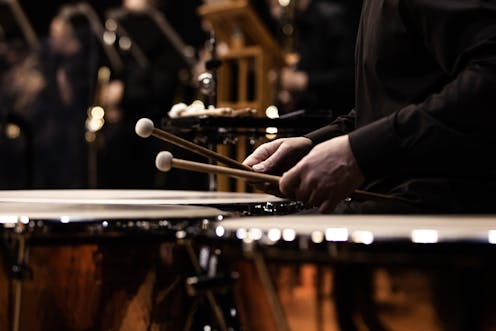
OK, tell me if you’ve heard this one: what did the percussionist say when they landed their first job?
“Would you like fries with that?”
It’s just a joke, right? Unfortunately for many aspiring percussionists even getting a foot in the door to complete a university qualification yet alone secure full time, paid and ongoing work as a professional musician is not too far from this reality.
While there are endless percussionist jokes to make – and there are thousands – I think we seriously underestimate the expertise, musicianship and teamwork percussionists bring to the orchestra and our favourite music. Not to mention the years of practice, heavy lifting, early set-ups, late pack downs, counting endless bars of rest, waiting for the vital moment in a symphony, and the mastery required to play the many instruments demanded of both “classical” and contemporary orchestral repertoire.
Let’s take a moment to appreciate the humble percussionist, what it takes to train as a professional drummer, and their sometimes less-than-obvious valuable contributions to the music we love.
A difficult road
Most large university Bachelor of Music programs will offer an average of but 40 positions per year. Few accepted will be pianists and percussionists.
A quick internet search of the nine professional orchestras in Australia reveals there is an average of 2.8 percussionists (including timpanists, who specialise in only the timpani, or kettledrums, rather than playing the wide variety of other instruments) per orchestra, out of a total of over 500 professional positions within Australian orchestras.
Permanent paid and full-time orchestral jobs are extremely competitive. This is especially true in Australia, as we have so few professional symphony orchestras compared to around the world. Like other artists in Australia, percussionists face higher rates of under- or unemployment, and lower incomes than others with similar levels of training.
The precarious work of contract artists also involve high hidden costs and unremunerated self-development costs. For many percussionists, making a living is extremely difficult.
Juggling many balls
Orchestral percussionists must be true multi-instrumentalists.
Except for timpani, which tend to be a speciality within itself, percussionists must navigate and master an ever-growing world of instruments in addition to the traditional orchestral percussion to meet the modern repertoire demands spanning far past “classical music”.
Everything from a giant hammer (I’m looking at you Mahler!), to African talking drums, the Indonesian gamelan and thunder sheets. Then there is the myriad of tuned percussion – instruments that can play melodies, for example the xylophone, marimba, tubular bells and glockenspiel – all the way to the humble triangle.
Each instrument comes with its own playing technique, cultural history and significance, mechanism of sound production and instrument maintenance requirements. Not to mention choosing the correct mallet or beater to make the timbre (sound quality) required of the music, expected by the composer, and what the conductor wants.
In addition to counting endless bars of rest and being masters of rhythm, the percussionist faces a unique challenge that no other instrument in the orchestra has to battle. Once the instrument is struck, shaken or scraped there is nothing the musician can do to change the quality of the sound.
A violinist or flautist can alter the movement of their bow or expression of air. However, can you imagine the pressure to produce perfection every time while being completely assured you are playing at the exact vital moment in a symphony?
And there’s no one else to copy because, you’re it!
To add to this, percussionists within an orchestral concert will be responsible for multiple parts and instruments. That requires some serious organisation and knowledge of the repertoire being played. Consider frequently performed works such as Holt’s Planets requiring not one but two timpanists on two sets of timpani to seamlessly manage our favourite melodies in Jupiter: The Bringer of Jollity.
Perhaps not such a jolly time for the percussionists.
A mainstay of culture
Can we really imagine our favourite car-sing-along song without that driving rhythm that gets our heart pumping and fingers tapping? The timpani in a much-loved symphony or suite? How about the famous Hedwig’s theme from Harry Potter without the celeste (a piano-like instrument with chime bards instead of strings) bringing a certain magic and mystery? Or Bluey without the textures, timbres and narratives captured through percussion instruments?
With perhaps the exception of the human voice, percussion instruments were the first attempts of music used by our cave dwelling ancestors. Music may have evolved, but percussion endures.
Around the world, percussion is universal. Without these diverse sounds we would be all the poorer. We cannot imagine a world without the rich tapestry of timbres percussion instruments and their musicians offer. Not only in terms of music, but also when it comes to ritual, celebration, entertainment and culture beyond the concert hall.
Even as audiences we use percussion to express our delight and gratitude through applause.
So next time you see someone at the back of the orchestra with their many varied percussion instruments, take a moment to reflect on and thank these masters of rhythm and timbre as part of the music you love.
Authors: Claire Nicholls, Lecturer in Music Education, University of Southern Queensland


















