

electricity demand will jump as NZ decarbonises – can renewable generation keep up?
- Written by: Alan Brent, Professor and Chair in Sustainable Energy Systems, Te Herenga Waka — Victoria University of Wellington
The prime minister has called it an “energy security crisis” and signalled a review of New Zealand’s electricity market as wholesale prices spike and industries suffer.
And he’s right – this year has seen pricing turmoil. August saw daily averages ranging between NZ$164.52 and $853.57 per megawatt hour (MWh). By comparison, August 2023 saw a maximum daily average price of $168.43 per MWh.
The Electricity Authority attributes this to a shortage of gas combined with low rain and inflows into our hydro lakes. The latter is a major concern. Storage levels are now around 800 gigawatt hours (GWh) less than the minimum levels in 2023, and more than 1,000GWh less than the historical mean for this time of year.
This is happening in the face of climate change, higher risk of dry years, and high projected growth in electricity demand. Electricity demand and generation scenarios released recently by the Ministry of Business, Innovation and Employment show this growth could be up to 82%, with a peak demand of between 9.1 and 12.5 gigawatts by 2050.
However, with greater electrification needed to decarbonise the economy, and aspirations to phase out all fossil fuels by 2030, some scenarios indicate the demand will be at least two to three times more. Of course, this means more generation capacity will be needed – 20 to 30 gigawatts above the current ten. The question is, can New Zealand do it?
Doubled capacity by 2030
The energy industry has been responding to these market signals, as highlighted in the government’s latest generation investment survey.
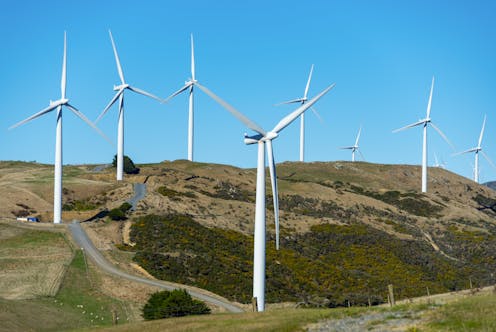
Committed and actively pursued projects will double generation capacity by the end of the decade. This will come largely from solar (6.4GW) and onshore wind (2.9GW), with smaller contributions from geothermal (0.6GW) and grid-scale batteries (0.6GW).
The first 35-megawatt battery facility was commissioned at Huntly this year. And battery capacity is important for stablising the grid and meeting peak demands. However, batteries will not address long-term storage of weeks and months, which is the focus of the NZ Battery Project.
The projected lesser investment in battery technology indicates a greater need to use hydropower capacity to compensate for the variability of solar and wind generation.
This “firming” of supply is based on the percentage of the year that a generation facility will provide power. For utility-scale solar it ranges between 19% and 26%, and for onshore wind between 33% and 55%.
Modelling by the Electricity Authority provides further insight on the firming that will be required. The analysis shows solar generation may be below 10% of the total capacity for 60% of the time. It will be above 50% of the overall capacity for 14% of the time.
Wind generation may be below 10% of the total capacity for 5% of the time, and above 50% of the capacity for 9% of the time over the entire country.
Renewables can meet future demand
Still, by 2030 we can expect around 11.5 terrawatt hours (TWh) a year from the new solar projects, and around 10.1TWh from the onshore wind projects. In total, this is about half the current yearly electricity demand.
Over the past decade, the country’s hydropower assets generated between 24 and 26TWh per year. So, to reach 100% renewable supply by 2030 (assuming biomass replaces coal at Huntley) will mean replacing between 3.5 and 5.6TWh of gas generation.
The battery capacity being developed won’t offset all of the gas generators currently used to respond to peak demands. If all of the batteries being developed participated in the market for four hours a day, they could provide around 1TWh over a year.
On a yearly basis, then, New Zealand can generate more than 47TWh from solar, wind and hydro, with some firming from the grid-scale batteries. That excludes the other baseload generators – geothermal, co-generation (where electricity is generated alongside heat production at industrial sites such as paper mills) and biomass.
In short, we should be able to meet our aspirations and the projected growth in energy demand by 2030.
Winter price spikes still likely
The challenge will be seasonal and daily power variations. The Electricity Authority analysis indicates wind generation should be reasonably consistent over the year. But there is an overall tendency to generate more during the day, typically peaking in the afternoons.
Solar generation, of course, will also peak in the early afternoons. But in winter it will generate a third less than in summer. This is important, given the risk of depleting hydro lake storage and running out of sufficient generation capacity in the grid.
The electricity system will need to cater for the lower solar generation in winter when hydro storage is at its lowest.
Morning and evening demand can be addressed, to some extent, with the rollout of rooftop solar, with batteries to store the solar electricity generated, augmented by the grid to charge the batteries if the sun doesn’t shine.
If the solar systems are managed collectively as a virtual power plant, it has been shown winter peak events can be addressed by feeding electricity back into the grid when needed.
Nevertheless, with solar and wind offering lower market prices, we can probably expect wholesale prices to stabilise at reasonably low levels from the end of September to early May in a year without drought spells.
But winter may well still see price spikes if we don’t address seasonal storage. Scrapping most of the NZ Battery Project, as others have observed, may well prove shortsighted.
Authors: Alan Brent, Professor and Chair in Sustainable Energy Systems, Te Herenga Waka — Victoria University of Wellington


















