history of NZ's Muslim population
- Written by: Eva Nisa, Lecturer in Religious Studies, Victoria University of Wellington
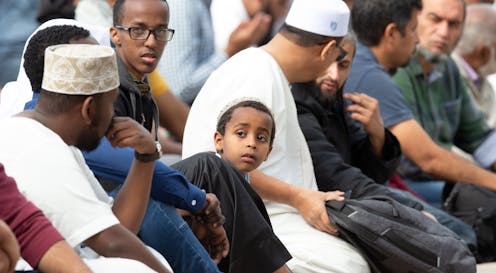
Muslims make up just over 1% of New Zealand’s population and one might assume most are new to this country. But historical accounts document that Islam first arrived in New Zealand in 1769, with two Indian Muslims.
Some official documents and scholarly work mention the years 1840 and 1874 as important periods from which Muslims were first acknowledged as a group. Abdullah Drury mentions the early Muslims were mainly from British India. The 1874 government census documented 17 Mahometans living in Otago (16) and Auckland (one).
These old documents refer to Muslims and Islam as Mahometan, Mahommedan, Mohammedan, Mohemmadanism, or Muhammadanism. They are old-school terms with particular pejorative connotations, drawing on the name of the prophet Muhammad.
Read more: How to move beyond simplistic debates that demonise Islam
Immigrant family settlement
In the early 19th century, the terms Islam and Muslims were becoming more familiar in European languages through the work of Edward Lane, but in New Zealand, public use of the term Islam only became more common in later years.
New Zealand’s national Muslim organisation, the Federation of Islamic Associations of New Zealand (FIANZ), mentions the 1850s as the beginning of Muslim immigrant family settlement in the country, specifically in Christchurch. The Lyttleton Times (13 March 1858) recorded a case in the Supreme Court at Lyttleton, a small town on the outskirts of Christchurch, at which two witnesses, Wuzeera and his wife Mindia from India, were sworn in on an English translation of the Quran.
The newspaper itself used the term Mahometan to ascertain their religious identification. It also described that Wuzeera worked for Mr Wilson of Cashmere (a suburb of Christchurch) who arrived in 1854 on a ship called Akbar. Wuzeera and Mindia had four children, with the youngest two born in Christchurch in 1859 and 1861.
A growing number of Muslims arrived in New Zealand during the early 20th century. The census of 1901, mentioned 41 Mahometans. The continued history of the Muslim community in New Zealand can be traced back, as William Shepard explains, to three Gujarati men who arrived between 1906 and 1920.
The men established a small shop and brought their children from India. In the early 1950s, their children brought their family members to settle in New Zealand. The following generation were born and raised in New Zealand with most becoming community leaders.
Muslim minority in the 21st century
Today, according to Tahir Nawaz, the president of the International Muslim Association of New Zealand, New Zealand’s Muslim minority reached almost 60,000 people. Gradual changes in the government’s immigration and refugee policy, especially through the Refugee Quota Programme in 1987, have provided Muslims with additional immigration opportunities. Shepard recorded that Fijian-Indians, professional and white-collar workers, as well as international students studying at New Zealand universities under the Colombo plan), boosted the number of Muslims to 2,500 by 1986.
The 2013 census recorded around 46,000 Muslims. About 75% lived in Auckland and 25% were born in New Zealand. The latter statistic was similar in 1986 (26% born in New Zealand). Today, about half of the Muslim population are women, reflecting a steady increase from the beginning of the 20th century, when there was virtually no female presence.
Of the total number in the 2013 census, 21% were born in the Pacific Islands and 26.9% in Asia, with only 23.3% born in the Middle East and Africa.
Muslims help build cathedral
The Christchurch terror attack reminds us of the important position of the city during the advent of Islam in New Zealand. Indeed, early interfaith activity in New Zealand involved Muslims. Daily newspaper The Star (1 May 1902) provided an obituary for Wuzeera (using the name Bezire). The story described how he had helped in the construction of Christchurch Cathedral by transporting stones from the Port Hills quarry. As Drury also mentioned, this could be considered the earliest contribution by Muslims to the history of Christianity in New Zealand.
The obituary can be seen as a public appreciation of Wuzeera or Wuzerah’s contribution to a symbol of Christianity. Some local newspapers in Christchurch, Auckland, Otago, and Wanganui republished it.
Throughout New Zealand’s development, Muslims have been seen as a moderate and peaceful minority. Muslim organisations, especially FIANZ, occasionally respond to contested issues related to Muslims elsewhere, including Salman Rushdie’s Satanic Verses and the Danish cartoon controversies. But Muslim leaders and organisations publicly condemn any form of extremism.
Read more: Thirty years on, why 'The Satanic Verses' remains so controversial
It is noteworthy that maintaining a peaceful atmosphere within Muslim communities themselves is not without challenge. Moderate Asian Muslims are significant in numbers, but Muslims in New Zealand come from several countries and the community is ethnically diverse.
Although the contestation between moderate and conservative understandings of religion cannot be denied, the vast majority of Muslim leadership holds moderate views. Therefore, in 2016, FIANZ’s national board of ulama (Muslim scholars) took strong action when an imam (Muslim cleric) in Auckland delivered an antisemitic comment in his speech.
Being Kiwi Muslim
Considering the peaceful nature of Muslims in New Zealand, it is not surprising that the families of the victims remained generous and Muslim leaders reacted without anger to the tragedy. This does not only refer to the very foundation of Islamic teachings but also to New Zealand’s culture, which has established an atmosphere of compassion.
Facing this tragedy, many Muslims have been amazed by the outpouring of sympathy, love and support from New Zealanders. This includes financial support, vigils, a national two-minute silence, the broadcast of the call to prayer through public broadcasting stations and solidarity with veil-wearing Muslim women.
Receiving the vast support from their compatriots in New Zealand, Muslims have actively expressed their gratitude and appreciation to all New Zealanders, as acknowledged by the imam during the first Friday prayer after the mass shootings.
We are broken-hearted but we are not broken.
As scholars in Islamic studies, we have been contacted by local and international media outlets to share our thoughts and reflections as New Zealanders. We live in this country, we see and we feel what it means to be Muslims in New Zealand. New Zealanders do not have to be taught how to express their compassion and love to their Muslim compatriots, because we have lived with these values for decades.
Authors: Eva Nisa, Lecturer in Religious Studies, Victoria University of Wellington
Read more http://theconversation.com/from-mahometan-to-kiwi-muslim-history-of-nzs-muslim-population-114067