

Australia needs tradies and materials to build the power grid of the future. So where are they?
- Written by: Chris Briggs, Research Director, Institute for Sustainable Futures, University of Technology Sydney
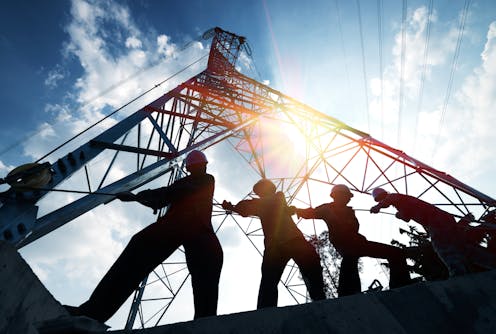
As Australia’s electricity supply shifts to clean energy, a big challenge is looming. How do we “keep the lights on” as big coal plants close, and a far-flung network of wind and solar generators replaces them?
This balancing act was outlined in the latest annual stocktake by the Australian Energy Market Operator. It said large-scale renewables projects must be delivered on time and in full if electricity in Australia’s eastern mainland states, plus South Australia and Tasmania, was to remain stable in the next decade.
The energy transition doesn’t just mean building wind and solar generators. It also means getting electricity to where consumers need it, via the transmission network.
But Australia desperately needs the skilled workers and materials to build that infrastructure and keep the energy transition on track.
The transmission crunch
After electricity is generated by a coal plant or wind farm, it must be transported to an electrical substation. There, the electricity is converted to a lower voltage, then sent to homes and businesses.
Moving electricity from the generator to the substation requires high-voltage cables, towers to support them, and devices known as “transformers” to convert the energy. Collectively, this is known as the transmission network.
The clean energy transition is testing Australia’s transmission capabilities. Solar and wind farms are often built in regional areas, where it’s sunny and windy. In many cases, transmission infrastructure to those areas doesn’t exist, or needs upgrading.
The Albanese government’s A$20 billion Rewiring the Nation policy is an attempt to grapple with this problem. It aims to help finance the 10,000 kilometres of transmission lines the Australian Energy Market Operator has identified as needed.
But transmission lines are large, complex projects that take years to plan and build. Projects often suffer delays, both in Australia and around the world.
The International Energy Agency estimates 80 million kilometres of power lines must be built or refurbished globally by 2040 – and projects are not keeping pace.
Several factors can delay the rollout of the transmission network. Opposition from communities or landholders to hosting infrastructure is a well-publicised problem.
But two other hurdles are often overlooked: the equipment and workers needed for the massive expansion.
How to build an electricity grid
Building transmission lines involves:
civil works to install foundations and erect the towers
electrical works to string the lines between the towers with cranes or helicopters and connect to the grid
installing sub-stations and transformers.
Most materials are imported. Specialised components such as lines, transformers and cables are manufactured near bigger markets in Europe and the United States. Transmission towers are imported from overseas and assembled in Australia.
And workers are needed to put all the materials together. They include construction managers, electrical engineers, electricians, truck drivers, construction riggers and earthmoving operators.
The Australian Energy Market Operator now factors in a 12-month delay for transmission projects, based on recent precedent. It also notes many are scheduled for completion between 2025 and 2030.
This will create a spike in demand for equipment and workers.
The race for materials and workers
Around the world, transmission projects have been hit by delays in recent years. Specialised components must be ordered well in advance, increasing lead times for projects.
And Australia is a small buyer located a long way from manufacturers. Larger, established buyers are often prioritised, leaving Australia struggling to compete.
The workforce required for transmission projects is not especially large – peaking at around 4,000 workers in the late 2020s.
However, there is a shortage of specialised labour. Australia has been importing skilled transmission workers. But as transmission projects scale up globally, this labour pool may dry up.
As one project manager noted in a federal government report in 2021, the transmission industry is bracing for worker shortages if multiple projects proceed at the same time:
We don’t have enough substation specialists, commissioning specialists or linesworkers across Australia. […] It’s going to be tricky.
Some workers can be sourced from other industries. But they must be trained or upskilled, and tradespeople may not want to move to regional areas or become fly in-fly out (FIFO) workers. As a transmission builder noted in the report:
if someone has a choice between a FIFO or to live in Sydney or Brisbane and work on overhead rail then what do you choose – jumping on a plane and living in a camp to do a 12-hour day?
And what about electricians? Australia faces a shortage of sparkies as renewable energy projects scale up and homes move away from gas towards electrification. Jobs Skills Australia estimates the transition to a clean energy economy will require between 26,000 and 42,000 electricians out to 2030.
Smoothing the bumps
Securing the materials we need to build out the grid will be difficult.
Companies have begun “bundling up” orders for several transmission projects at once, to increase their buying power with overseas manufacturers. Proposals for local manufacturing of components exist, but these take time and could only reduce, not eliminate, our dependence on imports.
National coordination is needed to smooth the peaks in demand – for both materials and workers – created by many simultaneous transmission projects.
On the labour front, a huge training effort is needed, especially for engineers and key trades. Some initiatives are underway, but not at the scale required.
Unless governments and industry tackle these problems more seriously, Australia’s clean energy transition could face major delays.
Authors: Chris Briggs, Research Director, Institute for Sustainable Futures, University of Technology Sydney


















