Chinese social media platform WeChat could be a key battleground in the federal election
- Written by: Wanning Sun, Professor of Media and Cultural Studies, University of Technology Sydney
NSW Labor leader Michael Daley’s “young Asians with PhDs taking our jobs” blunder cost him dearly in the recent NSW state election. His defeat also offered a taste of the crucial role the Chinese social networking platform WeChat could play in the forthcoming federal election.
After Daley’s comments were publicised, Liberal candidate and Chinese-Australian Scott Yung reportedly published articles on WeChat accusing Daley of being a “racist”. Yung says this helped him secure an 8.4% swing in the primary vote in the seat of Kogarah held by Labor candidate Chris Minns.
It’s likely WeChat also played a role played a role in Labor’s disastrous loss in the 2016 federal election, when the Liberal Party successfully harnessed the platform in the key marginal seat of Chisholm in Victoria.
Focusing more attention on the platform is a smart strategy for politicians. The 2016 Census counted approximately 1.2 million people of Chinese ancestry in Australia. Around 510,000 of these voters were born in China, and 597,000 speak Mandarin in the home. A large majority of these Mandarin speakers prefer WeChat as their social media platform.
Read more: How Australia’s Mandarin speakers get their news
Mainstream politicians are getting on board
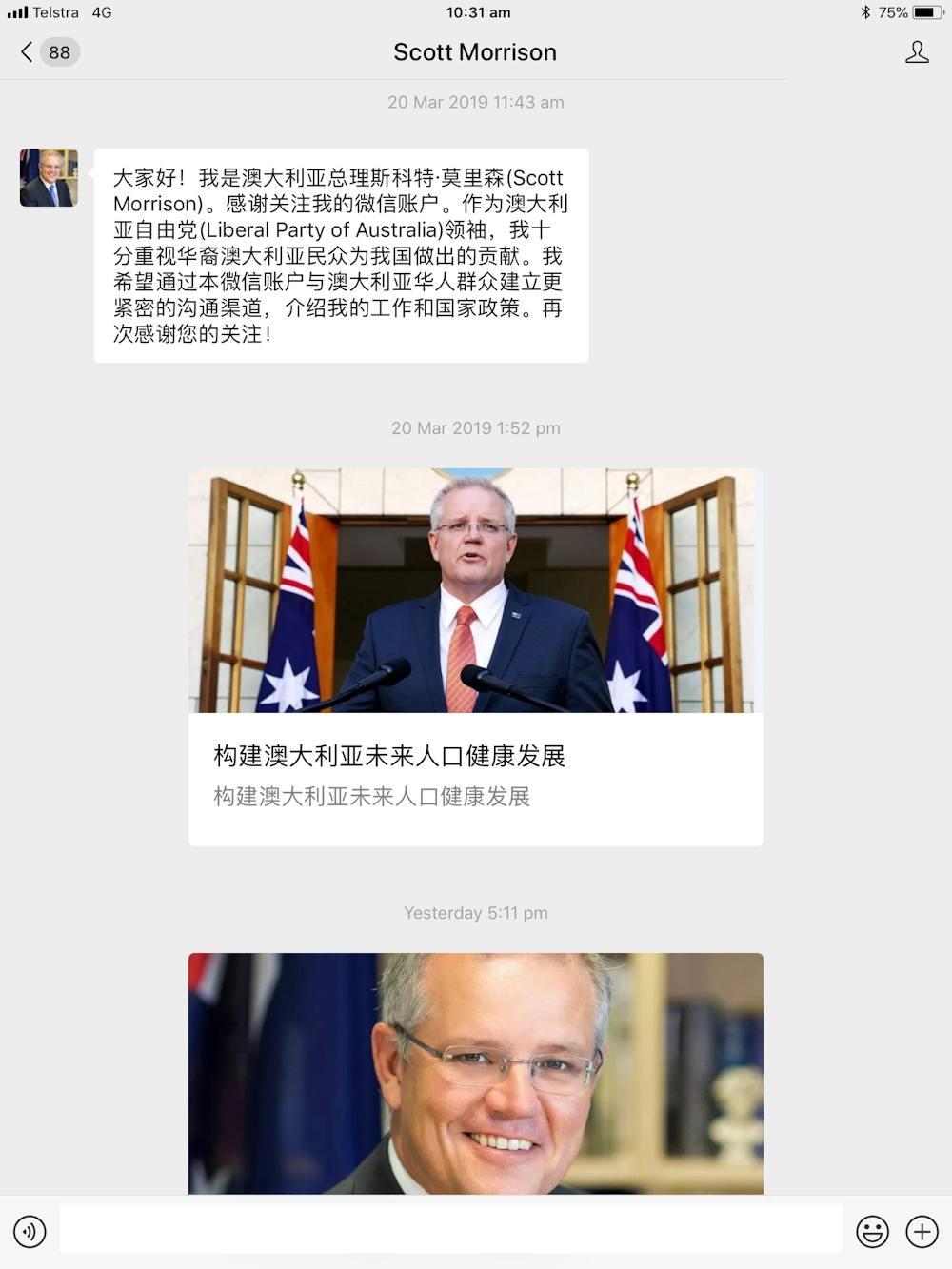 Scott Morrrison’s WeChat account.
Screengrab
Scott Morrrison’s WeChat account.
Screengrab
Mainstream Australian politicians have long used social platforms like Twitter and Facebook to engage voters, but their use of WeChat is a relatively recent phenomenon.
Prime Minister Scott Morrison opened his official WeChat account in early February in anticipation of the forthcoming federal election. But he wasn’t the first Australian prime minister to open a WeChat account. Kevin Rudd claimed that honour nearly six years ago.
Opposition leader Bill Shorten had already taken to WeChat by May 2017, while Chris Bowen was the first federal Labor politician to own a subscription account. In October 2017, he became the first politician from either side of politics to use WeChat Live to engage and interact in real-time with the Chinese community.
Aiming to up the ante with Morrison, Shorten participated in a WeChat Live interaction session for the first time this week, answering questions from 500 WeChat users.
Major parties at federal and state levels, as well as an increasing number of politicians at federal, state and local levels – including Clare O’Neil, Craig Laundy, David Coleman, Sam Crosby, Chris Minns, Jodi McKay, and many others – have now opened WeChat accounts.
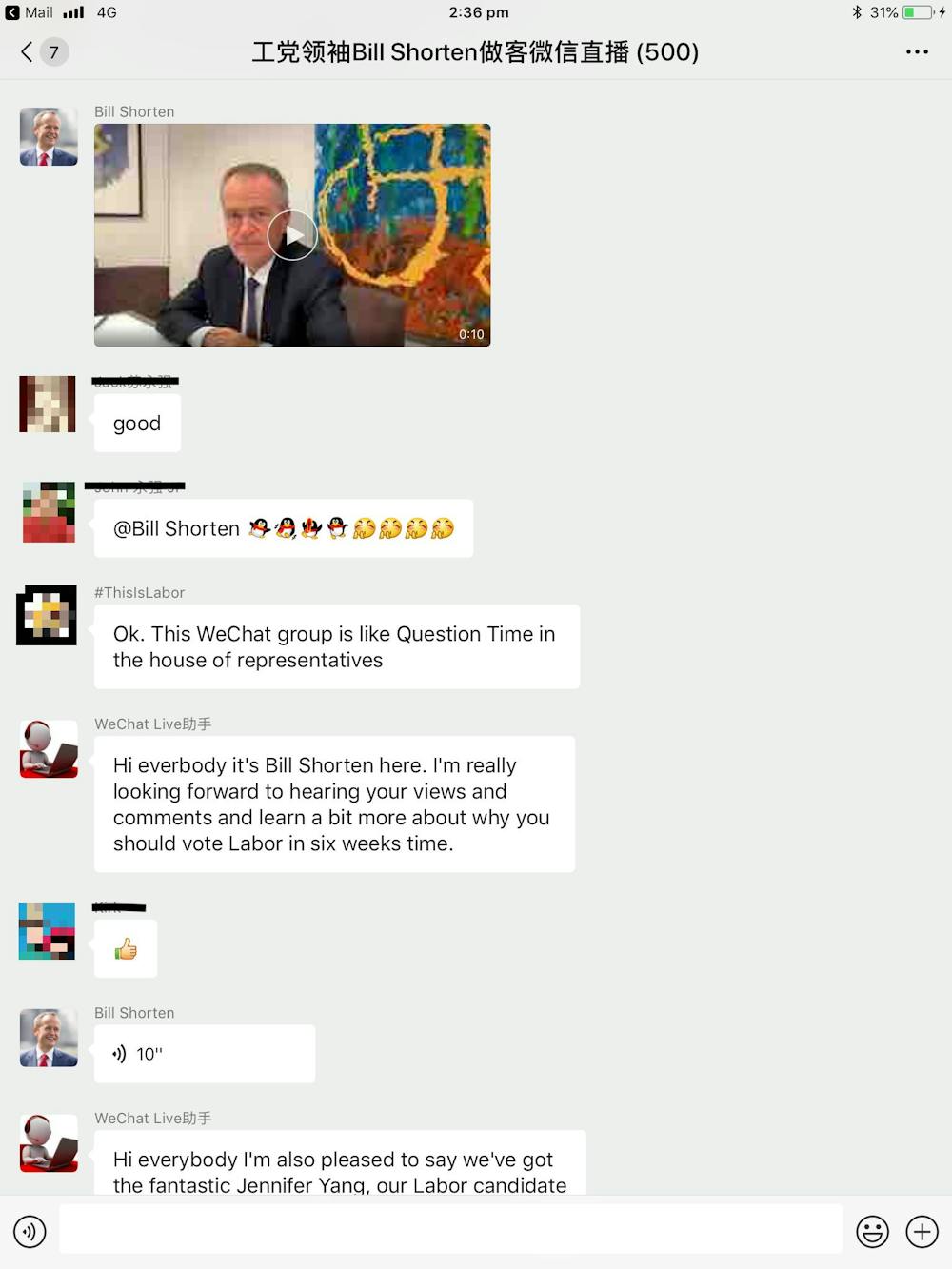 Bill Shorten took questions from 500 WeChat users on WeChat Live yesterday.
Screengrab
Bill Shorten took questions from 500 WeChat users on WeChat Live yesterday.
Screengrab
Read more: Thinking of taking up WeChat? Here's what you need to know
Candidates of Chinese heritage are using WeChat
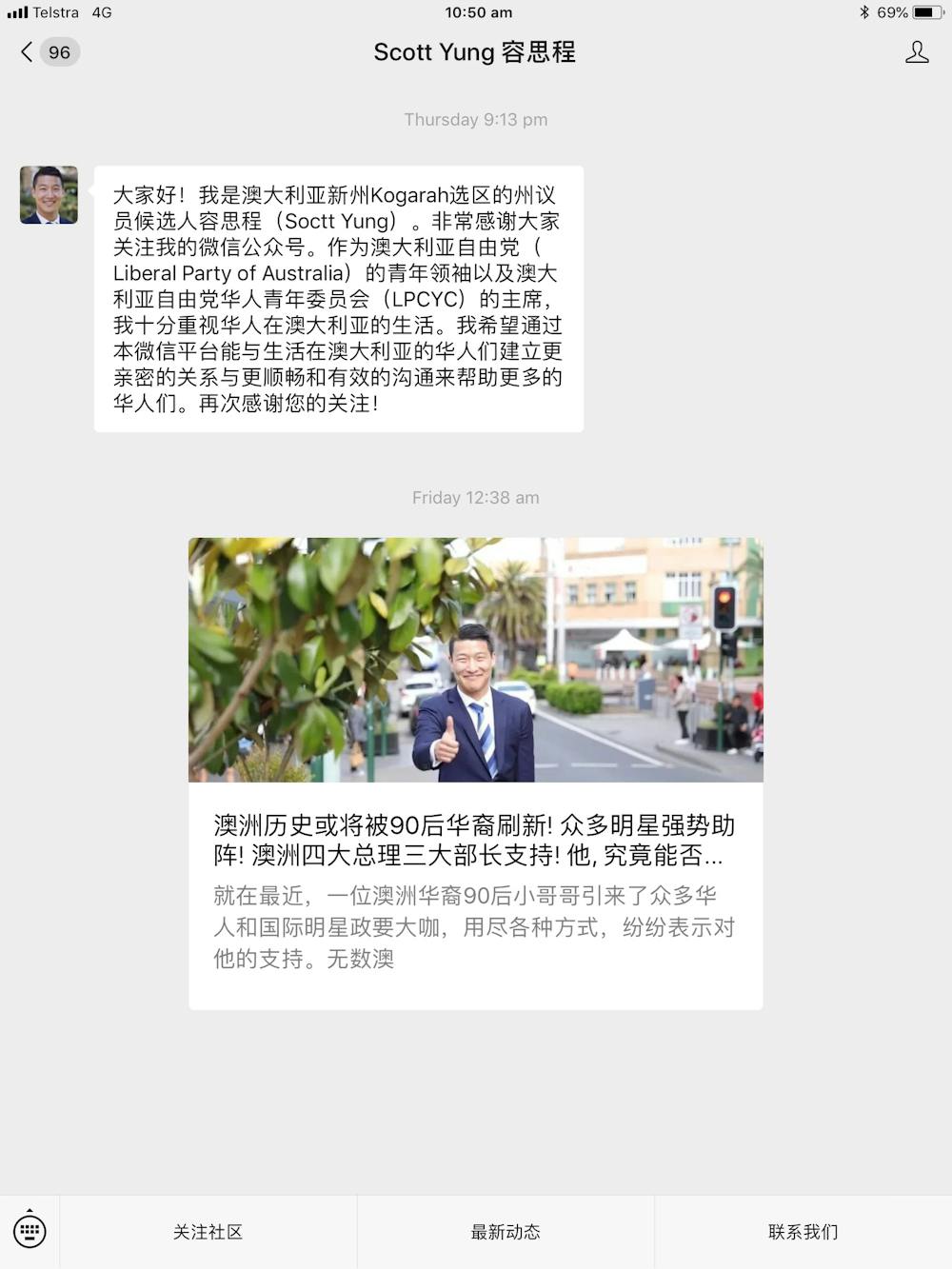 Liberal candidate Scott Yung’s WeChat account.
Screengrab
Liberal candidate Scott Yung’s WeChat account.
Screengrab
WeChat is not only a valuable way for mainstream politicians to reach out to Chinese Australians. It has also provided a crucial campaign platform for political candidates of Chinese heritage to garner support from Chinese communities.
Hong Kong migrant Gladys Liu (Liberal) and Taiwan migrant Jennifer Yang (Labor) are using WeChat to campaign for the federal seat of Chisholm in Victoria.
And Scott Yung, Liberal candidate for Kogarah in the recent NSW state election and possibly also for the federal election, has become such a celebrity on Chinese social media that he caught the attention of China’s CCTV.
These, and other political players, publicise their credentials and policies by posting material on “Moments” – a WeChat feature that allows users to reach everyone within their “circle of friends”. They also maintain an active, and often interactive, presence in the myriad WeChat groups – self-formed interest groups with as many as 500 Chinese-speaking members.
Polticians need a specific WeChat strategy
Whether WeChat will help federal candidates win Chinese votes depends on the extent to which candidates are prepared to invest in WeChat in the next few weeks, and how effective their communication strategies are.
So far, neither major party seems to have a coordinated strategic communication plan for WeChat. Users are yet to see a clearly articulated comparison between their respective policies on key issues. Nor is there evidence that politicians of any persuasion have figured out how to translate policies into information that Chinese voters can relate to or identify with.
The first problem seems to lie in attempts to use WeChat as a top-down, sender-to-receiver, one-to-all instrument of communication. In most cases, their accounts are maintained by Chinese-speaking proxies, which does little more than increase their visibility.
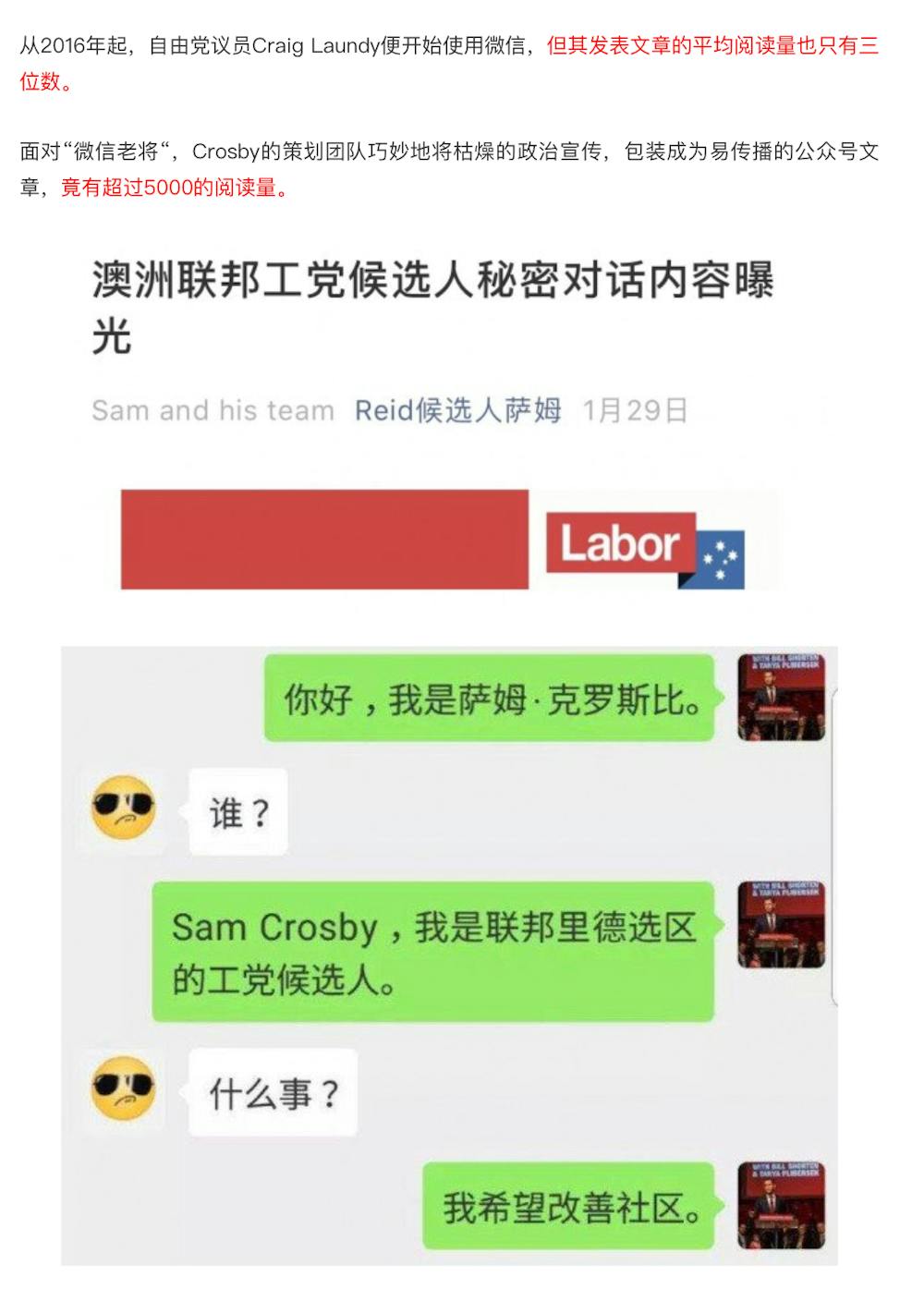 Sam Crosby on WeChat.
Screengrab
Sam Crosby on WeChat.
Screengrab
Language barriers aside, a knowledge of how WeChat works as a culture-specific platform is also crucial. A Sydney Today story provides an example of how Sam Crosby, Labor’s candidate for the seat of Reid, managed to beat his erstwhile opponent Craig Laundy in a “popularity contest” on WeChat.
The story’s attention-grabbing, even sensational, headline uses words such as “secret conversation” and “exposed” to describe a routine WeChat interaction between Crosby and an individual WeChat user to attract readers.
Whether politicians should stoop to such sensationalism to gain popularity is debatable. Nonetheless, politicians need to adopt the communication styles, vernacular and personas that are preferred by Chinese-speaking WeChat users.
With Scott Yung poised for Liberal preselection in Reid, and even more active and better known than Crosby on WeChat, this is a seat to watch closely leading up to election.
Read more: How Tencent became the world's most valuable social network firm – with barely any advertising
Treating the Chinese community as ‘us’ not ‘them’
One politician who has made effective use of Chinese-language media is Labor’s Jodi McKay, who retained the seat of Strathfield in the recent NSW election.
In addition to having a WeChat account, McKay has frequently engaged with Chinese communities through interviews with opinion leaders as well as various Chinese-language media. The content of these interviews, written in Chinese and relayed through WeChat, was widely circulated among Chinese-speaking WeChat users living in Strathfield and beyond.
Perhaps the biggest obstacle facing politicians is the temptation to use WeChat for political point-scoring. This is most clearly demonstrated in the uproar among Chinese-speaking communities following National Senator Barry O’Sullivan’s comment during a Senate Estimates hearing last month:
There’s a bigger chance of us having a biosecurity breach from some bloody old Chinaman that brings in his favourite sausage down the front of his undies.
Scott Morrison took to WeChat to distance himself from O’Sullivan’s remark. But some Chinese commentators noticed that Morrison’s statement was made only on WeChat, in Chinese.
There seems to be a view among Chinese communities that, in this instance, WeChat was used mainly to pacify a particular community, while also minimising the risk of alienating mainstream voters. This should alert politicians of all stripes that targeting Chinese-speaking communities via WeChat could backfire, if these communities feel that they are being treated as “them” rather than “us”.
It’s clear that WeChat is now a must for politicians, and the contest on this battleground will only intensify as the federal election looms. How best to harness WeChat to win key votes without being shafted by opponents is a trickier question.
Authors: Wanning Sun, Professor of Media and Cultural Studies, University of Technology Sydney