

how the Treaty ‘principles’ evolved and why they don’t stand up to scrutiny
- Written by: Jane Kelsey, Emeritus Professor of Law, University of Auckland, Waipapa Taumata Rau
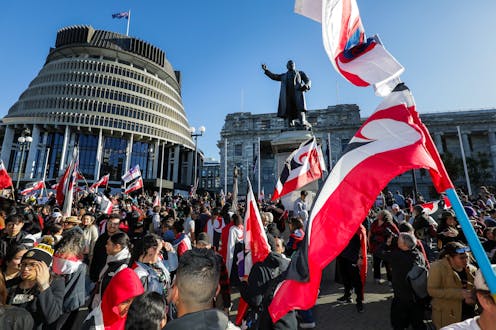
ACT Party leader David Seymour has said the goal of his Treaty Principles Bill is to stimulate an overdue conversation on te Tiriti o Waitangi/Treaty of Waitangi. At that level at least he has succeeded.
His proposal to rewrite te Tiriti through new legislation has certainly triggered debate – to the point where the most profound constitutional question of all has been asked on the floor of parliament: did Māori cede sovereignty when they signed te Tiriti in 1840?
But the debate has also exposed deep ignorance, among political leaders and many others, about te Tiriti and the more recent concept of Treaty “principles”.
Prime Minister Christopher Luxon fell back on Governor Hobson’s unilateral proclamations of sovereignty in 1840, which relied on what Māori scholar Margaret Mutu calls “the English draft of Hobson’s that Māori never agreed to”.
Meanwhile, Labour leader Chris Hipkins accepts there was no Māori cession of sovereignty, but that somehow the Crown has sovereignty now.
Beyond parliament, inflammatory and easily discredited disinformation about te Tiriti has circulated widely, backed by those who also advocate for the Treaty Principles Bill and its aim to cement into law a fundamental rewriting of te Tiriti.
Principles of compromise
The Treaty Principles Bill reportedly goes too far for the National and NZ First parties. Dissension within the coalition is growing as the political costs rise.
The Waitangi Tribunal was told Cabinet would consider a paper from David Seymour on the bill on September 2, but this was then deferred to “a later date”. Significantly, the tribunal was told on September 6 the paper would now go to Cabinet on September 9.
It is unclear whether this foreshadows the bill’s rapid introduction to the House. Once that happens, the tribunal will lose jurisdiction to report further on the legislation until it is passed.
But these developments will now put the focus on the fundamental question of Māori sovereignty. Some will seek to distance themselves from both the bill and the sovereignty issue by falling back on the current compromise, based on the existing principles developed by the courts since 1987.
However, those principles don’t stand up to scrutiny against te Tiriti, either. Indeed, ACT’s bill can be seen as the culmination of moves over several decades by the Crown to use Treaty principles to rewrite te Tiriti and justify its own power.
Origins of the Treaty principles
From the mid-1970s, Māori forced a reluctant Crown to create space within its institutions. In 1974, the Treaty of Waitangi Bill, which would establish the Waitangi Tribunal, came before parliament.
It referred to both “te Tiriti” (the Māori text) and “the Treaty” (the English language draft), with the Crown’s actions to be judged against “principles” derived from both.
The law’s architect, Labour’s Matiu Rata, based the reference to “principles” on Labour’s 1972 election manifesto. This apparently drew on the Rātana Party manifesto, which referred to “principles” as a means to uphold the mana and wairua of Te Tiriti. This was at a time when the courts and parliament denied relevance even to the English draft.
Presciently, the activist group Ngā Tamatoa’s submission on the Treaty of Waitangi Bill asked who was going to define these principles. It remains a critical question.
Early Waitangi Tribunal reports confirmed there was no cession of sovereignty, and derived the relevant “principles” from te Tiriti. The Crown could live with that, albeit unhappily for the then prime minister, Robert Muldoon, because the tribunal’s powers were limited to recommendations on historical claims.
As Māori activism and assertions of sovereignty intensified in the 1980s, the Crown came to see the “principles” as a device to maintain the status quo. Reference to the “principles of the Treaty” in the 1986 State-owned Enterprises Act was intended as a token nod to Māori. But the New Zealand Māori Council forced the courts to interpret it.
Instead of recognising Te Tiriti and rangatiratanga (authority and autonomy), the Court of Appeal came up with its own Treaty principles that put Crown sovereignty at their core.
A fundamental constitutional challenge
Over time, the “spirit” of the Treaty, embodied through “principles”, was redefined as a “partnership”: the Crown would govern and actively protect Māori rights as it saw them. Māori would be consulted where the Crown felt it needed more information. They would be loyal to the Queen of England and New Zealand and be reasonably co‑operative.
The Waitangi Tribunal adopted and adapted these principles – to the point where it abandoned its earlier position that Māori never ceded sovereignty in te Tiriti. It reinstated its initial finding that sovereignty was not ceded in the definitive 2015 report Paparahi o te Raki.
In the late 1980s, the Labour government devised a formal set of “Principles for Crown Action” on the Treaty. These bore as little relationship to te Tiriti as the Treaty Principles Bill does now.
The Principles for Crown Action co‑opted and distorted Māori terms. Rangatiratanga was downgraded to mean “self-management”, with “kawanatanga” meaning government. The other principles were “equality”, “reasonable co‑operation” and “redress” – the last to be decided by the Crown.
Over the next two decades, the principles produced by the courts, the Waitangi Tribunal, government agencies and some academics have reduced te Tiriti to “three Ps”: partnership, participation, protection (and sometimes prosperity). These have become embedded in the guidelines for state agencies, which then claim they are complying with the Treaty.
Maybe ACT can be thanked, after all, for exposing the chimera of Treaty principles to proper scrutiny, and opening the door to engaging with the fundamental constitutional challenge of what honouring te Tiriti o Waitangi means for Aotearoa New Zealand today.
Authors: Jane Kelsey, Emeritus Professor of Law, University of Auckland, Waipapa Taumata Rau


















